
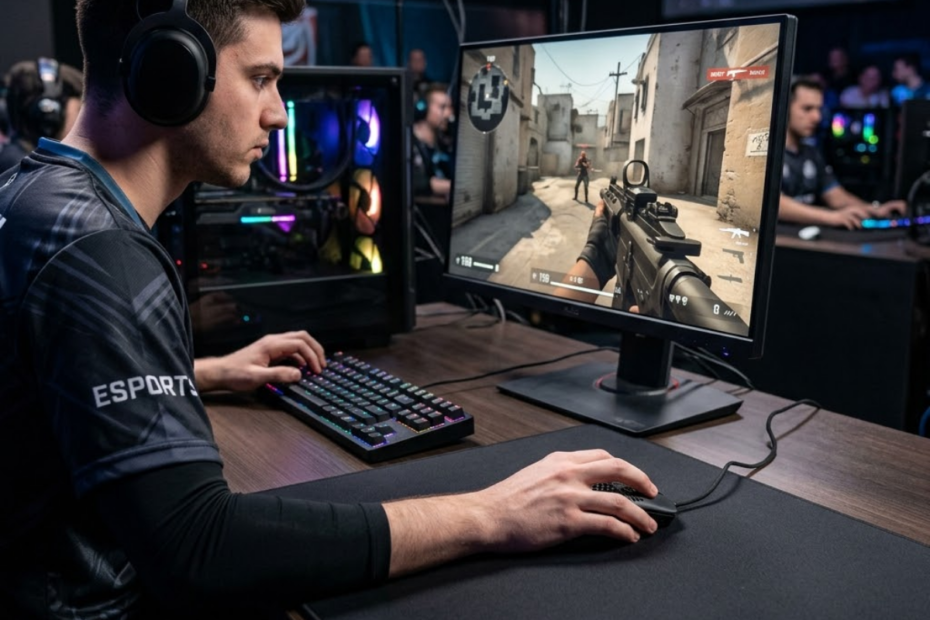
Gaming mice help FPS players maintain more consistent aim, faster response, and better control during competitive matches. Unlike regular mice, they are built around tracking accuracy, click reliability, low movement resistance, and long-session comfort.
FPS games place unusual pressure on mouse performance because every fight depends on quick reactions and precise crosshair movement. If you are new to the category, it helps to first understand what a gaming mouse is for FPS games before comparing its advantages in competitive play. A gaming mouse does not aim for the player, but it can remove hardware problems that make aiming feel unstable or delayed.
“The best gaming mouse for FPS games should combine low click latency, lightweight design, accurate sensors, and a shape that fits your grip style.”
These characteristics are often considered the most important gaming mouse features that matter for FPS because they directly influence control, comfort, and aiming consistency.
Why Do FPS Players Use Gaming Mice Instead of Regular Mice?
Gaming mice help FPS players achieve more consistent tracking, lower input delay, and better aim control than regular mice. Competitive shooters reward precision and repeatability, so small hardware differences can affect how reliable aiming feels during real matches.
The image below compares how gaming mice and regular mice are built around different performance priorities:
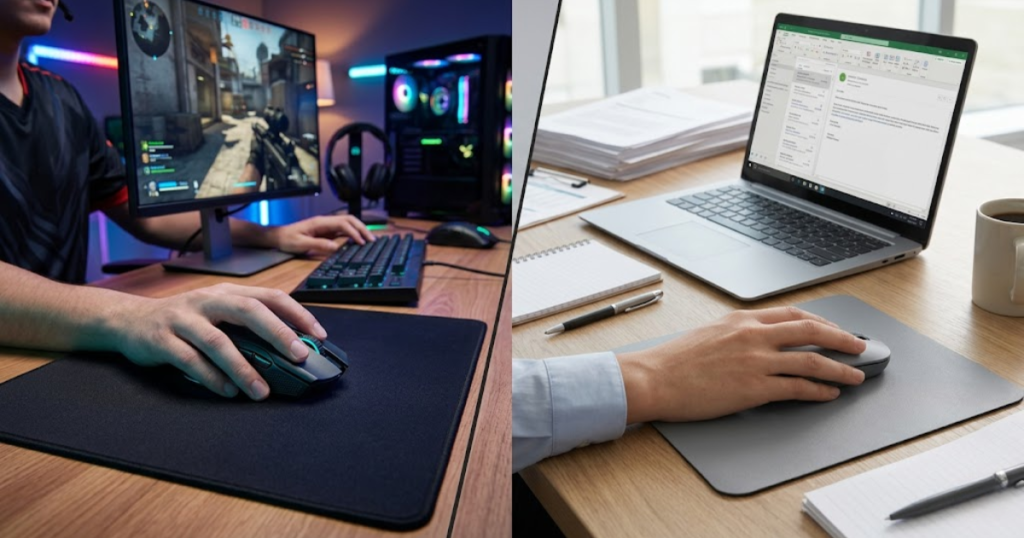
Regular mice are usually built for browsing, schoolwork, office tasks, and casual computer use. Those tasks do not require repeated fast swipes, controlled flicks, or precise micro-corrections under pressure. FPS players notice the difference because their mouse becomes part of their aiming system. For a deeper comparison of strengths, weaknesses, and real-world use cases, see this guide on gaming mouse vs office mouse.
The table below explains how gaming mice and regular mice are built for different priorities:
| Feature | Gaming Mouse Priority | Regular Mouse Priority |
|---|---|---|
| Sensor behavior | Stable tracking during fast and slow movement | Basic pointer movement for everyday tasks |
| Click response | Quick and consistent input during gameplay | Comfortable clicking for normal desktop use |
| Weight design | Lower movement resistance for aiming control | General comfort without competitive movement focus |
| Shape purpose | Grip stability during repeated aim movements | Comfort for office-style hand posture |
| Gaming value | Supports precision, speed, and repeatability | Good enough for casual computer navigation |
The comparison shows that gaming mice are not just regular mice with extra lights. Their main advantage is that they are designed around repeatable movement, stable input, and aiming confidence.
Competitive FPS Games Demand Higher Precision
Competitive FPS games demand higher precision because small mouse movements often decide whether a shot lands or misses. Games like Valorant, CS2, Apex Legends, and Warzone require players to control crosshair placement while reacting quickly to enemies.
This is why a mouse that feels acceptable for browsing may feel limiting during a ranked match. In FPS games, movement quality matters because the player is constantly aiming, correcting, stopping, and clicking within very short timing windows.
Precision does not mean using the highest DPI possible. It means the mouse should make movement feel predictable enough for the player to repeat the same action under pressure.
Small Aim Differences Can Decide Gunfights
Small aim differences matter because FPS fights are often decided by tiny timing and accuracy gaps. A slight overshoot, delayed click, or unstable correction can be enough to lose a duel.
Gaming mice help reduce unnecessary hardware inconsistency so the player can focus more on decision-making and mechanics. The goal is not perfection, but a cleaner connection between hand movement and in-game movement.
That cleaner connection becomes more valuable as the player faces faster opponents and tighter aiming situations.
Consistency Matters More Than Raw Speed
Consistency matters more than raw speed because accurate aiming depends on repeatable movement. A mouse that feels fast but unpredictable can make aim harder to control.
FPS players usually care about whether the mouse behaves the same way during flicks, tracking, resets, and micro-adjustments. That repeatability helps players build muscle memory over time.
A gaming mouse is valuable because it supports stable habits instead of forcing players to fight the hardware.
Overall, FPS players use gaming mice instead of regular mice because competitive aiming depends on stable tracking, reliable inputs, and predictable control. Regular mice can work, but gaming mice are built for the type of movement FPS games demand. If you want a broader overview of sensors, weight, shapes, and buying considerations, explore this complete guide to gaming mice for FPS games.
What Problems Do Gaming Mice Solve for FPS Players?
Gaming mice help solve common FPS problems such as inconsistent tracking, delayed response, hand fatigue, and unstable grip control. These issues may seem small on their own, but they can make aiming feel less reliable during real matches.
Most players do not notice these problems while browsing the web or doing schoolwork. They become obvious when the player needs to react quickly, stop the crosshair accurately, and repeat the same movement for many rounds.
The problems below explain why regular mice can feel limiting in FPS games:
- Tracking issues: Fast swipes can feel less predictable when the sensor is not designed for competitive movement.
- Input delay: Slow or inconsistent response can make clicks feel less connected to the player’s action.
- Heavy movement: Extra weight can make repeated flicks and resets more tiring over long sessions.
- Grip discomfort: Office-style shapes may not support claw, fingertip, or relaxed gaming grips well.
- Control inconsistency: The same hand motion may feel harder to repeat when the mouse shape, weight, or sensor feels unstable.
These problems do not mean every regular mouse is unusable. They mean that FPS players are more likely to notice limitations because the game constantly tests tracking, timing, and control.
Tracking Problems During Fast Swipes
Fast swipes can expose tracking problems because FPS players often move the mouse quickly to turn, clear angles, or react to sudden targets. If tracking feels unstable, the crosshair may not land where the player expects.
This can be frustrating because the player may feel like their hand movement was correct, but the result on-screen was not clean. Gaming mice are designed to maintain better tracking behavior during fast movement.
Reliable swipe tracking helps players trust their aim when they need to move quickly.
Delayed Response During Critical Moments
Delayed response becomes noticeable when a player clicks or adjusts aim during a close fight. Even a small delay can make the mouse feel disconnected from the game.
Gaming mice focus on more responsive input so clicks and movement feel closer to the player’s physical action. This helps players feel more confident when timing matters.
Low delay is not a magic advantage, but it helps remove one possible source of hesitation.
Fatigue Caused by Poor Mouse Design
Mouse fatigue can build up when a mouse is too heavy, uncomfortable, or awkward for the player’s grip. Long FPS sessions involve constant movement, so small comfort problems become more noticeable over time.
A better gaming mouse can reduce hand tension by fitting the player’s natural grip and movement style. This makes aim feel easier to maintain across multiple matches.
Comfort matters because tired hands usually create less stable aim.
Gaming mice solve FPS problems by reducing friction between the player’s hand and the game. The best improvement is not one flashy feature, but the combined effect of tracking, response, comfort, and control.
How Does Sensor Accuracy Help FPS Players?
Sensor accuracy helps FPS players maintain predictable crosshair movement by translating physical mouse movement more consistently. Reliable tracking reduces unexpected cursor behavior and supports cleaner aim corrections.
The image below illustrates why reliable sensor tracking is critical for consistent FPS aiming:
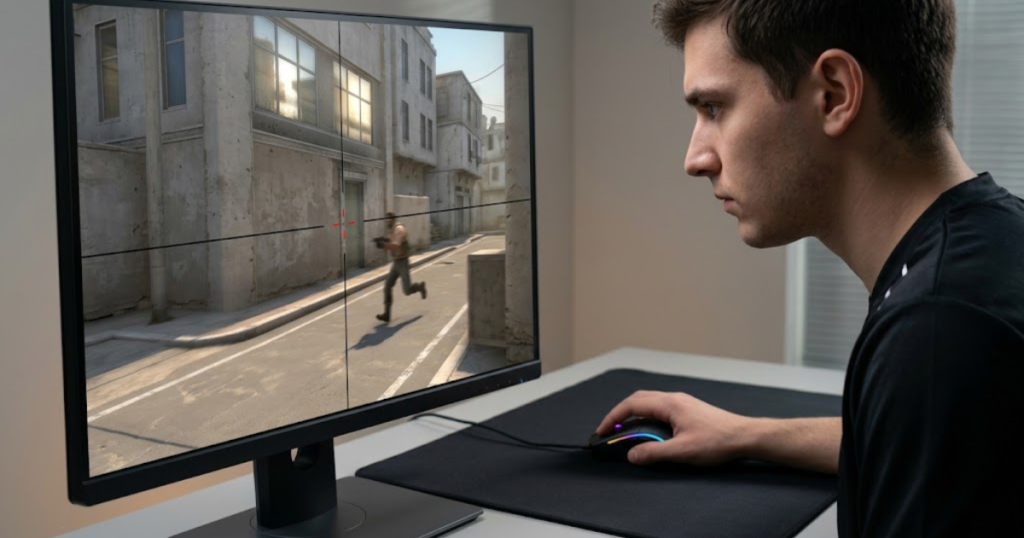
In FPS games, the sensor is one of the most important parts of the mouse because every movement must be converted into in-game aim. When the sensor feels stable, the player can trust that their hand movement will produce the same result again.
The table below explains how sensor accuracy affects different FPS aiming tasks:
| Aiming Task | Why Sensor Accuracy Matters | Player Benefit |
|---|---|---|
| Micro-adjustments | Small movements need clean tracking | More precise corrections near the target |
| Flick shots | Fast movement needs stable input | More predictable target transitions |
| Tracking aim | Continuous movement needs smooth reporting | Easier target following during motion |
| Angle clearing | Controlled movement needs repeatability | More stable crosshair placement |
| Low sensitivity play | Large swipes need dependable tracking | Cleaner arm movement without random behavior |
The table shows that sensor accuracy affects several aiming situations, not just one type of shot. This is why FPS players usually care more about sensor reliability than extreme DPI numbers.
Why Consistent Tracking Matters More Than Maximum DPI
Consistent tracking matters more than maximum DPI because FPS players need control, not just speed. A very high DPI setting does not help if the movement becomes too sensitive or hard to repeat.
Many players use moderate DPI and adjust in-game sensitivity to create a stable aiming feel. The goal is to make movement controllable across flicks, tracking, and crosshair placement.
How Accurate Sensors Improve Micro Adjustments
Micro-adjustments are small corrections used to move the crosshair onto the target after the first aim movement. Accurate sensors help these small corrections feel cleaner and easier to control.
This is especially important in tactical shooters where players often hold angles and make tiny corrections instead of constantly making huge flicks. A stable sensor helps the player avoid overcorrecting or fighting strange cursor behavior.
Clean micro-adjustments can make aim feel calmer during pressure moments.
Sensor Reliability During Fast Flicks
Sensor reliability during fast flicks matters because quick movements can expose weak tracking behavior. FPS players need the mouse to stay accurate even when they move quickly across the mousepad.
A reliable gaming mouse should keep the movement path predictable during sudden turns and fast target switches. This helps the player focus on timing and stopping control instead of wondering whether the mouse tracked correctly.
Flick aim still requires practice, but reliable tracking makes that practice more meaningful.
Sensor accuracy helps FPS players because it makes aim feel predictable across different movement speeds. A good sensor does not guarantee better aim, but it gives players a cleaner foundation for building consistent mechanics.
Why Are Gaming Mice Usually Lighter?
Lightweight gaming mice help players perform faster and more controlled aiming movements with less physical effort. Lower weight can reduce fatigue while making flicks, resets, and direction changes easier to manage.
The image below demonstrates why lightweight mice have become popular among competitive FPS players:
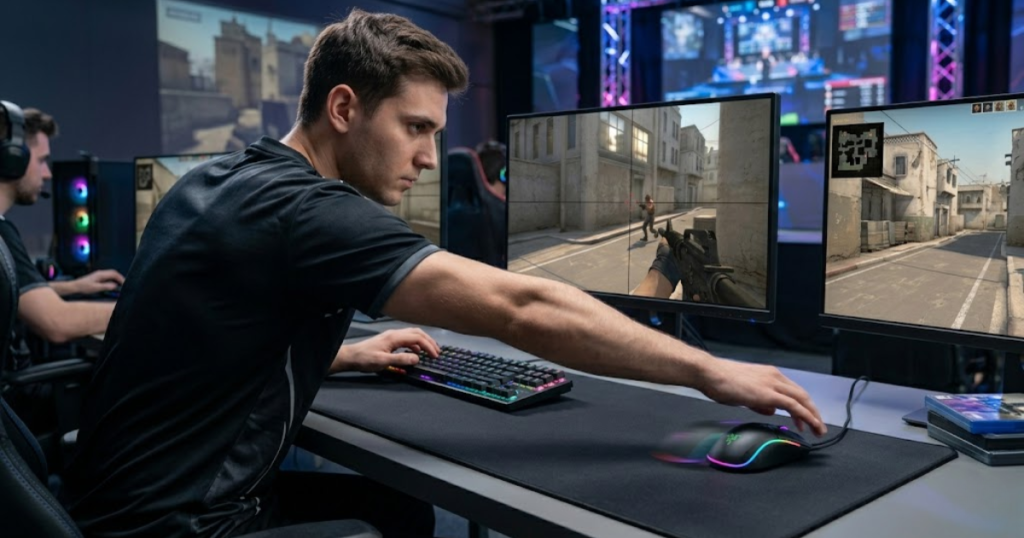
FPS players move their mouse far more aggressively than typical office users. A lighter mouse can feel easier to start, stop, and reposition during repeated fights, especially for players who use low or medium sensitivity.
The factors below explain why lighter designs are popular among FPS players:
- Lower inertia: Less force is needed to start and stop the mouse during quick movements.
- Faster direction changes: Rapid corrections can feel easier when the mouse resists movement less.
- Reduced fatigue: Long sessions can feel less tiring because the hand moves less mass repeatedly.
- Cleaner flick efficiency: Quick target transitions may feel smoother when the mouse is easier to reposition.
- More responsive feel: A lighter shell can make movement feel more connected to the player’s hand.
Lightweight design is useful because it reduces unnecessary effort. However, the best weight still depends on grip style, sensitivity, hand size, and personal comfort.
Faster Mouse Movement Requires Less Effort
Less effort helps FPS players move quickly without forcing the hand to work too hard. This can make aim feel smoother during quick turns and repeated repositioning.
A heavy mouse can still work well for some players, especially if they prefer extra stability. The main difference is that lighter mice usually require less force to accelerate and stop.
For many FPS players, less movement resistance makes the mouse feel easier to control.
Reduced Fatigue During Long Sessions
Reduced fatigue matters because FPS players often play multiple matches in one session. A mouse that feels fine for ten minutes can feel tiring after several hours.
Lighter mice may help players keep their hand more relaxed over time. Relaxed movement usually supports smoother corrections and steadier crosshair control.
Comfort is not separate from performance because tired hands rarely aim consistently.
Why Most Modern FPS Mice Stay Under 70 Grams
Modern FPS mice often stay under 70 grams because many competitive players prefer a balance of speed, control, and comfort. This range can feel light without becoming too unstable for most users.
Not every player needs the lightest mouse possible. Some players aim better with slightly more weight because it helps them stop more confidently.
The best weight is the one that lets the player move naturally without tension.
Gaming mice are usually lighter because FPS movement rewards fast control, repeated corrections, and long-session comfort. Lightweight design is not automatically better for everyone, but it explains why many FPS players avoid heavy regular mice.
How Do Gaming Mice Improve Aim Control?
Gaming mice help improve aim control through accurate sensors, balanced weight, responsive clicks, and FPS-focused shapes. Together, these factors create more stable and repeatable aiming mechanics. Many players also wonder whether gaming mice improve aim overall or simply make aiming feel more consistent during practice and matches.
Aim control is not only about moving fast. It also includes stopping accurately, making small corrections, holding angles, and clicking at the right moment without disturbing the mouse.
The benefits below show how gaming mice support better aim control:
- Stable tracking: Movement feels more predictable across different aiming speeds.
- Accurate micro-corrections: Small adjustments become easier when the sensor and shape feel controlled.
- Reliable click timing: Inputs feel more consistent during close fights.
- Grip support: The mouse shape helps the hand stay stable during repeated movements.
- Movement repeatability: Players can build more consistent mechanics when the mouse behaves predictably.
Gaming mice improve aim control by removing common sources of instability. The player still has to practice, but the mouse gives that practice a more reliable base.
Better Stability During Flick Shots
Flick shot stability improves when the mouse moves quickly without feeling unpredictable. FPS players need to accelerate, stop, and click cleanly during fast target transitions.
A gaming mouse can support this by offering lower movement resistance, reliable tracking, and a shape that does not shift awkwardly in the hand. This helps the player stop the crosshair with more confidence.
Improved Precision During Micro Corrections
Micro-correction precision improves when small movements feel controllable. This is important because many FPS fights are won by tiny corrections, not giant flicks.
A comfortable gaming mouse shape can help the player keep a relaxed grip while making fine adjustments. A stable sensor then helps those small movements translate cleanly in-game.
Micro-corrections are where comfort, sensor quality, and sensitivity control meet.
More Predictable Mouse Movement Under Pressure
Predictable movement under pressure helps players avoid panic corrections. When the mouse feels familiar and stable, the player can focus on the fight instead of second-guessing the setup.
This is one reason many FPS players avoid changing mice too often. Consistency across practice and matches helps aim feel more natural over time.
A predictable mouse reduces distraction when the game already demands fast decisions.
Gaming mice improve aim control by helping movement feel stable, responsive, and repeatable. The best result comes when the mouse matches the player’s grip, sensitivity, and aiming style.
Why Do Professional FPS Players Almost Always Use Gaming Mice?
Professional FPS players use gaming mice because competitive environments require maximum consistency and reliability. Small hardware advantages become more valuable when matches are decided by narrow timing and accuracy differences.
Pro players practice for long hours, compete under pressure, and need gear that behaves predictably every time. A gaming mouse is not a shortcut to pro-level aim, but it helps remove avoidable hardware limitations.
The table below explains why gaming mice fit professional FPS environments better than regular mice:
| Competitive Need | Why It Matters | How Gaming Mice Help |
|---|---|---|
| Reliable tracking | Players repeat thousands of aim movements | Stable sensors support consistent mechanics |
| Low input delay | Timing differences can affect close duels | Responsive clicks and movement feel more connected |
| Comfort over long practice | Long sessions can create fatigue | Better shapes and lower weight reduce strain |
| Setup consistency | Practice should match competition feel | Players can keep the same mouse behavior every day |
| Confidence under pressure | Doubt hurts decision-making | Trusted gear reduces distraction during matches |
The table shows that pro players choose gaming mice mainly for reliability, not because the mouse replaces skill. At high levels, fewer equipment variables means more focus on execution.
Equipment Consistency Across Practice and Competition
Equipment consistency helps professional players make practice more transferable to competition. If the mouse feels the same every day, the player can build stable habits around it.
Changing mouse shape, weight, or response too often can interrupt muscle memory. This is why many competitive players stick with a mouse once it fits their hand and aiming style.
Consistency matters because practice only works when the setup remains repeatable.
Reliability During High Pressure Matches
Reliability becomes more important when pressure rises. In tournaments or ranked climbs, players do not want to think about sensor issues, click feel, or grip discomfort.
A trusted gaming mouse lets players keep their attention on positioning, timing, communication, and aim. That mental clarity is valuable because FPS games already demand fast decisions.
Reliable hardware helps players stay focused when the match is stressful.
Why Pro Players Rarely Switch Mouse Categories
Mouse category changes are risky because switching from one shape or weight class to another can affect aiming habits. Pro players usually avoid unnecessary changes unless there is a clear reason.
A player who practices with a lightweight symmetrical mouse may not instantly feel comfortable on a heavier ergonomic model. Even if both are good mice, the movement pattern can feel different.
Professional players value familiarity because familiar gear reduces adaptation time.
Professional FPS players use gaming mice because they need consistent, responsive, and comfortable hardware across practice and competition. The mouse does not create skill, but it helps protect the skill they have built.
Are Gaming Mice Really Faster Than Regular Mice?
Gaming mice help deliver more responsive and predictable performance during gameplay, but they are not automatically faster in cursor speed. Their advantage comes from consistency, tracking quality, and input reliability rather than raw movement speed.
This distinction matters because many new players confuse speed with sensitivity. A mouse can feel fast because the sensitivity is high, but that does not mean it is better for FPS aiming.
The table below separates real gaming mouse performance from common speed misconceptions:
| Question | Common Misunderstanding | Better Explanation |
|---|---|---|
| Is a gaming mouse faster? | It always moves the cursor faster | It usually responds and tracks more reliably |
| Does higher DPI mean better aim? | More DPI automatically improves accuracy | Stable sensitivity matters more than extreme DPI |
| Does polling rate fix aim? | Higher polling rate creates better mechanics | It can improve smoothness, but fundamentals still matter |
| Does low latency guarantee wins? | Faster input beats skill | It removes delay, but the player must still aim well |
| Does a gaming mouse feel different? | The difference is only marketing | Shape, sensor, weight, and clicks can noticeably change control |
The table shows that gaming mice are better understood as more responsive and controlled, not simply faster. Speed without control can make FPS aim worse.
Understanding Input Response
Input response describes how quickly and consistently the mouse reports movement or clicks to the computer. In FPS games, responsive input can make the mouse feel more connected to the player’s hand.
This does not mean every player will instantly notice a dramatic difference. The benefit becomes clearer when a player already has stable sensitivity, good mechanics, and enough experience to feel timing differences.
Input response supports performance, but it does not replace control.
Why Speed Alone Does Not Improve Aim
Speed alone does not improve aim because FPS accuracy depends on control, timing, and stopping ability. A mouse that moves too quickly can make the player overshoot targets.
Many competitive players prefer controlled sensitivity because it helps them place the crosshair precisely. A gaming mouse helps most when it makes that controlled movement feel consistent.
Fast movement is useful only when the player can stop accurately.
The Difference Between Responsiveness and Sensitivity
Responsiveness is about how reliably the mouse reacts, while sensitivity is about how far the crosshair moves for a given hand movement. These are related, but they are not the same thing.
A responsive mouse can still be used at low sensitivity. A high sensitivity setup can still feel bad if the mouse or player control is inconsistent.
Understanding this difference helps players avoid chasing the wrong upgrade.
Gaming mice are not better because they simply make the cursor faster. They are better for FPS players because they make movement and input feel more predictable during aiming situations.
Do Gaming Mice Make Players Aim Better Automatically?
Gaming mice help create a more reliable aiming platform, but they do not automatically improve player skill. Practice, mechanics, positioning, and game knowledge still contribute far more to long-term performance.
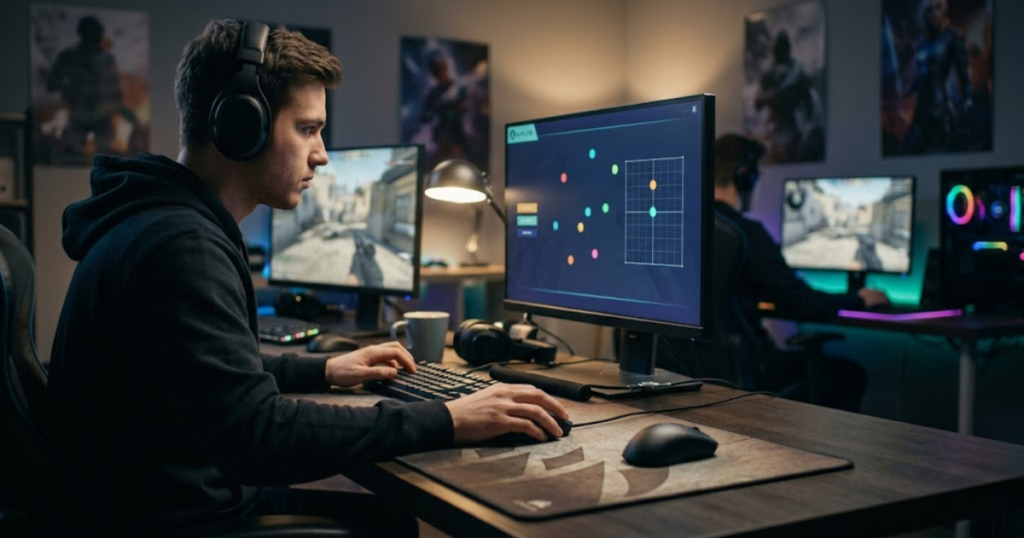
This is important because many players expect a new mouse to instantly fix aim problems. A better mouse can remove some hardware limitations, but it cannot replace training or smart gameplay.
The points below explain what a gaming mouse can and cannot do for aim:
- Better equipment: It can reduce hardware inconsistency, but it cannot create good mechanics by itself.
- Muscle memory: It still requires repeated practice with stable sensitivity and movement habits.
- Crosshair placement: It remains a player skill built through map knowledge and discipline.
- Game sense: It cannot improve timing, positioning, or decision-making on its own.
- Long-term consistency: It helps most when combined with regular practice and a stable setup.
A gaming mouse is best understood as support equipment. It can make practice cleaner, but the player still has to build the skill.
Equipment Cannot Replace Fundamentals
Fundamentals still matter more than hardware because aiming is only one part of FPS performance. Players also need crosshair placement, movement control, timing, and decision-making.
A gaming mouse can make movement feel better, but poor fundamentals will still create inconsistent results. Hardware helps most when it supports habits that are already improving.
Good gear removes friction, but fundamentals create progress.
Why Practice Remains the Biggest Factor
Practice remains the biggest factor because aim improves through repetition, feedback, and adjustment. A player needs time to learn how far to move, how quickly to stop, and how to correct mistakes.
A gaming mouse can make those repetitions more consistent. That means practice may feel more reliable because the mouse is less likely to interfere with movement quality.
The mouse supports the process, but practice builds the result.
The Real Relationship Between Gear and Skill
Gear and skill work together when the mouse fits the player’s hand, sensitivity, and aiming style. The right mouse helps the player express their mechanics more consistently.
The wrong mouse can still hold a player back if it causes discomfort, unstable grip, or unpredictable movement. That does not mean expensive gear is required, but it does mean fit matters.
The best gear is the gear that lets skill show up more reliably.
Gaming mice do not make players aim better automatically. They help FPS players practice and perform with fewer hardware distractions, which makes improvement easier to measure and repeat.
Can Casual FPS Players Benefit from Gaming Mice?
Casual FPS players can benefit from gaming mice through improved comfort, control, and consistency. The difference may be smaller than it is for competitive players, but many users still notice smoother gameplay.
Casual players do not need to copy professional setups to enjoy the benefits of a better mouse. Even simple improvements in shape, weight, and tracking can make FPS games feel more comfortable and less frustrating.
The benefits below explain why gaming mice can still help casual FPS players:
- More comfort: Better shapes can make longer sessions feel easier on the hand.
- Improved control: Stable tracking can make aiming adjustments feel smoother.
- Better reliability: Fewer movement surprises can reduce frustration during fights.
- Skill development: A consistent mouse helps players practice the same movement patterns.
- Enjoyable gameplay: A smoother setup can make games feel more responsive and satisfying.
Casual players may not need premium esports features, but a basic gaming mouse can still improve comfort and control in ways that matter.
Benefits for New Players
New FPS players can benefit from a gaming mouse because it gives them a more consistent starting point. Learning aim is easier when the mouse feels stable and comfortable.
A beginner does not need the most expensive model. A reliable entry-level gaming mouse is often enough to make movement feel more controlled than a basic office mouse.
Starting with stable gear can make early practice less confusing.
Benefits for Intermediate Players
Intermediate players often benefit more because they can already feel when aim is inconsistent. At this stage, a better mouse can make tracking, flicks, and corrections feel cleaner.
These players may also begin to understand their grip style, sensitivity preference, and comfort needs. That makes it easier to choose a mouse that fits their actual play style.
Intermediate players usually notice the upgrade because they have enough experience to feel the difference.
When a Gaming Mouse Starts Becoming Noticeable
A gaming mouse starts becoming noticeable when the player cares about repeatability, comfort, and missed shots. The more often a player thinks about aim control, the more useful a proper mouse becomes.
If a regular mouse feels heavy, slippery, delayed, or uncomfortable, the upgrade may feel meaningful even for casual play. If the player only plays occasionally and feels no limitation, the benefit may be smaller.
The upgrade becomes more valuable when the current mouse is clearly interfering with comfort or control.
Casual FPS players can benefit from gaming mice, especially when they want smoother aim and better comfort. The key is choosing based on real use, not copying extreme competitive setups.
When Is a Regular Mouse Still Good Enough for FPS Games?
Regular mice can still support casual FPS gaming when competitive performance is not the primary goal. Many office mice can handle basic gameplay, although they often lack features designed for precision aiming.
This section matters because not every player needs to upgrade immediately. The value of a gaming mouse depends on how often the player plays, how competitive they are, and whether the current mouse causes noticeable problems.
The table below explains when a regular mouse may still be sufficient:
| Situation | Regular Mouse Status | Upgrade Pressure |
|---|---|---|
| Occasional casual play | Usually acceptable | Low |
| Story-based shooters | Often good enough | Low to medium |
| Low competition matches | Can work if comfortable | Medium |
| Ranked FPS grind | May feel limiting | High |
| Fast tactical aim practice | Often less ideal | High |
The table shows that regular mice are not useless. They simply become less suitable as the player’s aiming demands, playtime, and competitive goals increase.
Casual Play Versus Competitive Play
Casual play gives players more room to use basic equipment because the stakes are lower. If the goal is fun, a regular mouse may be completely fine.
Competitive play is different because players care more about consistency, speed, and repeatable control. In that environment, regular mice are more likely to reveal their limits.
The right choice depends on how seriously the player treats FPS performance.
Situations Where Upgrading Is Not Necessary
Upgrading is not necessary when the player rarely plays FPS games, feels comfortable with their current mouse, and does not care about ranked performance. In that case, spending money may not create enough value.
A player should not buy new gear only because other players use it. The better reason is a clear problem such as discomfort, tracking inconsistency, or poor control.
No upgrade is needed if the current mouse already supports the player’s goals.
Signs a Regular Mouse Is Becoming a Limitation
Mouse limitations become obvious when the player repeatedly feels held back by tracking, comfort, weight, or response. These signs matter more than marketing claims.
If the mouse feels hard to stop, uncomfortable after long sessions, or inconsistent during fast movement, a gaming mouse may become a practical upgrade. The player should connect the purchase to a real problem.
The clearest upgrade signal is when the current mouse makes aiming feel harder than it needs to be.
A regular mouse can still be good enough for casual FPS games, but it becomes less ideal as the player becomes more competitive. Gaming mice are most useful when performance, comfort, and repeatability start to matter.
Are Gaming Mice Worth It for FPS Players?
Gaming mice help improve consistency, comfort, and aim control, making them worthwhile for many FPS players. The value becomes more noticeable as playtime, competitive demands, and aiming expectations increase.
The best way to decide is not to ask whether gaming mice are always worth it. A better question is whether the player’s current mouse is limiting comfort, control, or consistency in the games they actually play.
The following process can help FPS players decide whether a gaming mouse is worth buying:
- Identify your play style: Decide whether you play casually, competitively, or somewhere between both.
- Evaluate current limitations: Check whether your current mouse feels heavy, delayed, uncomfortable, or inconsistent.
- Consider play frequency: More weekly playtime usually increases the value of comfort and consistency.
- Compare budget options: Entry-level gaming mice can often provide major improvements without requiring premium pricing. If you are ready to compare actual models, this list of the best gaming mice for FPS games in 2026 can help narrow down the options.
- Decide based on usage: Choose a gaming mouse only if it solves a real problem for your setup and goals.
This decision process keeps the upgrade practical. A gaming mouse is worth it when it supports the player’s actual FPS habits, not when it is bought only because it looks competitive.
Who Benefits the Most
Competitive FPS players benefit the most because they rely heavily on stable movement, quick input, and long practice sessions. A good gaming mouse supports those needs directly.
Players who grind ranked, practice aim regularly, or play low to medium sensitivity may also notice the upgrade more clearly. Their mouse movement demands are higher than casual desktop use.
The more seriously a player treats aim consistency, the more valuable a gaming mouse becomes.
Who May Not Need One Yet
Casual users may not need a gaming mouse yet if they rarely play FPS games and feel comfortable with their current mouse. Not every player needs specialized gear immediately.
If the current mouse feels fine and the player is not focused on improving aim, the upgrade can wait. Money may be better spent only when a clear limitation appears.
A gaming mouse should solve a real problem, not create pressure to buy gear unnecessarily.
The Long Term Value of a Gaming Mouse
Long-term value comes from comfort, reliability, and consistent practice over time. A good gaming mouse can support many hours of play without forcing the player to constantly adjust to hardware problems.
This is why the best value is not always the cheapest mouse or the most expensive one. It is the mouse that fits the player’s hand, grip, sensitivity, and games well enough to stay useful.
Gaming mice are worth it for many FPS players because they support more consistent aiming, better comfort, and more predictable control. The smartest upgrade is the one connected to how the player actually plays.
Frequently Asked Questions About Why FPS Players Use Gaming Mice
FPS players often ask whether gaming mice truly matter or whether they are mostly marketing. The answers below clarify the most common questions without repeating the full guide.
Why do FPS players prefer gaming mice?
FPS players prefer gaming mice because they offer better tracking consistency, faster response, and more comfortable control than most regular mice. These advantages help aiming feel more reliable during competitive gameplay.
Are gaming mice more accurate than office mice?
Gaming mice are usually more accurate for FPS movement because they are designed for stable tracking during fast and precise actions. Office mice are normally built for everyday desktop navigation.
Can a gaming mouse improve aim?
A gaming mouse can improve aim consistency by reducing hardware friction, but it does not create skill automatically. Better aim still depends on practice, mechanics, and stable settings.
Do professional players use gaming mice?
Professional players almost always use gaming mice because high-level competition requires reliable tracking, low latency, and consistent comfort. They need gear that stays predictable during practice and matches.
Does mouse weight matter in FPS games?
Mouse weight matters because it affects how easy the mouse is to start, stop, and reposition. Many FPS players prefer lighter mice because they reduce movement effort during repeated aiming actions.
Is a lightweight mouse always better?
A lightweight mouse is not always better because some players aim more confidently with slightly more weight. The best weight depends on grip style, sensitivity, hand size, and control preference.
What makes a gaming mouse different?
A gaming mouse is different because it usually focuses on accurate sensors, responsive clicks, lighter construction, and shapes built for gaming grips. Regular mice usually prioritize general comfort and everyday use.
Do gaming mice reduce input delay?
Gaming mice can reduce input delay compared with many basic mice because they are designed for responsive movement and clicking. However, system performance and game settings also affect overall input feel.
Can beginners benefit from gaming mice?
Beginners can benefit from gaming mice because stable tracking and better comfort make early aim practice feel more consistent. They do not need premium models to feel an improvement.
Is an expensive gaming mouse necessary?
An expensive gaming mouse is not necessary for every FPS player. Many affordable gaming mice provide accurate tracking, comfortable shapes, and reliable performance for casual and intermediate players.
Can office mice be used for FPS games?
Office mice can be used for casual FPS games, but they may feel limiting during competitive play. The main weaknesses are usually tracking consistency, weight, response, and gaming grip support.
Are gaming mice worth buying for competitive gaming?
Gaming mice are usually worth buying for competitive gaming because they support better consistency, comfort, and control. The value becomes stronger when the player practices often and cares about reliable aim.
Why Gaming Mice Continue to Dominate FPS Gaming
Gaming mice help FPS players achieve more consistent tracking, responsive input, and reliable aim control during competitive gameplay. While they do not automatically improve skill, they can remove hardware limitations that make aiming feel less predictable or less comfortable.
The biggest reason FPS players use gaming mice is not marketing, RGB lighting, or brand popularity. It is the combination of sensor reliability, movement consistency, grip comfort, and long-term control that supports better performance across different aiming situations.
For players who care about improving aim, building muscle memory, and creating a more stable gaming setup, a gaming mouse is often a practical upgrade rather than a luxury. The most important goal is not finding the most expensive mouse, but finding one that fits your hand, grip style, sensitivity, and FPS playstyle.
Thank you for taking the time to read this guide. We hope it helped you better understand why gaming mice have become a standard choice for FPS players and how the right mouse can support more consistent aim and long-term improvement.