
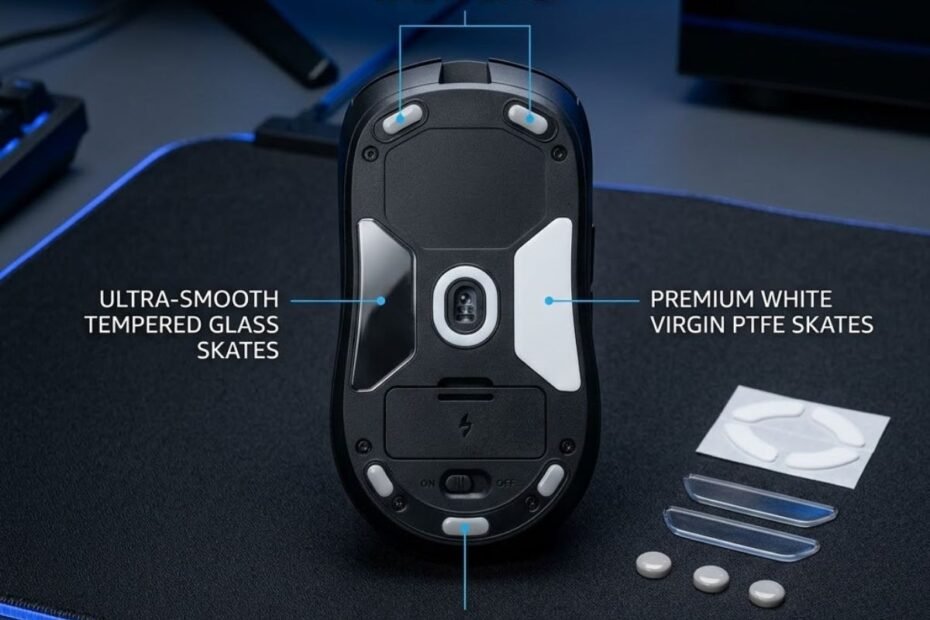
Gaming mouse skates, often called mouse feet, are small pads attached to the underside of a gaming mouse that reduce friction between the mouse and the mouse pad. Although they are one of the smallest components of a gaming mouse, they have a measurable impact on glide consistency, stopping control, and overall aiming feel. Choosing the right mouse skates is not about making your mouse as fast as possible. Instead, it is about creating a smooth, predictable movement that matches your preferred aiming style.
Many gamers spend considerable time comparing sensors, switches, weight, or polling rates while overlooking the only part of the mouse that stays in constant contact with the mouse pad. As mouse skates wear down, glide becomes less consistent, friction increases, and muscle memory becomes harder to maintain. Replacing worn skates or choosing a material that better suits your setup can noticeably improve the overall experience, especially in competitive FPS games.
This guide explains what gaming mouse skates are, how they influence mouse performance, the differences between popular skate materials and designs, and how to choose the right replacement for your gaming setup.
What Are Gaming Mouse Skates and Why Do They Matter for Gaming Performance?
Gaming mouse skates are low-friction pads installed on the bottom of a gaming mouse that allow it to glide smoothly across a mouse pad while maintaining consistent surface contact. Their primary purpose is to minimize unnecessary friction, protect the mouse shell from direct wear, and provide stable movement that helps players build reliable aiming consistency. While they do not improve the sensor itself, they significantly influence how the sensor performs by ensuring smooth and predictable movement across the mouse pad.
The illustration below shows where gaming mouse skates are located on a gaming mouse:
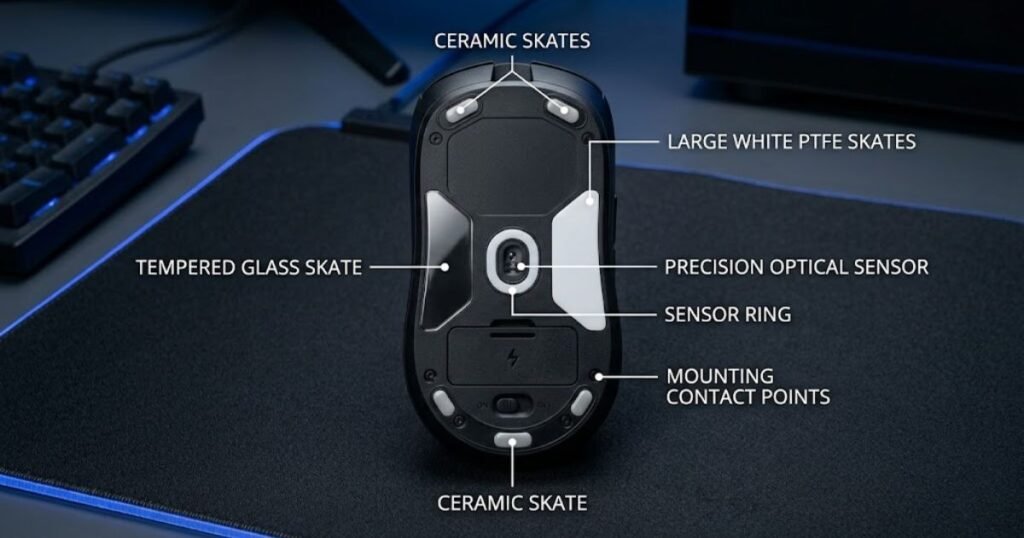
Every movement your hand makes must pass through the mouse skates before the sensor can accurately translate that motion into cursor movement. If the skates generate uneven friction because of wear, poor-quality materials, or surface contamination, the mouse may feel inconsistent despite having a flagship sensor. This is why experienced FPS players often replace worn stock skates long before replacing the mouse itself.
To better understand why smooth movement is essential for accurate tracking, it’s also helpful to learn how a gaming mouse sensor converts physical movement into on-screen cursor movement.
What Are Gaming Mouse Skates?
Gaming mouse skates are replaceable glide pads designed to reduce friction and create a consistent sliding surface between the mouse and the mouse pad. They are commonly manufactured from materials such as virgin PTFE, tempered glass, ceramic, or hybrid composites, with each material offering a different balance of speed, control, durability, and maintenance requirements.
Most gaming mice include multiple skates positioned around the sensor opening to evenly distribute pressure across the mouse pad. This balanced contact helps maintain stable tracking while preventing the mouse body from scraping against the surface. Because skates gradually wear with regular use, many competitive players consider them a consumable component similar to mouse grips or switches.
Although aftermarket skates often advertise increased speed, the real advantage is consistency. High-quality skates produce more predictable friction throughout every movement, making it easier to develop reliable muscle memory over time.
In short, gaming mouse skates create the physical foundation that allows every mouse movement to feel smooth, repeatable, and controlled.
Why Are Mouse Skates More Important Than Most Gamers Think?
Mouse skates have a greater influence on aiming consistency than many players realize because they directly determine how the mouse interacts with the surface beneath it. Even the most advanced sensor cannot compensate for inconsistent glide caused by worn or poorly matched skates.
Many players attribute inconsistent aim to sensitivity settings or hardware upgrades when the real issue is uneven friction. As skates wear down, different sections of the mouse begin to experience varying resistance, making identical hand movements produce slightly different results. These small inconsistencies become increasingly noticeable during precision aiming and repeated flick shots.
The factors below explain why gaming mouse skates matter:
- Consistent Glide: Stable friction helps maintain predictable mouse movement throughout long gaming sessions.
- Improved Control: Balanced resistance allows players to stop the mouse more accurately after fast swipes.
- Surface Protection: Mouse skates prevent the mouse shell from rubbing directly against the mouse pad.
- Reliable Muscle Memory: Consistent glide makes repeated movements easier to reproduce over time.
- Smoother Tracking: Reduced friction allows the sensor to receive cleaner movement input during gameplay.
Although they are inexpensive compared to most gaming peripherals, quality mouse skates can significantly improve the overall feel of a gaming mouse by delivering smoother and more predictable movement.
How Mouse Skates Work Together with the Mouse Sensor
Mouse skates and the mouse sensor perform different functions, but they work together to create accurate and consistent cursor movement. The sensor captures movement data, while the skates determine how smoothly the mouse travels across the surface before that movement is measured.
If the skates glide consistently, the sensor receives stable movement that is easier to interpret accurately. Conversely, excessive friction, uneven wear, or debris on the skates can introduce irregular movement patterns that make aiming feel less predictable, even though the sensor itself is functioning correctly.
This relationship explains why upgrading mouse skates often changes the overall feel of a gaming mouse without altering its sensor specifications. The improvement comes from smoother physical movement rather than increased sensor performance.
Understanding this relationship makes it easier to evaluate future upgrades based on your complete gaming setup instead of focusing on a single hardware specification.
How Gaming Mouse Skates Affect Speed, Control, and Overall Mouse Feel
Gaming mouse skates directly influence how a mouse feels during gameplay by changing the balance between glide speed, stopping control, and movement consistency. Faster skates reduce resistance and make large swipes feel effortless, while slower skates create more friction for greater precision. Neither characteristic is inherently better. The ideal balance depends on your aiming style, mouse pad, and the games you play.
Many players assume faster skates automatically improve performance, but competitive aiming is built on consistency rather than raw speed. Mouse skates should complement your preferred mouse control instead of forcing you to adapt to unpredictable glide characteristics. Understanding how speed and control interact helps you select skates that support your muscle memory instead of disrupting it.
Faster Glide Does Not Always Mean Better Performance
Lower friction makes a mouse feel faster, but faster movement does not automatically translate into better aim. Extremely fast skates require more precise hand control because the mouse continues moving with less resistance after each swipe. While this can benefit experienced players who rely on rapid target switching, it may reduce confidence for gamers who prefer controlled crosshair placement.
The ideal glide speed should feel predictable rather than effortless. If a mouse moves too freely, making small corrections or stopping exactly on target becomes more difficult. Conversely, excessive friction can make fast flicks feel sluggish and physically demanding during long gaming sessions.
Instead of chasing the fastest available mouse skates, most competitive players benefit from choosing a balanced glide that matches their preferred sensitivity and aiming technique.
How Mouse Skates Influence Stopping Power
Stopping power describes how easily you can bring the mouse to a precise stop after movement, and mouse skates play an important role in achieving that control. Higher-friction skates naturally generate more resistance, allowing players to stop the mouse with less effort. Lower-friction skates require finer hand control because momentum carries the mouse farther before it comes to rest.
This characteristic becomes especially important in tactical FPS games where accurate first-shot placement often matters more than continuous tracking. Players who rely on precise flick shots generally prefer a balanced level of stopping power rather than the lowest possible friction.
Choosing mouse skates with appropriate stopping characteristics helps create a more predictable aiming experience without sacrificing overall mobility.
Why Consistent Glide Improves Aim Accuracy
Consistent glide is more valuable than maximum glide speed because repeatable movement allows players to develop reliable muscle memory. When friction remains uniform across the mouse pad, identical hand movements produce nearly identical cursor movement, making aim easier to reproduce under pressure.
Inconsistent glide often results from worn skates, uneven edges, accumulated debris, or incompatible mouse pad surfaces. Even small variations in resistance can affect crosshair placement during micro adjustments and repeated flick shots. Maintaining consistent glide allows players to focus on target acquisition instead of unconsciously compensating for changing friction.
Because movement consistency is closely related to how the mouse processes physical motion, understanding technologies such as Motion Sync provides additional insight into how modern gaming mice deliver smoother tracking.
The table below compares how different glide characteristics influence overall mouse feel:
| Performance Factor | Lower-Quality or Worn Skates | High-Quality Gaming Mouse Skates |
|---|---|---|
| Glide Consistency | Uneven friction across the surface | Smooth and predictable movement |
| Stopping Control | Difficult to stop accurately | More controlled and repeatable stops |
| Micro Adjustments | Can feel inconsistent during small movements | Fine adjustments remain stable and precise |
| Long-Term Comfort | Higher resistance may increase fatigue | Reduced effort during extended gaming sessions |
| Overall Mouse Feel | Variable and less predictable | Balanced, consistent, and confidence-inspiring |
Ultimately, gaming mouse skates should be evaluated by how consistently they support your aiming style rather than how fast they feel during the first few minutes of use. A predictable glide profile is what allows experienced FPS players to build reliable muscle memory and maintain consistent performance over time.
Gaming Mouse Skate Materials Explained: PTFE, Glass, Ceramic, and More
The material used to manufacture gaming mouse skates has the greatest influence on glide characteristics, durability, maintenance requirements, and overall mouse feel. While every type of mouse skate aims to reduce friction, different materials achieve this in unique ways. Some prioritize effortless speed, while others focus on delivering greater control or long-term durability. Understanding these differences helps you choose a material that matches your mouse pad and aiming style rather than simply selecting the fastest option available.
The following comparison illustrates the most common gaming mouse skate materials:
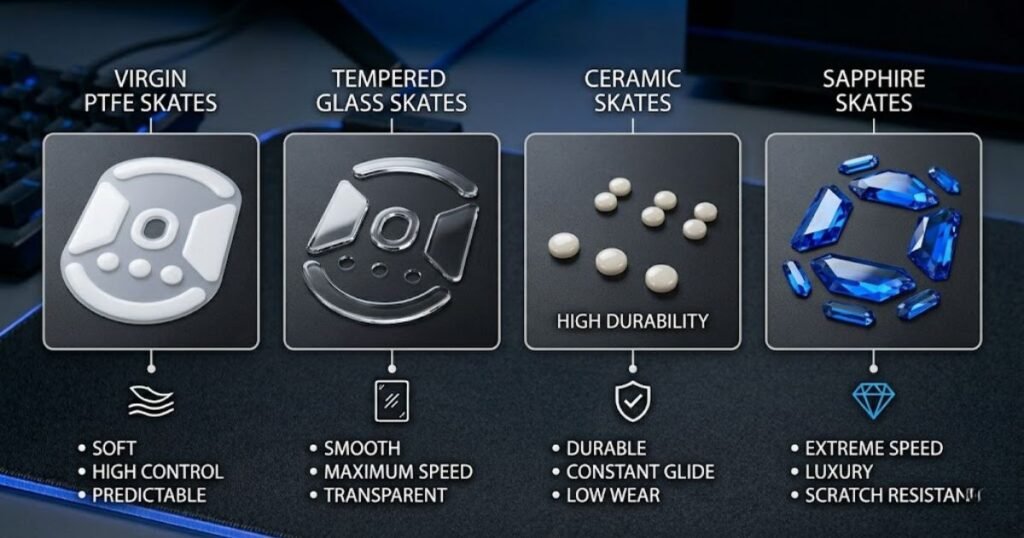
Modern gaming mouse skates are commonly made from virgin PTFE, glass, ceramic, or various hybrid materials. Each option offers a distinct balance between glide speed, stopping power, surface compatibility, and maintenance. Instead of asking which material is objectively best, competitive players should consider which one best supports their preferred gameplay experience.
To better understand why smooth physical movement is essential for accurate cursor tracking, you can also explore how gaming mouse sensors work, as sensor performance and glide consistency complement each other during gameplay.
Virgin PTFE Mouse Skates
Virgin PTFE is the most widely recommended material for gaming mouse skates because it offers an excellent balance between speed, control, durability, and compatibility with nearly every mouse pad. Unlike recycled PTFE, virgin PTFE contains no fillers or additives, allowing it to maintain a smoother and more consistent glide over time.
Most premium aftermarket manufacturers use 100% virgin PTFE because it produces predictable friction across cloth, hybrid, and hard mouse pads. It also develops a comfortable glide after a short break-in period without becoming overly slippery. This balanced performance explains why professional FPS players continue to prefer virgin PTFE despite the availability of newer materials.
For players seeking dependable performance across a wide variety of games and mouse pads, virgin PTFE remains the safest and most versatile choice.
Glass Mouse Skates
Glass mouse skates are designed to minimize friction as much as possible, creating an exceptionally fast and effortless glide. Their rigid surface allows the mouse to move with very little resistance, making them attractive to players who enjoy rapid swipes and low-friction movement.
However, extremely low friction also reduces natural stopping control. Players often need additional hand precision to stop the mouse exactly where intended, especially during flick shots. Glass skates may also wear cloth mouse pads more quickly than traditional PTFE skates and can produce a louder glide depending on the surface material.
Glass skates are best suited for experienced players who intentionally prefer an ultra-fast glide and are comfortable managing reduced stopping resistance.
Ceramic Mouse Skates
Ceramic mouse skates emphasize durability while delivering a smooth and consistent glide that changes very little over time. Because ceramic is significantly harder than PTFE, it resists wear exceptionally well and can maintain its surface characteristics through extended use.
Many ceramic skates provide a unique glide feel that sits between the effortless movement of glass and the balanced control of PTFE. Depending on the mouse pad, ceramic skates may produce slightly more audible movement and can feel noticeably different from traditional mouse feet during the first few gaming sessions.
Players who prioritize longevity and stable long-term performance often appreciate ceramic skates, provided they are paired with a compatible mouse pad.
Sapphire and Hybrid Mouse Skates
Sapphire and hybrid mouse skates represent niche alternatives designed for enthusiasts seeking specialized glide characteristics. Sapphire skates are extremely hard and wear-resistant, while hybrid designs combine multiple materials in an attempt to balance speed, control, and durability.
Although these options can provide unique glide experiences, they are generally less common than PTFE, glass, or ceramic. Availability may also be limited to specific manufacturers or mouse models, making replacement and long-term support more difficult.
For most gamers, these specialty materials are interesting alternatives rather than necessary upgrades, particularly when high-quality virgin PTFE already delivers excellent all-around performance.
The table below compares the most common gaming mouse skate materials:
| Material | Glide Speed | Stopping Control | Durability | Typical Use Case |
|---|---|---|---|---|
| Virgin PTFE | Balanced | Excellent | High | Most competitive FPS players |
| Glass | Very Fast | Lower | Very High | Players who prefer maximum glide speed |
| Ceramic | Moderately Fast | Good | Excellent | Long-term durability and stable performance |
| Sapphire | Fast | Moderate | Exceptional | Enthusiasts seeking premium durability |
| Hybrid Materials | Varies by Design | Varies by Design | High | Specialized or experimental setups |
No single mouse skate material is universally superior. Virgin PTFE remains the most balanced option for the majority of gamers, while glass, ceramic, and sapphire each serve more specialized preferences. Choosing the right material should always consider your mouse pad, desired glide characteristics, and personal aiming style rather than focusing on a single specification.
How Mouse Skate Design Influences Glide and Stability
The design of gaming mouse skates affects how pressure is distributed across the mouse pad, influencing glide smoothness, stability, and overall control. While material determines the friction characteristics, the physical design determines how that material interacts with the surface. Factors such as edge shape, thickness, and contact area all contribute to the way a mouse feels during real gameplay.
Many gamers focus exclusively on skate materials, but two sets of skates made from the same PTFE can produce noticeably different experiences if their shape or dimensions differ. Understanding these design characteristics helps you choose skates that complement your preferred aiming style instead of simply following popular recommendations.
Rounded Edge and Flat Edge Mouse Skates
Rounded-edge mouse skates generally provide smoother movement because they transition across the mouse pad with less resistance, while flat-edge skates may create slightly more friction until they become worn.
The image below compares two common gaming mouse skate designs:
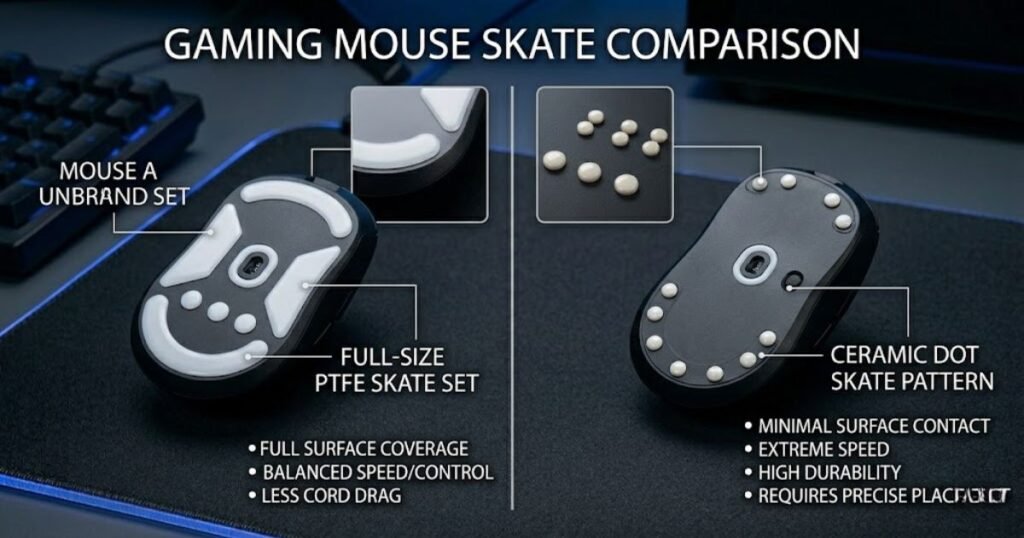
Most premium aftermarket skates feature factory-rounded edges that reduce the chance of the skate catching on the mouse pad during quick directional changes. This creates a smoother glide immediately after installation and shortens the break-in period. In contrast, flat-edge skates often require additional use before the edges naturally become smoother.
For competitive FPS gaming, rounded edges provide a more refined glide experience, especially during rapid flicks and repeated micro adjustments.
Overall, rounded-edge skates offer a more consistent feel from the first gaming session and have become the preferred design among premium manufacturers.
Thick vs. Thin Mouse Skates
Mouse skate thickness influences how the mouse sits on the surface and how consistently pressure is distributed during movement. Although the difference is usually measured in fractions of a millimeter, it can subtly change the overall glide experience.
Thicker skates typically provide a slightly softer feel because they create more separation between the mouse shell and the mouse pad. They may also extend product lifespan since there is more material available before wear becomes noticeable. Thinner skates position the sensor closer to the surface and often preserve the original feel intended by the mouse manufacturer.
Replacing stock skates with products of a similar thickness is generally recommended to maintain consistent sensor positioning and preserve the intended glide characteristics.
Choosing an appropriate thickness helps maintain the mouse’s original performance while ensuring stable long-term tracking.
Full-Size Mouse Feet vs. Dot Skates
Full-size mouse feet maximize stability by distributing pressure across a larger contact area, while dot skates reduce surface contact to create a lighter and faster glide. Both designs have advantages depending on the user’s priorities.
Traditional full-size skates are designed specifically for each mouse model and provide predictable performance across a wide range of mouse pads. Dot skates, on the other hand, use several individual circular pads that allow users to customize placement and reduce total contact with the surface. This lower contact area often produces less friction, making the mouse feel faster and more agile.
However, because dot skates rely on proper placement, incorrect installation can lead to uneven pressure distribution or inconsistent glide. Full-size skates remain the more forgiving option for most gamers, while dot skates are commonly preferred by enthusiasts looking to fine-tune their setup.
Ultimately, neither design is universally better. The best choice depends on whether you prioritize maximum stability or the flexibility to customize glide characteristics.
The table below compares the most common gaming mouse skate designs:
| Design Feature | Option A | Option B | Recommended For |
|---|---|---|---|
| Edge Shape | Rounded Edge | Flat Edge | Rounded edges for smoother initial glide |
| Thickness | Thicker Skates | Thinner Skates | Match the original thickness whenever possible |
| Contact Area | Full-Size Feet | Dot Skates | Choose based on stability or customization preferences |
| Installation | Simple | Requires precise placement | Full-size skates are easier for most users |
| Customization | Limited | Highly Flexible | Dot skates suit experienced enthusiasts |
Mouse skate design is just as important as material when optimizing glide characteristics. By understanding how edge shape, thickness, and contact area influence movement, you can choose skates that better complement your mouse, mouse pad, and preferred aiming style without changing the mouse’s core hardware.
Why Mouse Pad Surface Changes the Performance of Gaming Mouse Skates
The same gaming mouse skates can feel completely different depending on the mouse pad surface underneath. While skate material determines the potential glide characteristics, the mouse pad ultimately dictates how much friction is created during real-world use. This is why two players using identical mouse skates may report very different experiences if they play on different mouse pads.
Rather than evaluating mouse skates in isolation, it is more accurate to view the mouse and mouse pad as a single performance system. The ideal combination balances glide speed, stopping control, consistency, and durability according to your preferred aiming style.
Cloth Mouse Pads Offer the Most Balanced Experience
Cloth mouse pads are the most compatible surface for nearly every type of gaming mouse skate because they provide a balanced combination of speed and control. Their textured fabric creates moderate friction that helps players stop the mouse accurately while maintaining smooth movement during tracking and flick shots.
Different mouse pad surfaces create noticeably different glide characteristics:
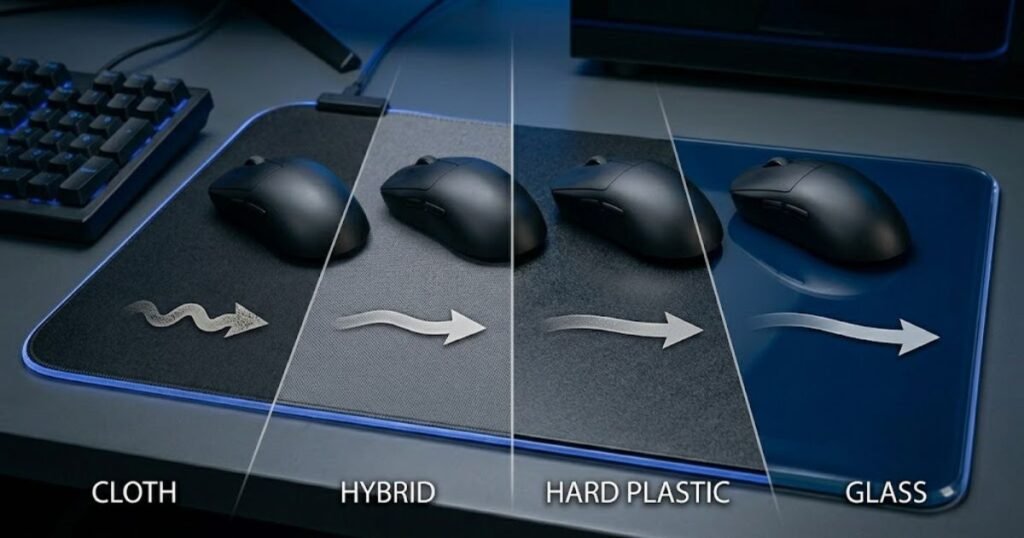
Virgin PTFE skates perform particularly well on cloth surfaces because they glide smoothly without becoming excessively slippery. This combination explains why the majority of competitive FPS players continue to use cloth mouse pads together with high-quality PTFE skates.
Although cloth pads gradually wear over time, they remain the safest and most forgiving choice for gamers seeking consistent aiming performance across different game genres.
Overall, cloth mouse pads deliver the most versatile environment for aftermarket mouse skates and remain the benchmark for competitive gaming.
Hybrid Mouse Pads Balance Speed and Precision
Hybrid mouse pads are designed to sit between traditional cloth and hard surfaces, offering faster glide without completely sacrificing stopping control. Their denser weave or specialized coating reduces friction while still providing enough resistance for controlled aiming.
Because hybrid surfaces respond differently depending on skate material, players often notice greater variation in glide characteristics than they would on cloth pads. Virgin PTFE generally remains well balanced, while faster materials such as glass can feel significantly quicker on hybrid surfaces.
Hybrid mouse pads are an excellent option for players who want more speed than cloth without committing to the extremely low friction associated with hard surfaces.
For gamers looking to fine-tune glide characteristics, hybrid mouse pads provide one of the most flexible compromises available.
Hard Plastic Mouse Pads Reduce Surface Friction
Hard plastic mouse pads create less friction than cloth surfaces, allowing gaming mouse skates to glide more freely across the surface. This results in faster movement and lighter hand effort during long gaming sessions.
However, reduced friction also means players receive less natural stopping assistance. Precision becomes increasingly dependent on hand control rather than surface resistance, making hard pads more suitable for gamers who intentionally prefer faster glide characteristics.
Because hard plastic surfaces are less forgiving than cloth, choosing high-quality skates with smooth edges becomes even more important for maintaining consistent movement.
Hard plastic mouse pads are best suited for players who prioritize speed while remaining comfortable with lower stopping resistance.
Glass Mouse Pads Demand the Right Mouse Skates
Glass mouse pads generate extremely low friction, making skate compatibility more important than on any other surface. Not every mouse skate material is designed to perform optimally on glass, and some combinations may accelerate wear or produce inconsistent glide.
For this reason, manufacturers often recommend using skates specifically designed for glass surfaces rather than relying on standard aftermarket options. Matching the appropriate skate material to a glass pad helps preserve smooth movement while minimizing unnecessary wear on both components.
Surface consistency also plays an important role in modern mouse performance. Technologies such as Motion Sync can improve how movement data is synchronized, but they cannot compensate for poor physical interaction between the mouse skates and the mouse pad.
Glass mouse pads offer exceptional glide, but achieving consistent performance requires selecting compatible skates and maintaining both surfaces properly.
The table below compares how different gaming mouse skate materials interact with common mouse pad surfaces:
| Mouse Pad Surface | Virgin PTFE | Glass Skates | Ceramic Skates |
|---|---|---|---|
| Cloth | Excellent balance of speed and control | Very fast with reduced stopping power | Smooth and durable |
| Hybrid | Balanced and consistent | Fast and responsive | Stable with moderate speed |
| Hard Plastic | Fast glide with predictable control | Extremely low friction | Fast and durable |
| Glass | Compatible only with selected models | Depends on manufacturer recommendations | Requires compatibility verification |
Choosing gaming mouse skates without considering the mouse pad often leads to disappointing results. The best glide experience comes from selecting a skate material that complements the characteristics of your mouse pad rather than evaluating either component independently.
How to Choose the Best Gaming Mouse Skates for Your Gaming Setup
The best gaming mouse skates are the ones that complement your mouse pad, aiming style, and long-term preferences rather than simply offering the fastest glide. Because every player uses different sensitivity settings, grip styles, and playing surfaces, there is no universally perfect mouse skate. A well-matched combination creates a predictable glide that supports consistent aim instead of forcing you to adapt to unfamiliar movement characteristics.
Rather than choosing skates based solely on marketing claims or material type, start by evaluating how your current setup feels. If your mouse already tracks comfortably but feels slightly slow, a faster skate may be enough. If the mouse feels difficult to control after upgrading, the problem is often an imbalance between the skate material and the mouse pad instead of the skates themselves.
If you’re building or upgrading an entire competitive setup, our complete Gaming Mouse for FPS Games guide explains how mouse skates fit alongside other important hardware decisions.
Choose Based on Your Mouse Pad
Your mouse pad should always be the first factor when selecting aftermarket mouse skates because it determines how much friction the skates will generate during gameplay. Even premium skates can feel too fast or too slow when paired with the wrong surface.
Choosing the right mouse skates depends on several factors working together:
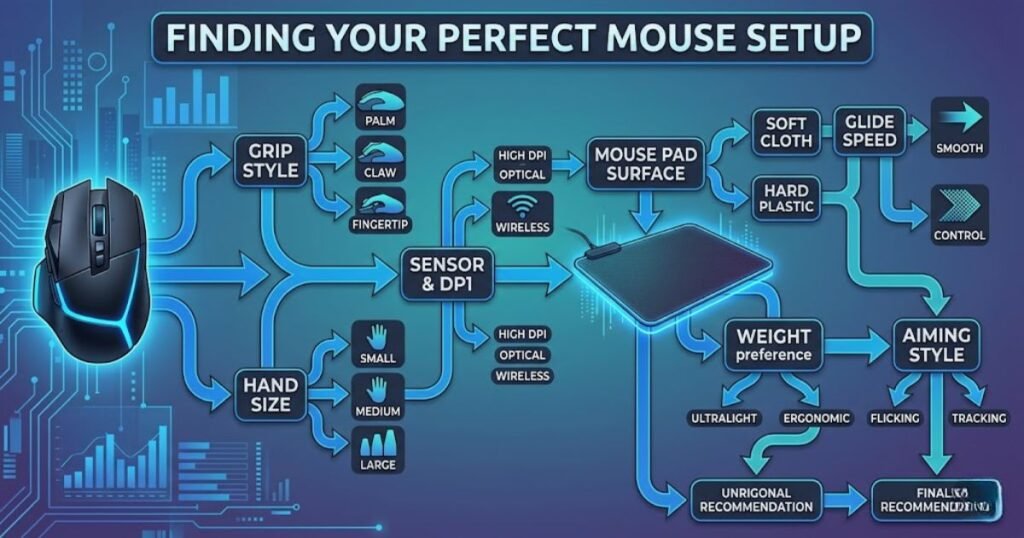
Players using cloth mouse pads usually benefit from balanced materials such as virgin PTFE because they preserve both glide speed and stopping control. Those using hard or hybrid surfaces may prefer different combinations depending on whether they prioritize faster movement or additional precision. Glass mouse pads require even greater attention because not every skate material is designed for long-term compatibility.
Selecting skates that match your mouse pad ensures the entire setup works together as a unified system rather than as unrelated components.
Choose Based on Your Preferred Aim Style
Your aiming style has a significant influence on which glide characteristics feel the most natural. Players who rely on rapid target switching often prefer lower friction, while those who emphasize crosshair placement and controlled flicks generally benefit from slightly more stopping resistance.
Arm aimers using lower sensitivity typically perform long swipes across the mouse pad and may appreciate smoother glide over larger distances. Wrist aimers who make frequent micro adjustments often prioritize stability and precise stopping control over maximum speed. Neither approach is objectively superior, as the ideal skate depends entirely on how you naturally aim.
Choosing skates that reinforce your existing muscle memory is usually more effective than chasing the fastest available option.
Choose Based on Maintenance and Durability
Long-term maintenance is another important consideration because different skate materials wear at different rates and require different levels of care. Some players prioritize longevity, while others simply want the most consistent glide regardless of replacement frequency.
Virgin PTFE gradually wears with normal use but remains easy to replace and widely available for most gaming mice. Harder materials such as ceramic or sapphire typically last much longer, although they may require greater attention to mouse pad compatibility. Keeping both the mouse skates and mouse pad clean is equally important, since accumulated dust and debris increase friction regardless of the material used.
Considering durability alongside performance helps reduce maintenance while preserving consistent glide over months of regular gameplay.
The following process can help you choose the right gaming mouse skates:
- Identify Your Mouse Pad: Determine whether you use a cloth, hybrid, hard plastic, or glass surface before comparing skate materials.
- Evaluate Your Aim Style: Decide whether you prefer faster glide, stronger stopping control, or a balanced combination of both.
- Select the Appropriate Material: Choose a skate material that complements your preferred glide characteristics instead of chasing maximum speed.
- Consider Durability: Think about how often you’re willing to replace skates and how much maintenance your setup requires.
- Verify Mouse Compatibility: Purchase skates specifically designed for your mouse model to ensure proper fit and even pressure distribution.
Following a structured decision process reduces guesswork and helps you select gaming mouse skates that improve your overall experience instead of introducing unnecessary changes to your aiming technique.
Common Mistakes to Avoid When Replacing Gaming Mouse Skates
Most problems with aftermarket gaming mouse skates are caused by installation mistakes rather than the skates themselves. Even high-quality skates can feel inconsistent if they are installed incorrectly, mounted on a dirty surface, or paired with unrealistic expectations. Avoiding these common mistakes helps preserve glide consistency and ensures you experience the performance improvements the skates are designed to provide.
Replacing mouse skates is a relatively simple process, but taking a few extra minutes during installation can significantly improve long-term performance and prevent unnecessary wear.
Some players mistake inconsistent glide for sensor problems when the real issue is poor installation or uneven friction. Understanding how factors like sensor smoothing differ from physical glide characteristics makes troubleshooting much easier.
Leaving Adhesive Residue Behind
Old adhesive residue prevents new mouse skates from sitting perfectly flat, creating uneven pressure across the mouse pad. Even small pieces of leftover adhesive can alter glide consistency and reduce the lifespan of replacement skates.
Before installing new skates, carefully remove the original adhesive and clean the surface using an appropriate cleaning solution. A clean base allows the new skates to adhere evenly and perform as intended.
Proper surface preparation is one of the simplest ways to achieve smooth and consistent glide immediately after installation.
Installing Mouse Skates Incorrectly
Improper alignment can cause uneven contact with the mouse pad, resulting in inconsistent movement and premature wear. Each skate should fit precisely within its designated recess without overlapping edges or leaving visible gaps.
Applying excessive pressure during installation or repositioning adhesive-backed skates multiple times may also reduce adhesive strength. Taking time to align each skate correctly produces a more stable and predictable glide.
Accurate installation ensures the skates perform as designed throughout their expected lifespan.
Ignoring the Break-In Period
Many new gaming mouse skates require a short break-in period before reaching their intended glide characteristics. Fresh PTFE skates, in particular, may initially feel slightly faster or rougher until the surface becomes evenly polished through regular use.
Replacing the skates and immediately judging their performance can lead to incorrect conclusions about their quality. Allowing a reasonable break-in period provides a more accurate representation of how they will feel during long-term gameplay.
Patience during the first few gaming sessions helps you evaluate the true performance of new mouse skates.
Choosing Skates That Do Not Match the Mouse Pad
Even premium mouse skates can produce disappointing results when paired with an incompatible mouse pad. Selecting skates without considering the characteristics of the underlying surface often creates either excessive friction or insufficient stopping control.
Compatibility should always be evaluated as part of the entire gaming setup rather than treating each component independently. A balanced combination generally delivers more consistent performance than choosing the fastest or most expensive skates available.
Matching your skates to your mouse pad remains one of the most effective ways to maximize both comfort and aiming consistency.
The mistakes below are the most common causes of poor mouse skate performance:
- Skipping Surface Cleaning: Leaving dust or adhesive behind prevents proper installation.
- Incorrect Alignment: Uneven placement creates inconsistent pressure across the mouse pad.
- Ignoring Break-In Time: Judging new skates too early may lead to inaccurate conclusions.
- Poor Surface Compatibility: Choosing skates without considering the mouse pad reduces overall performance.
- Neglecting Regular Cleaning: Dirt buildup gradually increases friction regardless of skate material.
A careful installation process and proper maintenance routine allow aftermarket gaming mouse skates to deliver smooth, predictable glide throughout their service life while minimizing unnecessary wear.
Are Aftermarket Gaming Mouse Skates Worth Upgrading?
Yes, aftermarket gaming mouse skates are worth upgrading if your original skates are worn, inconsistent, or no longer match your preferred glide characteristics. However, replacing mouse skates should be viewed as a refinement rather than a dramatic performance upgrade. Premium skates cannot compensate for poor aiming fundamentals, but they can provide a smoother, more predictable glide that helps experienced players maintain consistency.
The value of an upgrade depends on your current setup and expectations. Players using heavily worn stock skates often notice an immediate improvement in smoothness, while those already using high-quality aftermarket skates may experience only subtle differences when switching materials.
Casual Players
Casual gamers do not need to replace mouse skates frequently, but upgrading becomes worthwhile once the original skates begin showing signs of wear. If everyday mouse movement feels rough, noisy, or inconsistent, replacing the skates is usually more cost-effective than replacing the entire mouse.
For most casual players, high-quality virgin PTFE skates offer the best balance of affordability, durability, and compatibility. They restore the original glide characteristics without introducing an adjustment period associated with more specialized materials.
Unless you notice clear signs of wear, upgrading mouse skates should be considered an optional improvement rather than an essential purchase.
Competitive FPS Players
Competitive FPS players benefit the most from aftermarket gaming mouse skates because consistent glide directly supports repeatable aiming and muscle memory. Even minor variations in friction become noticeable after hundreds of hours of practice, particularly during tracking, flick shots, and precision micro adjustments.
The comparison below illustrates the difference between worn stock skates and quality aftermarket replacements:
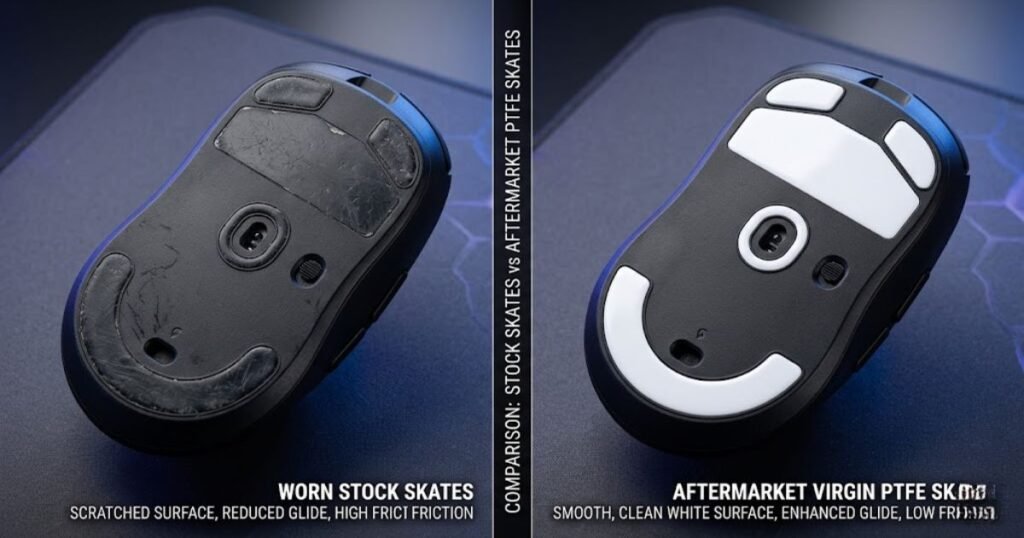
Replacing worn skates before they develop uneven edges helps maintain predictable movement across the entire mouse pad. Many experienced players also choose aftermarket skates because they offer tighter manufacturing tolerances and higher-quality materials than standard factory-installed feet.
For players focused on long-term aiming consistency, replacing mouse skates is one of the most practical hardware upgrades available.
Esports Players
Professional and semi-professional players often treat mouse skates as consumable components that require periodic replacement to preserve a familiar glide profile. Consistency is significantly more valuable than experimenting with dramatically different glide characteristics before tournaments or important practice sessions.
Many esports players replace their skates proactively rather than waiting for obvious wear. Doing so minimizes changes in friction over time and helps maintain the same feel throughout months of competition. The goal is not maximum speed, but predictable performance under pressure.
For high-level competition, maintaining consistent hardware often matters more than constantly searching for new equipment.
To better understand why stable physical movement works together with accurate sensor performance, you can also read our guide explaining Lift-Off Distance (LOD) and how it influences tracking behavior during gameplay.
The table below explains who benefits most from upgrading gaming mouse skates:
| Player Type | Upgrade Recommendation | Primary Benefit |
|---|---|---|
| Casual Gamer | Upgrade only when stock skates wear out | Restore smooth and consistent glide |
| Regular FPS Player | Recommended | Improve aiming consistency and comfort |
| Competitive FPS Player | Highly Recommended | Maintain reliable muscle memory |
| Esports Player | Routine Maintenance | Preserve identical glide characteristics over time |
Aftermarket gaming mouse skates deliver the greatest value when they solve a specific problem, such as worn stock feet or inconsistent glide. For competitive players, maintaining consistent movement is often more important than achieving the fastest possible glide.
Which Gaming Mouse Skate Brands Are Trusted by Competitive Players?
Several aftermarket manufacturers have earned strong reputations by producing high-quality gaming mouse skates with consistent materials, precise manufacturing, and reliable compatibility. Rather than focusing on marketing claims, experienced players typically choose brands known for manufacturing consistency and predictable glide characteristics.
Although every brand has its own design philosophy, the differences are generally smaller than the differences between skate materials or mouse pad surfaces. Selecting a reputable manufacturer helps ensure accurate dimensions, smooth edge finishing, and dependable adhesive quality.
Corepad
Corepad is widely recognized for producing balanced virgin PTFE skates that emphasize control, consistency, and broad compatibility. Their products are available for a large number of gaming mice and are commonly recommended for players seeking a dependable all-around upgrade.
Corepad skates are especially popular among gamers who want predictable glide without dramatically changing the original feel of their mouse.
Overall, Corepad remains one of the safest choices for players upgrading from stock mouse feet.
Tiger Gaming
Tiger Gaming offers several PTFE product lines with different glide characteristics, allowing players to choose between greater speed or stronger control. This variety makes the brand popular among enthusiasts who enjoy fine-tuning their setup instead of using a one-size-fits-all solution.
Different Tiger Gaming series are designed to satisfy different preferences while maintaining consistent manufacturing quality.
The brand is well suited for gamers looking for more customization than standard aftermarket skates typically provide.
X-Raypad
X-Raypad manufactures both gaming mouse pads and aftermarket mouse skates, giving the company extensive experience in surface interaction and glide characteristics. Their PTFE skates are known for smooth edge finishing and reliable compatibility with a wide range of gaming mice.
Players already using X-Raypad mouse pads often appreciate the company’s understanding of how skates and surfaces work together as a complete system.
X-Raypad remains a respected choice for players seeking balanced aftermarket upgrades.
Pulsar Superglide
Pulsar Superglide is best known for its glass mouse skates, which prioritize extremely fast glide and minimal friction. These products appeal primarily to enthusiasts who intentionally seek ultra-low resistance rather than a traditional PTFE experience.
Because glass skates create a very different glide profile, they are generally recommended for players who already understand their preferred aiming style and mouse pad compatibility.
Pulsar Superglide demonstrates how specialized skate materials can serve different gameplay preferences rather than replacing traditional PTFE.
Other Reputable Manufacturers
Several smaller manufacturers also produce excellent aftermarket gaming mouse skates, provided they use high-quality materials and maintain precise manufacturing standards. Instead of selecting a brand solely because it is popular, evaluate the quality of the material, edge finishing, adhesive, and compatibility with your specific mouse model.
If you’re also comparing complete gaming mice rather than individual upgrades, our Top Best Gaming Mouse for FPS Games guide highlights complete mouse recommendations for different competitive playstyles.
Choosing a reputable manufacturer helps ensure your replacement skates deliver consistent performance throughout their lifespan.
The table below compares several trusted gaming mouse skate manufacturers:
| Brand | Primary Material | Known For | Best Suited For |
|---|---|---|---|
| Corepad | Virgin PTFE | Balanced glide and broad compatibility | Most FPS players |
| Tiger Gaming | Virgin PTFE | Multiple glide profiles | Users seeking customization |
| X-Raypad | Virgin PTFE | Smooth edge finishing and consistency | Balanced all-around performance |
| Pulsar Superglide | Glass | Ultra-fast glide | Experienced enthusiasts |
While brand reputation is important, material quality, manufacturing precision, and compatibility with your mouse have a much greater impact on long-term performance. Selecting a reputable manufacturer simply increases the likelihood that your replacement skates will deliver the consistent glide you expect.
Frequently Asked Questions About Gaming Mouse Skates
Choosing gaming mouse skates often raises practical questions about performance, compatibility, durability, and maintenance. The answers below address the most common concerns from FPS players and expand on topics that have not been covered in detail throughout this guide.
Do gaming mouse skates wear out?
Yes, gaming mouse skates gradually wear down through regular use. Friction slowly removes material from the skates, reducing glide consistency over time. The lifespan depends on the skate material, mouse pad surface, usage frequency, and maintenance habits.
How often should I replace gaming mouse skates?
There is no fixed replacement schedule because wear varies between users. Replace your skates when you notice uneven glide, visible wear, rough edges, inconsistent movement, or damage that affects aiming consistency.
Can gaming mouse skates improve aim?
Gaming mouse skates cannot improve your aiming skill directly, but they can improve movement consistency. Predictable glide makes it easier to develop reliable muscle memory and reduces unwanted variations caused by worn or damaged mouse feet.
Are aftermarket mouse skates better than stock mouse feet?
Many aftermarket skates use higher-quality materials and tighter manufacturing tolerances than standard stock skates. However, whether they feel better depends on your preferred glide characteristics, mouse pad, and overall gaming setup.
Can I install gaming mouse skates myself?
Yes. Most aftermarket mouse skates are designed for simple installation. Carefully remove the original skates, clean away any remaining adhesive, and apply the new skates according to the manufacturer’s alignment instructions.
Do gaming mouse skates affect DPI or sensor accuracy?
No. Mouse skates do not change the sensor’s DPI or tracking accuracy. Their role is to create smoother and more consistent physical movement, allowing the sensor to operate under stable conditions.
Can I clean gaming mouse skates?
Yes. Regular cleaning helps maintain consistent glide. Remove dust and debris using a soft microfiber cloth or other non-abrasive cleaning materials. Keeping both the skates and mouse pad clean reduces unnecessary friction.
Are glass mouse skates always faster than PTFE?
In most situations, yes, but speed depends on the complete setup. Mouse pad texture, humidity, and surface condition all influence how glass skates perform. Faster movement does not necessarily result in better aiming performance.
Do mouse skates work on every mouse pad?
Most mouse skates work across multiple surfaces, but compatibility varies. Certain materials perform better on cloth, while others are optimized for hard or glass mouse pads. Always verify manufacturer recommendations before purchasing.
Should I choose full-size skates or dot skates?
The better option depends on your preferences. Full-size skates generally provide greater stability and easier installation, while dot skates offer additional customization and can reduce overall surface contact.
Do premium gaming mouse skates last longer?
Premium skates often use higher-quality materials that wear more consistently over time. However, actual lifespan still depends on your mouse pad, playing style, maintenance routine, and gaming hours.
Are gaming mouse skates worth upgrading for FPS games?
For players who value consistent aim and smooth glide, upgrading gaming mouse skates is often worthwhile. While they will not instantly improve skill, replacing worn or low-quality skates can restore predictable movement and provide a more consistent aiming experience.
Conclusion
Gaming mouse skates are a small component that can make a meaningful difference in how a gaming mouse performs. Their material, design, and compatibility with your mouse pad all influence glide consistency, stopping control, and the overall feel of every movement. Rather than searching for the fastest or most expensive option, the goal should be finding a combination that supports your preferred aiming style and remains consistent over time.
Whether you are replacing worn stock mouse feet or exploring aftermarket upgrades for the first time, understanding how gaming mouse skates interact with the rest of your setup allows you to make more informed purchasing decisions. A balanced combination of the right skates, a suitable mouse pad, and proper maintenance will usually provide greater long-term benefits than changing a single component in isolation.
By focusing on consistency instead of marketing claims, you can build a gaming setup that feels predictable, comfortable, and reliable across every match.
Thank you for reading this guide. We hope it helps you choose the right gaming mouse skates for your setup.