
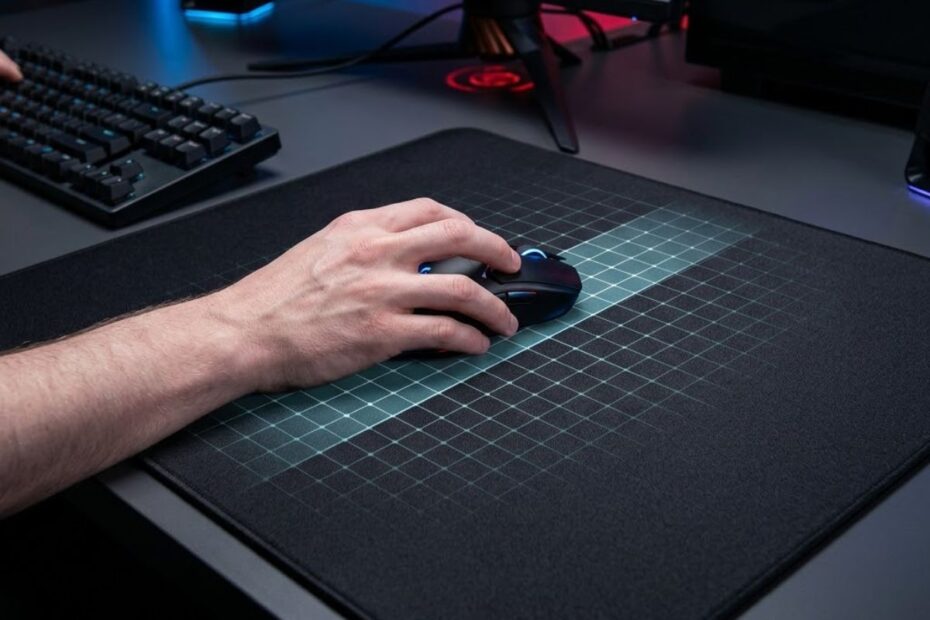
Surface consistency is the ability of a mouse pad to maintain the same glide characteristics, tracking response, and resistance across its entire surface. For FPS players, a consistent surface helps create predictable mouse movement, stronger muscle memory, and more reliable aiming performance over time.
Many players focus on mouse sensors, DPI settings, polling rates, or sensitivity values when trying to improve their aim. While those factors are important, the surface underneath the mouse also plays a major role in determining how predictable each movement feels during gameplay.
A gaming mouse pad can be fast, slow, or highly controlled, but none of those characteristics matter as much if the surface behaves differently across the pad. When glide characteristics change from one area to another, players often experience inconsistent tracking, unreliable flicks, and reduced confidence during important moments.
If you are still learning how different mouse pad characteristics influence aiming performance, it helps to first understand what makes a gaming mouse pad for FPS games different from a standard desk mat. Surface consistency is one of the key traits that separates a competitive gaming surface from an ordinary one.
In this guide, you will learn what surface consistency means, why it matters in FPS games, and how it affects real-world aiming performance.
What Does Surface Consistency Mean on a Gaming Mouse Pad?
Surface consistency is the degree to which every area of a gaming mouse pad delivers the same glide, resistance, and tracking response during gameplay. A highly consistent surface helps the mouse feel predictable regardless of where movement occurs on the pad.
For example, the image below shows how a uniform surface maintains similar glide characteristics across the entire mouse pad:
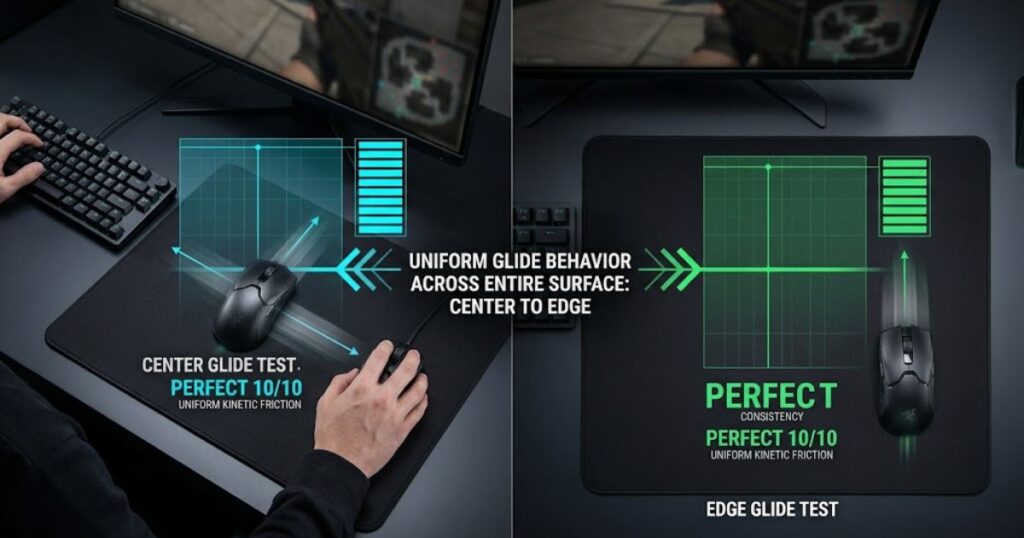
When FPS players move their mouse across different parts of the pad, they expect similar feedback from start to finish. If one section feels smoother while another feels rougher, the mouse can behave differently even when the player performs the same physical movement.
This is why surface consistency is often considered a quality indicator rather than a speed indicator. A surface can be extremely fast or extremely controlled while still being consistent if the glide characteristics remain uniform throughout the usable area.
How Surface Consistency Is Measured
Surface consistency is measured by how uniform the glide, resistance, and tracking experience remain across the entire mouse pad. The goal is not to create the fastest surface possible but to create a surface that behaves the same way everywhere.
Manufacturers often evaluate consistency by examining surface texture, material density, and production quality. A well-made gaming mouse pad should provide similar resistance whether the mouse moves near the center, edges, or corners.
Players usually notice consistency through experience rather than technical testing. If repeated movements feel identical regardless of mouse position, the surface is likely maintaining a high level of consistency.
Because FPS aiming relies heavily on repeatable movements, consistency often becomes more valuable than raw speed once players develop stronger mechanics.
As a result, surface consistency is best evaluated through uniform performance rather than a single glide speed measurement.
What Creates Surface Inconsistency
Surface inconsistency occurs when different parts of a mouse pad produce different glide characteristics or tracking behavior. These variations can develop gradually or exist from the beginning due to manufacturing quality.
Uneven stitching, inconsistent material density, surface contamination, and long-term wear are common causes of inconsistency. Even small differences can affect how the mouse feels during large swipes or repeated aiming motions.
Environmental conditions can also contribute to inconsistent behavior. Humidity, sweat, and accumulated dust may alter the surface texture in specific areas while leaving other areas unchanged.
Over time, these changes can create sections that feel faster, slower, smoother, or rougher than the rest of the pad.
Understanding what causes inconsistency makes it easier to recognize why some mouse pads remain reliable for years while others lose performance much sooner.
Why Consistency Is Different From Surface Feel
Surface feel describes how a mouse pad feels during use, while surface consistency describes whether that feeling remains stable across the entire pad. These characteristics are related but should not be confused.
A mouse pad may feel extremely smooth, rough, fast, or controlled. Those qualities define the overall surface feel. However, that feel only becomes valuable when it remains uniform throughout the usable area.
For example, a control-oriented cloth pad may provide excellent stopping power while still suffering from inconsistent glide between heavily used and lightly used areas. Likewise, a fast surface can remain highly consistent if every section behaves similarly.
Many players judge a mouse pad based on first impressions alone. However, long-term consistency often has a greater impact on aiming performance than the initial feel of the surface.
To better understand the broader role of gaming surfaces in FPS performance, it also helps to learn what a gaming mouse pad is and how different design elements affect gameplay.
Ultimately, surface feel influences preference, while surface consistency influences predictability and long-term performance.
Surface consistency forms the foundation of reliable mouse movement because it ensures the pad behaves the same way regardless of where or how the mouse travels across the surface.
Why Surface Consistency Creates More Predictable Mouse Movement
Surface consistency helps create more predictable mouse movement by keeping glide, resistance, and tracking behavior stable across the entire pad. When the surface remains uniform, players can expect the same physical movement to produce the same in-game result.
Predictability is one of the most important qualities in FPS aiming. Tracking targets, controlling recoil, and landing flick shots all depend on the ability to repeat movements accurately. A consistent surface removes unnecessary variables that can interfere with that process.
Instead of adapting to changing glide characteristics, players can focus entirely on target positioning, movement timing, and mechanical execution.
The table below explains how surface consistency influences common FPS aiming tasks:
| FPS Aiming Task | Consistent Surface | Inconsistent Surface |
|---|---|---|
| Tracking | Movement remains stable throughout long target follow | Tracking speed can vary across the pad |
| Flick Shots | Stopping points feel more repeatable | Similar flicks may overshoot or undershoot |
| Micro Adjustments | Small corrections remain predictable | Corrections may feel too fast or too slow |
| Muscle Memory | Repeated movements reinforce reliable habits | Mixed feedback disrupts movement learning |
| Aim Confidence | The setup feels trustworthy under pressure | Players may hesitate or overcorrect |
The comparison above shows that surface consistency influences far more than comfort. It directly affects how reliably players can perform the same aiming actions throughout a match.
Because competitive FPS games reward precision and repeatability, even small surface variations can become noticeable over time.
In short, predictable mouse movement is one of the biggest advantages of a consistent gaming surface.
How Consistent Surfaces Improve Tracking Accuracy
Consistent surfaces improve tracking accuracy by helping the mouse move at a stable pace while following a target. This allows players to maintain smoother crosshair movement without constantly compensating for changing glide characteristics.
Tracking requires continuous control over movement speed and direction. If one area of the mouse pad feels slower than another, the hand may apply extra force without realizing it. When the surface suddenly becomes faster again, the crosshair can drift away from the target.
These small differences are often difficult to notice consciously, but they can affect overall tracking performance during long gaming sessions. The more frequently a player performs tracking movements, the easier it becomes to detect inconsistent surface behavior.
A stable surface helps create a cleaner relationship between physical hand movement and on-screen cursor movement. This consistency allows players to develop stronger movement habits through repetition.
Players who want to understand how surface quality influences overall aiming performance can also explore how mouse pads affect aim consistency in competitive FPS games.
As a result, surface consistency helps reduce unexpected tracking errors and allows players to maintain smoother target follow during gameplay.
How Consistent Surfaces Improve Flick Shot Precision
Consistent glide supports flick shot precision by making the start, travel, and stopping phases of a flick feel more repeatable. When the surface behaves the same way throughout the pad, players can better predict where their crosshair will stop after each movement.
Flick shots rely heavily on timing and force application. Players develop an understanding of how much speed and distance are required to move from one target to another. That understanding becomes less reliable when different sections of the mouse pad generate different amounts of resistance.
For example, a player may perform the same flick motion twice but receive different outcomes because one movement passes through a slower section of the pad while the other travels across a smoother area. Even minor variations can influence stopping accuracy in tactical FPS games.
Because flicking is based on repetition, consistent glide helps reinforce the relationship between physical hand movement and crosshair placement.
As a result, players can develop more repeatable flick mechanics and achieve greater confidence when reacting to sudden targets.
How Consistent Feedback Builds Better Muscle Memory
Consistent feedback strengthens muscle memory by ensuring that repeated movements generate similar physical sensations over time. The brain learns aiming patterns more effectively when the surface behaves predictably during practice and competition.
Muscle memory develops through repetition. Every tracking movement, flick shot, and micro adjustment teaches the brain how much force is needed to achieve a desired result. When surface behavior changes unexpectedly, that learning process becomes less efficient.
Players often describe this problem as feeling “off” even when their sensitivity settings remain unchanged. In many cases, the issue is not the mouse itself but the inconsistent feedback being provided by the surface underneath it.
A consistent gaming surface allows players to build stronger movement habits because the feedback remains stable from one session to the next.
Over time, this stability helps transform conscious aiming adjustments into more natural and automatic movements.
Reliable tracking, repeatable flicks, and stronger muscle memory all depend on predictable surface behavior. This is why surface consistency remains one of the most important long-term performance characteristics of a gaming mouse pad.
Why Surface Consistency Matters More During Competitive Matches
Surface consistency becomes more important during competitive matches because pressure exposes small aiming weaknesses that may go unnoticed during casual play. When every shot matters, even minor surface variations can affect confidence and execution.
During ranked games and tournaments, players rely heavily on established habits and muscle memory. They expect their setup to behave exactly as it did during practice. If the mouse pad responds differently across certain areas, those expectations become harder to trust.
While casual gaming may hide small inconsistencies, competitive environments often magnify them. The faster the pace of the game and the higher the skill level of opponents, the more noticeable those differences become.
The example below illustrates how small surface variations can influence aiming precision during competitive FPS situations:
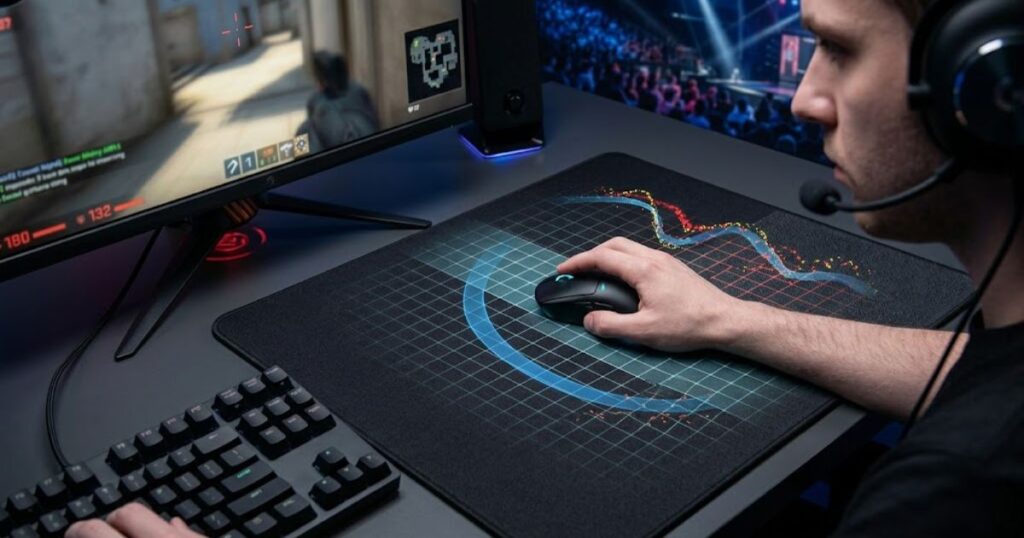
For this reason, many experienced FPS players value long-term consistency as much as speed or control when choosing a gaming mouse pad.
Why Small Surface Differences Become Noticeable Under Pressure
Small surface differences become more noticeable under pressure because players perform movements with greater precision and higher expectations. Competitive situations leave less room for adjustment and compensation.
In casual matches, players may not pay attention to subtle glide changes because the outcome of individual engagements is less important. However, ranked and tournament environments often demand near-perfect execution.
A slight difference in stopping distance or tracking behavior may only affect a few pixels on screen, but those pixels can determine whether a shot lands or misses. As a result, inconsistencies that seem insignificant during practice can become frustrating during competition.
Pressure does not create inconsistency. It simply makes existing inconsistencies easier to detect.
That is why competitive players often notice surface issues long before casual players do.
Why Repeated Movements Depend on Surface Stability
Repeated movements depend on surface stability because FPS aiming is built around performing the same actions consistently. The more frequently a movement is repeated, the more important stable surface behavior becomes.
Whether tracking a strafing opponent or clearing common angles, players constantly rely on familiar movement patterns. Those patterns become reliable only when the mouse pad delivers consistent feedback every time.
When glide characteristics change across the surface, players must unconsciously adapt to different movement conditions. That adaptation increases workload and reduces overall efficiency.
Stable surfaces reduce the need for constant correction by allowing players to trust the results of familiar movements.
Because competitive FPS games reward consistency, stable movement conditions often produce more reliable performance over time.
How Surface Consistency Improves Aim Confidence
Surface consistency improves aim confidence by making mouse movement feel trustworthy during high-pressure situations. Players perform better when they believe their setup will respond predictably.
Confidence plays a larger role in aiming than many players realize. When a setup feels inconsistent, players may second-guess their movements, hesitate before taking shots, or overcompensate during corrections.
A consistent surface helps remove those doubts. Because the mouse behaves predictably, players can focus on decision-making, positioning, and target acquisition instead of worrying about equipment performance.
Confidence does not guarantee accuracy, but it allows players to execute mechanics more naturally. That advantage becomes increasingly important as competition becomes more demanding.
Ultimately, surface consistency supports confidence by giving players one less variable to worry about during important engagements.
Competitive environments highlight the true value of surface consistency. The more players rely on precision, repetition, and confidence, the more important predictable surface behavior becomes for maintaining performance.
Surface Consistency vs Friction vs Stopping Power Explained
Surface consistency, friction, and stopping power influence mouse movement differently and should not be treated as interchangeable characteristics. While all three affect how a mouse feels during gameplay, they solve different performance needs.
Many FPS players confuse these terms because they are often discussed together in mouse pad reviews. However, understanding the difference is important when evaluating why a surface feels reliable or inconsistent over time.
A mouse pad can have high stopping power while maintaining excellent consistency. Likewise, a fast pad can have low friction but still provide highly predictable glide. Each characteristic contributes something unique to the overall experience.
The table below compares surface consistency, friction, and stopping power in FPS gaming:
| Characteristic | What It Measures | Primary Goal |
|---|---|---|
| Surface Consistency | Uniformity across the surface | Predictability |
| Friction | Amount of movement resistance | Glide speed |
| Stopping Power | Ability to slow and stop movement | Control |
The comparison shows that consistency focuses on repeatability, friction focuses on movement resistance, and stopping power focuses on control. Understanding these differences makes it easier to choose a mouse pad based on actual performance needs.
Although these characteristics influence one another, they should be evaluated independently when assessing a gaming surface.
What Surface Consistency Actually Measures
Surface consistency measures how uniformly a mouse pad behaves across its entire usable area. It evaluates whether glide, resistance, and tracking conditions remain stable regardless of where movement occurs.
A highly consistent surface produces similar feedback from edge to edge. This allows players to build reliable movement habits because every swipe feels familiar.
Unlike speed or control, consistency does not describe how the surface feels. Instead, it describes how stable that feeling remains over time and across different areas of the pad.
Because consistency supports repeatability, it directly contributes to long-term aiming reliability.
For this reason, consistency is often viewed as a quality characteristic rather than a preference characteristic.
What Friction Actually Measures
Friction measures the amount of resistance encountered while moving a mouse across a surface. Higher friction generally creates a slower and more controlled glide experience, while lower friction creates a faster feeling surface.
Friction primarily affects movement speed rather than movement predictability. Two mouse pads may provide identical friction levels while delivering very different levels of consistency.
This is why friction alone cannot determine whether a surface will feel reliable during extended gameplay. A pad may offer excellent control but still feel inconsistent if resistance varies across different areas.
Players should view friction as a preference-related characteristic rather than a direct indicator of surface quality.
Ultimately, friction influences how movement feels, while consistency influences whether that feeling remains dependable.
What Stopping Power Actually Measures
Stopping power measures how effectively a surface helps players slow down and stop mouse movement. It is one of the most important characteristics for players who rely on precise flick shots and controlled crosshair placement.
Surfaces with strong stopping power typically create additional resistance when players attempt to stop quickly. This can make it easier to avoid overshooting targets during high-precision aiming situations.
However, stopping power does not automatically guarantee consistency. A mouse pad can provide excellent stopping control while still developing uneven glide zones over time.
Because of this, stopping power should be evaluated separately from consistency when choosing a gaming surface.
Strong stopping power improves control, while strong consistency improves repeatability. The best FPS mouse pads often provide a balance of both characteristics.
Understanding these three concepts separately helps players evaluate gaming mouse pads more accurately instead of assuming that one characteristic automatically guarantees another.
What Causes a Mouse Pad to Lose Surface Consistency Over Time?
Most mouse pads gradually lose surface consistency due to contamination, environmental conditions, and physical wear. Even high-quality surfaces can experience changes if they are used heavily or maintained poorly.
Surface consistency is not a fixed characteristic. It changes as the mouse pad interacts with dust, moisture, skin oils, and repeated friction from daily use. Over time, these factors can create sections that behave differently from the rest of the surface.
Understanding what causes consistency loss helps players recognize performance issues before they begin affecting gameplay significantly.
The table below explains the most common causes of declining surface consistency:
| Cause | Impact On Surface Behavior |
|---|---|
| Dust Accumulation | Creates uneven glide resistance |
| Sweat And Skin Oils | Changes surface texture |
| Humidity | Alters cloth resistance levels |
| Surface Wear | Creates faster and slower zones |
| Physical Damage | Introduces irregular tracking areas |
The causes above affect different mouse pads at different rates. Premium materials often resist these changes better, but no surface is completely immune to long-term wear.
Identifying these factors early can help players preserve more consistent performance for longer periods.
How Dirt And Dust Change Surface Behavior
Dirt and dust reduce surface consistency by creating small areas of increased resistance across the mouse pad. These contaminants often accumulate gradually, making changes difficult to notice at first.
As particles settle into the surface texture, they alter how the mouse feet interact with the pad. Some areas may become slower, while others remain unchanged.
This uneven resistance can affect tracking smoothness and create inconsistent movement feedback during gameplay.
Regular cleaning helps reduce these effects and maintain more stable surface behavior.
Even a high-quality mouse pad can lose consistency if dirt accumulation is ignored for extended periods.
How Humidity Changes Glide Characteristics
Humidity affects surface consistency by changing how cloth materials interact with mouse feet. Some surfaces absorb moisture more easily than others, causing noticeable differences in resistance.
In humid environments, certain sections of a mouse pad may retain moisture longer than others. This can create variations in glide speed across the surface.
Players often notice this effect during long gaming sessions when temperature and moisture levels gradually increase.
Mouse pads designed with stronger environmental resistance typically maintain more stable performance under changing conditions.
For many FPS players, humidity is one of the most overlooked causes of inconsistent glide behavior.
How Surface Wear Creates Uneven Tracking Zones
Surface wear reduces consistency by creating areas that behave differently from the rest of the mouse pad. These worn sections often develop after thousands of repeated mouse movements in the same locations.
Most FPS players naturally use specific regions of their mouse pad more frequently than others. Over time, repeated friction gradually alters the surface texture in those high-use areas. The result is a surface that no longer provides identical glide characteristics across the entire pad.
Worn zones often feel smoother and faster than surrounding areas. In some cases, they may also affect how the mouse sensor interprets movement because the surface texture has changed significantly.
These differences can make familiar aiming motions feel inconsistent, particularly for players who rely on large swipes or low sensitivity settings.
As wear increases, maintaining predictable tracking becomes more difficult because the surface no longer behaves uniformly.
Players interested in understanding how surface changes can influence sensor performance should also explore how mouse pads affect mouse sensors in FPS games.
Ultimately, physical wear is one of the most common reasons a mouse pad loses consistency after extended use.
The factors below explain the most common causes of declining surface consistency:
- Dust buildup: Creates uneven resistance and disrupts glide smoothness.
- Sweat and skin oils: Alter surface texture and affect movement feel.
- Humidity exposure: Changes cloth resistance levels across different areas.
- Surface wear: Produces faster and slower zones over time.
- Physical damage: Introduces irregular tracking conditions.
These factors rarely appear overnight. Instead, they gradually change how the surface behaves until aiming performance begins to feel less predictable.
Understanding the causes of consistency loss makes it easier to identify when a mouse pad needs maintenance, replacement, or a different material choice.
Which Mouse Pad Materials Maintain Better Surface Consistency?
Different mouse pad materials vary significantly in their ability to preserve consistent glide and tracking performance over time. Material quality often determines how well a surface resists wear, humidity, and long-term texture changes.
Some materials maintain nearly identical behavior for years, while others begin developing inconsistent glide characteristics after relatively short periods of heavy use. Choosing the right material can therefore have a major impact on long-term aiming reliability.
Although personal preference still matters, certain materials generally perform better when consistency is the priority.
The table below compares how common mouse pad materials maintain surface consistency over time:
| Material Type | Consistency Retention | Durability | Environmental Resistance |
|---|---|---|---|
| Premium Cloth | High | High | Moderate to High |
| Hybrid Surface | High | High | High |
| Hard Surface | Very High | High | Very High |
| Budget Cloth | Medium | Medium | Low to Medium |
The comparison shows that premium materials generally maintain more predictable glide characteristics over time. However, each material offers different tradeoffs in terms of comfort, control, and maintenance requirements.
Understanding these tradeoffs helps players choose a surface that matches both their aiming preferences and long-term performance expectations.
Premium Cloth Mouse Pads
Premium cloth mouse pads are among the most popular choices for maintaining consistent performance in FPS games. High-quality cloth surfaces are designed to provide uniform texture and predictable glide across the entire pad.
The comparison below highlights how different mouse pad materials vary in consistency retention over time:
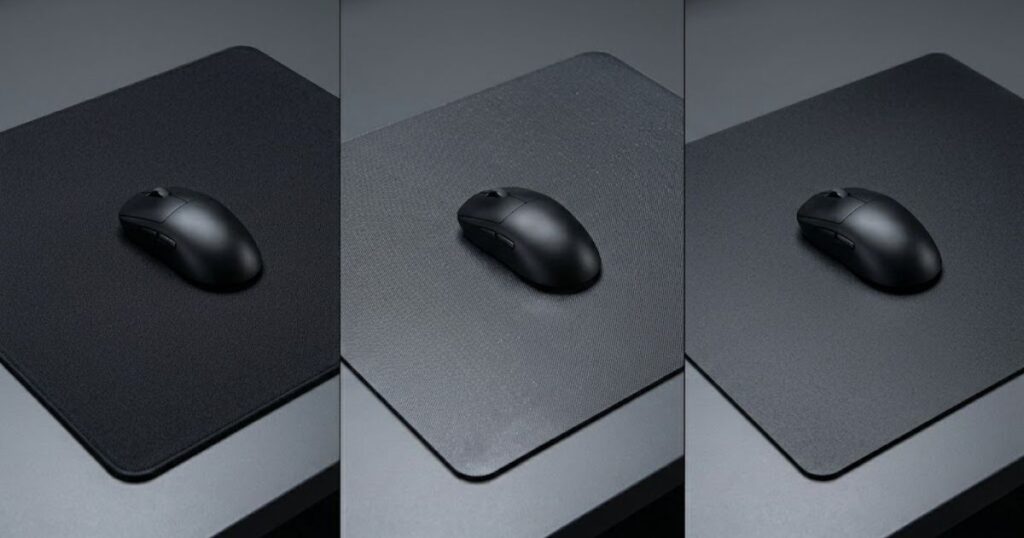
Compared with budget cloth options, premium materials usually feature tighter manufacturing tolerances and more durable surface construction. These improvements help reduce uneven wear and preserve glide characteristics longer.
Many professional FPS players continue using premium cloth surfaces because they offer a strong balance between consistency, comfort, and control.
While cloth materials are still affected by humidity and contamination, premium versions generally resist these issues more effectively.
For players seeking long-term reliability without sacrificing comfort, premium cloth remains one of the strongest options available.
Hybrid Gaming Surfaces
Hybrid mouse pads combine characteristics from cloth and hard surfaces to create a balance between speed, durability, and consistency. Many modern hybrid surfaces are specifically designed to maintain stable glide characteristics under varying conditions.
These materials often feature tighter surface structures that absorb less moisture and resist wear more effectively than traditional cloth pads. As a result, they tend to maintain more uniform behavior during extended use.
Hybrid surfaces are particularly attractive to players who want a faster glide experience without sacrificing long-term consistency.
Although they may feel different from traditional cloth pads, their ability to maintain stable performance is one of their strongest advantages.
For players concerned about environmental changes affecting their setup, hybrid materials can provide a dependable middle ground.
Hard Surface Mouse Pads
Hard surface mouse pads typically offer the highest level of surface consistency because their texture changes very little over time. Unlike cloth materials, hard surfaces absorb virtually no moisture and resist deformation during use.
This stability allows the mouse to experience nearly identical glide conditions across the entire pad. As a result, hard surfaces often deliver exceptionally predictable movement behavior.
However, consistency is only one factor when choosing a mouse pad. Some players prefer the softer feel and greater stopping control offered by cloth surfaces despite their increased maintenance requirements.
Hard surfaces may also generate more noise and produce a faster overall glide experience than some players prefer.
Even so, when surface consistency is the primary goal, hard mouse pads remain among the most stable options available.
Material choice plays a major role in determining how well a mouse pad maintains consistent performance. The better a material resists wear and environmental changes, the more predictable the aiming experience tends to remain over time.
How Can You Tell If a Mouse Pad Has Poor Surface Consistency?
Poor surface consistency usually reveals itself through noticeable changes in glide feel, tracking behavior, and aiming performance. Many players experience these symptoms without realizing that the mouse pad itself may be contributing to the problem.
Unlike obvious hardware failures, consistency problems often develop gradually. Because the changes happen over time, players may mistakenly blame sensitivity settings, poor aim habits, or temporary performance slumps.
Recognizing the warning signs early can help prevent frustration and maintain a more predictable aiming experience.
The signs below can help identify poor surface consistency:
- Uneven glide: Different areas of the mouse pad feel faster or slower.
- Inconsistent tracking: Similar movements produce different crosshair behavior.
- Variable stopping distance: Flick shots stop differently across the surface.
- Reduced aim confidence: The setup feels less predictable than before.
- Performance changes without setting changes: Aim feels different despite identical DPI and sensitivity values.
These symptoms often appear gradually as the surface experiences contamination, wear, or environmental exposure.
Why Does Glide Feel Different Across Certain Areas Of The Mouse Pad?
Glide usually feels different across certain areas because the surface has developed uneven wear, contamination, or moisture exposure. These changes alter how mouse feet interact with the pad.
Heavily used sections often become smoother over time, while less-used sections maintain their original texture. This difference can create noticeable changes in movement resistance.
As the gap between these areas increases, players begin noticing inconsistent movement behavior during large swipes and repeated aiming patterns.
Uneven glide is often one of the earliest signs that surface consistency is beginning to decline.
Why Can Aim Feel Different Even When Sensitivity Stays The Same?
Aim can feel different without sensitivity changes because the surface itself may be altering movement feedback. Even when DPI and in-game settings remain identical, variations in glide characteristics can change how movements feel.
The brain relies on consistent physical feedback to maintain reliable aim. When that feedback changes, familiar movements may no longer produce expected results.
This often causes players to believe they need new settings when the real issue is surface inconsistency.
Stable aiming depends not only on settings but also on consistent movement conditions.
When Should You Replace A Mouse Pad Due To Consistency Problems?
A mouse pad should be considered for replacement when cleaning and maintenance no longer restore consistent glide behavior. At that point, physical wear may have permanently altered the surface.
Minor consistency issues can often be improved through cleaning. However, long-term wear eventually changes surface texture beyond what maintenance can correct.
If glide differences remain noticeable after cleaning and the pad continues affecting tracking performance, replacement may be the most effective solution.
Recognizing when a surface has reached the end of its useful life helps maintain reliable aiming performance.
Understanding the warning signs of poor surface consistency makes it easier to identify performance issues before they significantly affect gameplay.
How To Evaluate Surface Consistency Before Buying A Mouse Pad
Players can evaluate surface consistency before buying a mouse pad by examining material quality, durability, environmental resistance, and long-term user feedback. Looking beyond marketing claims often provides a clearer picture of real-world performance.
The image below shows several factors experienced FPS players evaluate before choosing a mouse pad:
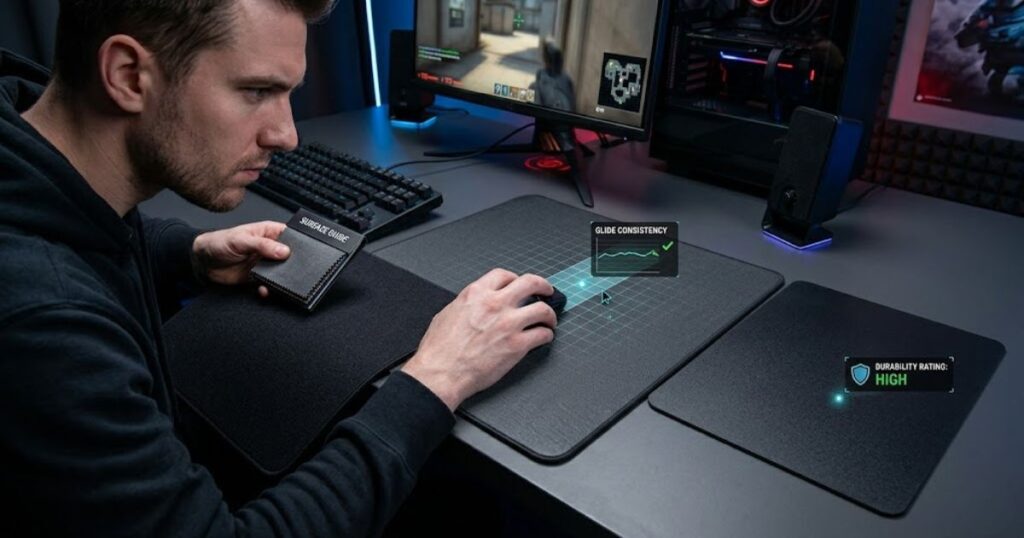
Because consistency develops over months and years rather than days, long-term durability is often more important than initial impressions. A surface that feels great out of the box may not maintain the same characteristics after extended use.
Evaluating consistency before purchase helps reduce the risk of buying a mouse pad that loses performance quickly.
The table below highlights the most important factors when evaluating surface consistency:
| Evaluation Factor | Why It Matters |
|---|---|
| Material Quality | Determines surface uniformity and durability |
| Long-Term Reviews | Reveals real-world consistency retention |
| Humidity Resistance | Reduces environmental performance changes |
| Manufacturing Quality | Improves surface uniformity across the pad |
| Wear Resistance | Maintains consistent glide over time |
The factors above provide a more reliable way to judge consistency than marketing descriptions alone.
Players who focus on long-term performance often benefit from evaluating durability and consistency retention before considering speed or control preferences.
The following process can help evaluate surface consistency before buying:
- Check material quality: Look for durable cloth, hybrid, or hard-surface construction.
- Read long-term reviews: Focus on user experiences after months of use.
- Research humidity resistance: Determine how the surface performs in different environments.
- Compare consistency feedback: Look for reports of uneven glide or wear patterns.
- Evaluate durability reputation: Prioritize surfaces known for long-term stability.
This evaluation process helps identify products that are more likely to maintain predictable performance throughout their lifespan.
Frequently Asked Questions About Surface Consistency
Many FPS players have additional questions about how surface consistency affects tracking, aim performance, durability, and mouse pad selection. The answers below address some of the most common concerns.
Does Surface Consistency Affect FPS Aim?
Yes, surface consistency affects FPS aim by influencing how predictable mouse movement feels across the entire pad. Consistent surfaces help players develop more reliable tracking and muscle memory.
Is Surface Consistency More Important Than Mouse Pad Speed?
Not always, but consistency is often more important for long-term reliability. A fast surface becomes less useful if different areas behave differently during gameplay.
Can A Fast Mouse Pad Still Have Good Surface Consistency?
Yes, speed and consistency measure different characteristics. A fast surface can maintain excellent consistency if glide behavior remains uniform across the pad.
Do Professional FPS Players Care About Surface Consistency?
Yes, professional players value consistency because repeatable movement is critical for competitive aiming performance.
Can Humidity Reduce Surface Consistency?
Yes, humidity can alter cloth resistance and create differences in glide behavior across the surface. Some materials resist these effects better than others.
How Long Does A Mouse Pad Typically Maintain Good Consistency?
The lifespan varies by material quality, maintenance habits, and usage intensity. Premium surfaces generally maintain consistency longer than budget alternatives.
Does Cleaning Improve Surface Consistency?
Yes, cleaning can remove contaminants that create uneven glide characteristics. However, cleaning cannot reverse permanent wear.
Can Surface Consistency Affect Mouse Sensor Performance?
Yes, inconsistent surface conditions can influence how reliably a sensor tracks movement. Uniform surfaces generally support more predictable tracking.
Which Material Usually Offers The Best Surface Consistency?
Hard surfaces typically provide the highest consistency retention, while premium cloth and hybrid surfaces also perform very well.
Why Does My Mouse Feel Different In Certain Areas Of The Pad?
This usually happens because of uneven wear, contamination, or environmental exposure that changes surface behavior.
Should Low-Sensitivity Players Care More About Surface Consistency?
Yes, low-sensitivity players often use more of the mouse pad, making surface variations easier to notice.
Can Surface Consistency Improve Aim Confidence?
Yes, predictable movement conditions help players trust their setup and execute aiming mechanics more naturally.
Final Verdict: Why Surface Consistency Matters For FPS Players
Surface consistency matters because predictable glide characteristics help create more reliable tracking, stronger muscle memory, and greater confidence during gameplay. Regardless of whether a mouse pad is fast or slow, consistency determines how repeatable its behavior remains over time.
Players often focus on speed, friction, and stopping power when evaluating a gaming surface. While those characteristics influence preference, consistency influences predictability. A surface that behaves the same way every time allows players to build aiming habits with fewer variables interfering.
If you are comparing products and looking for options that maintain reliable performance over time, explore our guide to the best gaming mouse pads for FPS games to see which surfaces offer the strongest balance of consistency, durability, and overall aiming performance.
Ultimately, surface consistency is one of the most important qualities of a gaming mouse pad because it supports the repeatability that FPS players depend on every day.
Thanks for reading GearTP. We hope this guide helps you better understand why surface consistency matters for reliable FPS aiming performance.