
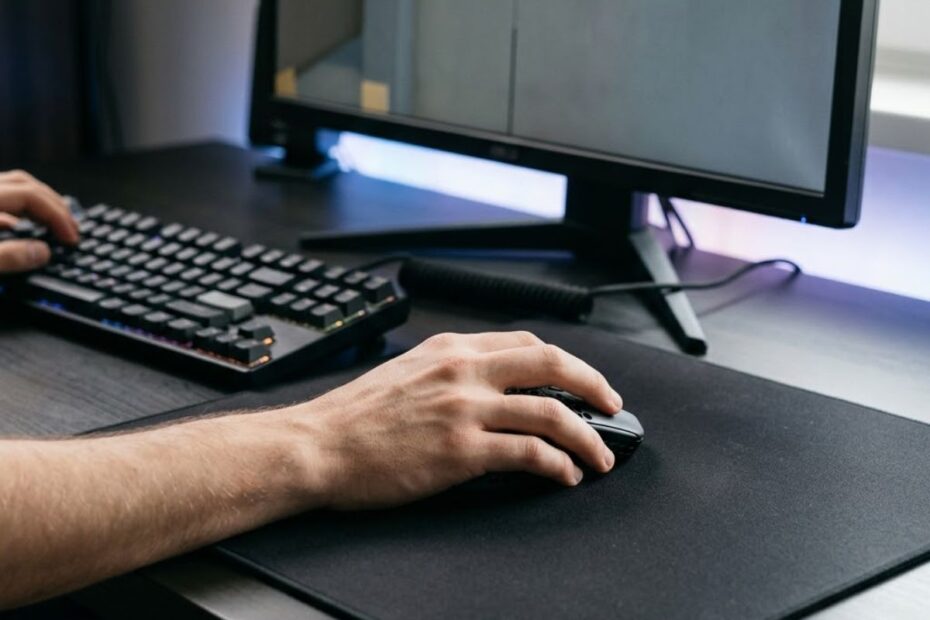
Mouse pads do affect aim consistency because the surface underneath your mouse influences friction, tracking behavior, stopping power, and muscle memory. A consistent mouse pad helps create repeatable mouse movements, while an inconsistent surface can make aiming feel different from one session to another.
Many FPS players spend hours adjusting DPI, sensitivity, and crosshair settings while overlooking the mouse pad entirely. However, the surface a mouse moves across can significantly influence how predictable every flick, micro-adjustment, and tracking movement feels during gameplay.
This guide explains how mouse pads affect aim consistency, why surface characteristics matter, and how to determine whether your mouse pad could be limiting your performance in games such as Valorant, CS2, Apex Legends, and other competitive shooters.
Do Mouse Pads Affect Aim Consistency?
Mouse pads affect aim consistency because they provide the physical surface that controls how a mouse moves and tracks. A stable and predictable surface helps players build reliable muscle memory, while inconsistent surfaces can introduce subtle variations that make aiming less repeatable over time.
What Does Aim Consistency Actually Mean?
Aim consistency is the ability to reproduce similar mouse movements and aiming results repeatedly. Consistent aim helps players perform the same flick, tracking motion, or micro-adjustment with predictable outcomes across different matches and practice sessions.
Many players confuse consistency with accuracy. Accuracy describes whether a shot hits its target, while consistency describes how reliably a player can reproduce the same movement pattern every time.
For FPS games, consistency often matters more than occasional moments of exceptional aim. Players who consistently perform at a stable level generally achieve better long-term results than players who alternate between amazing and poor performances.
Understanding the role of equipment is an important part of improving consistency. Before evaluating advanced surface characteristics, it helps to understand what is a gaming mouse pad for fps games and why competitive players pay close attention to their mouse pad selection.
In short, aim consistency is not about hitting impossible shots. It is about creating reliable and repeatable performance under different conditions.
Why Consistent Aim Matters More Than Fast Aim
Consistent aim is more valuable than fast aim because predictable performance wins more engagements over time. Reliable crosshair placement and repeatable mouse control allow players to make better decisions during stressful situations.
Fast aim can sometimes produce impressive highlights, but inconsistent movement often leads to overshooting, undershooting, and missed opportunities. A player who can consistently stop the mouse at the intended location usually performs better across an entire match.
This is especially true in tactical shooters where precision matters more than raw speed. Small aiming errors become increasingly noticeable when every shot carries significant consequences.
As players improve mechanically, they often become more sensitive to inconsistencies in their setup. Minor variations that beginners never notice can become frustrating obstacles for experienced players.
The difference between consistent aim and inconsistent aim becomes easier to understand in practical FPS situations:

Therefore, consistency should be viewed as the foundation upon which speed and precision are built.
The signs below explain inconsistent aim problems:
- Overshooting: The crosshair frequently travels beyond the intended target.
- Undershooting: The crosshair stops before reaching the intended position.
- Inconsistent Tracking: Following moving targets feels different from match to match.
- Variable Performance: Aim feels excellent one day and noticeably worse the next.
These symptoms often indicate that something within the setup is affecting movement consistency, whether it involves technique, hardware, or the mouse pad surface itself.
Why Small Surface Differences Become Big Problems
Small surface differences become major problems because FPS aiming relies on thousands of repeated movements. Even minor changes in glide behavior can influence muscle memory over long periods of use.
When a surface becomes uneven, develops slow spots, or changes its friction characteristics, the mouse no longer behaves exactly as expected. These differences may be subtle, but repeated thousands of times, they can significantly affect performance.
Players often blame sensitivity settings when their aim feels inconsistent. In reality, the problem may originate from physical changes occurring on the surface beneath the mouse.
This explains why many competitive players prefer using the same mouse pad for extended periods. Familiarity helps maintain stable movement patterns and reduces unnecessary adaptation.
Ultimately, consistency depends on removing variables. The fewer variables affecting mouse movement, the easier it becomes to develop reliable aim.
In summary, mouse pads can directly influence aim consistency because they determine how predictable every mouse movement feels. Understanding this relationship is the first step toward identifying whether a surface is helping or hurting long-term FPS performance.
How Mouse Pads Influence Mouse Movement
Mouse pads influence mouse movement because they control friction, texture, and glide behavior. These characteristics help determine how easy it is to start, stop, and maintain precise mouse movements during gameplay.
How Surface Friction Changes Mouse Control
Surface friction is the resistance between the mouse feet and the mouse pad. Friction helps control stopping power, movement speed, and overall predictability during aiming.
Higher-friction surfaces generally provide greater control because they resist movement more strongly. This resistance helps players stop the mouse more precisely after a flick.
Lower-friction surfaces allow the mouse to move faster and with less effort. While this can feel smooth and responsive, it may also require greater precision from the player when stopping the mouse accurately.
Neither approach is automatically better. The ideal friction level depends on personal preference, aiming style, and the games being played.
What matters most for consistency is not whether friction is high or low, but whether that friction remains predictable across the entire surface.
In short, friction directly affects how controlled or effortless mouse movement feels during gameplay.
How Surface Texture Changes Glide Feel
Surface texture is the physical pattern of the mouse pad material. Texture helps determine how smooth, controlled, or responsive the mouse feels while moving across the pad.
Different cloth weaves create different glide experiences. Some textures feel silky and fast, while others feel rougher and more controlled.
The relationship between texture and consistency becomes important because players gradually develop expectations about how the mouse should behave. When the texture remains uniform, those expectations stay accurate.
However, if different sections of the mouse pad feel noticeably different, muscle memory becomes harder to maintain. The same movement may produce slightly different results depending on where the mouse is located.
For this reason, high-quality mouse pads typically focus on maintaining uniform texture throughout the entire surface.
Ultimately, texture shapes the overall feel of mouse movement and contributes significantly to long-term aiming consistency.
How Wear and Tear Changes Mouse Movement Over Time
Mouse pad wear is the gradual deterioration of the surface caused by repeated use. Wear helps explain why a mouse pad that once felt consistent can eventually create unpredictable mouse movement and aiming performance.
Every mouse pad changes over time. Constant contact from mouse feet, pressure from the player’s hand, dust accumulation, skin oils, and environmental conditions slowly alter the characteristics of the surface.
One of the most common issues is the development of slow spots. These areas create more resistance than the rest of the pad, causing the mouse to glide differently depending on its position. As a result, identical hand movements may produce slightly different outcomes.
Surface wear can be especially noticeable for players who spend hundreds of hours practicing aim trainers or competitive FPS games. High-traffic areas near the center of the mouse pad often experience the most significant degradation.
Many players mistakenly blame their sensitivity settings when performance begins to feel inconsistent. In reality, the surface itself may no longer behave the same way it did when the mouse pad was new.
In short, wear and tear gradually reduce surface consistency, making it more difficult to maintain reliable muscle memory over long periods.
The table below explains how mouse pad characteristics affect aim consistency:
| Mouse Pad Factor | Impact on Aim Consistency | Reason |
|---|---|---|
| Friction | High | Controls stopping power and movement predictability. |
| Texture Uniformity | High | Ensures the mouse behaves consistently across the entire surface. |
| Surface Wear | High | Creates slow spots and inconsistent glide behavior. |
| Thickness | Medium | Influences comfort and surface stability. |
| Stitching Quality | Low | Mainly affects durability rather than aiming performance. |
As shown above, friction, texture uniformity, and surface wear have the greatest influence on long-term aim consistency. These factors directly affect how predictable mouse movement feels during everyday gameplay.
Players often focus on upgrading sensors or increasing polling rates, but a worn or inconsistent surface can still limit performance regardless of how advanced the mouse hardware may be.
Understanding these characteristics helps players identify whether aiming issues originate from mechanics, settings, or the mouse pad itself.
In summary, mouse movement is heavily influenced by the physical properties of a mouse pad. A surface that remains uniform and predictable over time provides a stronger foundation for consistent FPS aiming.
How Mouse Pads Affect Mouse Sensor Tracking
Mouse pads affect mouse sensor tracking because the sensor relies on surface information to detect movement accurately. A consistent surface helps sensors capture reliable tracking data, while problematic surfaces can reduce tracking stability and aiming precision.
Why Sensors Need Consistent Surface Data
Consistent surface data is the visual information a mouse sensor uses to calculate movement. Reliable surface data helps the sensor maintain accurate tracking and predictable cursor behavior during gameplay.
Modern gaming mouse sensors operate by rapidly capturing images of the surface beneath them. The sensor then compares those images to determine movement direction and distance.
When the surface texture remains consistent, the sensor receives stable information and produces accurate tracking results. This allows the mouse to translate physical movement into predictable in-game movement.
However, if the surface contains irregularities, damaged sections, or inconsistent texture patterns, the sensor may receive slightly different information depending on where it is positioned on the pad.
This is one reason why premium mouse pads prioritize uniform surface construction. Consistency across the entire pad helps maintain reliable sensor performance throughout every swipe.
Players interested in the technical relationship between surfaces and tracking performance can learn more about how mouse pads affect mouse sensors and why surface quality remains important even with modern flagship sensors.
Ultimately, sensors perform best when they receive predictable surface information from a stable and consistent mouse pad.
How Uneven Surfaces Create Tracking Problems
Uneven surfaces are areas where texture, friction, or material consistency differs across the mouse pad. Uneven surfaces help explain why tracking can feel inconsistent despite using the same mouse and sensitivity settings.
The relationship between sensor tracking and surface consistency can be visualized below:
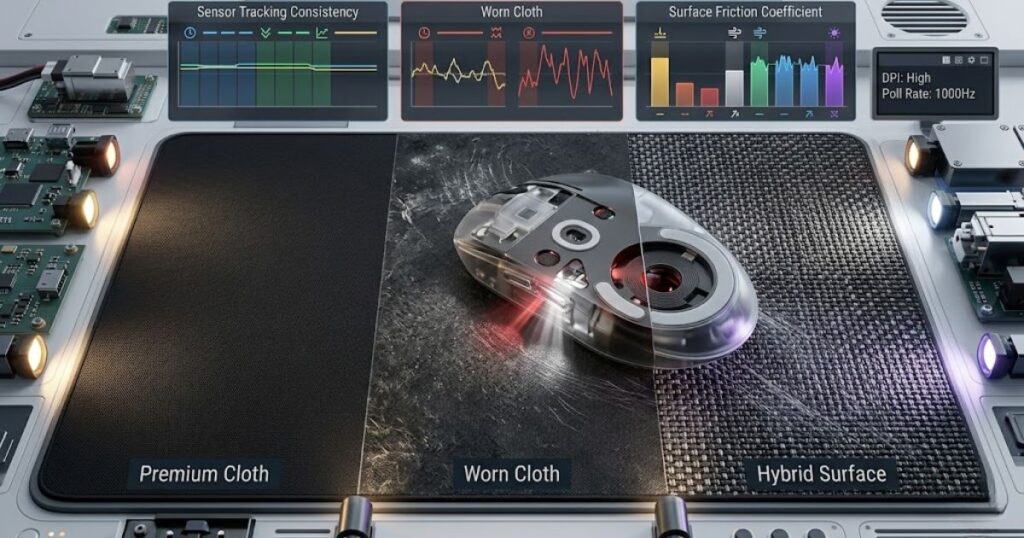
Tracking problems do not always appear as obvious sensor failures. In many cases, the issue presents itself as subtle inconsistencies during flicks, micro-adjustments, or target tracking.
When a mouse travels across worn sections of a pad, the interaction between the sensor and the surface may differ slightly from what occurs on unaffected areas. While modern sensors are highly capable, they still benefit from uniform tracking conditions.
Uneven surfaces can also influence how mouse feet interact with the pad. Increased friction in one section and reduced friction in another may alter movement speed even when hand motion remains identical.
Over time, these small differences can make aim feel less predictable and force players to constantly adapt to changing surface conditions.
In short, surface consistency supports sensor consistency. The more uniform the surface, the easier it becomes for players to trust every movement.
Why Some Mouse Pads Work Better With Modern Sensors
Some mouse pads work better with modern sensors because they provide cleaner and more consistent tracking information. High-quality surfaces help sensors maintain stable performance, reduce tracking irregularities, and deliver more predictable aiming behavior.
Modern flagship sensors are dramatically better than older generations, but they still depend on the surface beneath them. A premium sensor cannot fully compensate for a surface that has inconsistent texture, damaged areas, or poor manufacturing quality.
Well-designed gaming mouse pads focus on surface uniformity rather than simply advertising speed or control. A sensor benefits most when every section of the pad presents similar tracking characteristics during movement.
This is particularly important for competitive FPS players who rely on muscle memory. When the sensor consistently receives the same type of surface information, aiming becomes easier to repeat under pressure.
For that reason, many experienced players prioritize surface consistency over marketing specifications when selecting a mouse pad.
Ultimately, modern sensors perform best when paired with surfaces that remain predictable across the entire tracking area.
The table below compares sensor tracking behavior across different surface types:
| Surface Type | Tracking Stability | Consistency Potential |
|---|---|---|
| Premium Cloth | Excellent | Very High |
| Hybrid Surface | Very Good | High |
| Hard Surface | Good | Medium to High |
| Worn Cloth Surface | Poor | Low |
| Reflective Surface | Poor | Very Low |
The table shows that sensor performance is affected more by surface quality and consistency than by whether a pad is marketed as fast or slow. A uniform surface gives the sensor better conditions to operate reliably.
As a result, maintaining a consistent tracking environment often contributes more to long-term aim consistency than chasing increasingly higher sensor specifications.
In summary, modern sensors are highly capable, but their performance remains closely connected to the quality and consistency of the mouse pad surface.
Before evaluating specific surface styles, it is important to understand that tracking consistency and movement consistency are not exactly the same thing. A mouse pad can track perfectly while still feeling too fast or too slow for a player’s preferred aiming style.
That distinction becomes especially important when comparing control and speed-oriented mouse pads.
Control vs Speed Mouse Pads for Aim Consistency
Control and speed mouse pads affect aim consistency differently because they create different movement characteristics. Control pads help create more stopping precision, while speed pads help create smoother and faster movement across the surface.
Why Control Pads Feel More Consistent for Most Players
Control mouse pads feel more consistent for many players because they provide greater stopping power. Additional friction helps players stop the mouse at intended positions more predictably during flicks and micro-adjustments.
Most FPS aiming mistakes occur at the end of a movement rather than the beginning. Reaching a target is often easier than stopping precisely on that target. Control-oriented surfaces help reduce this problem by increasing resistance during movement.
This extra resistance can make crosshair placement feel more stable, particularly in tactical shooters where precision matters more than raw movement speed. Small adjustments become easier to control, which supports more reliable muscle memory.
Control pads are especially popular among Valorant and CS2 players because these games often reward precise stopping accuracy rather than continuous tracking.
The goal is not to make movement slower. The goal is to make movement easier to predict and repeat under different conditions.
In short, control pads often feel more consistent because they help players manage stopping accuracy more effectively.
When Speed Pads Improve Consistency
Speed mouse pads improve consistency when a player’s aiming style depends on fluid movement and rapid target transitions. Reduced friction helps maintain smooth motion during tracking-heavy gameplay.
While speed pads are often associated with faster movement, their biggest advantage is the ability to maintain uninterrupted glide. Some players naturally perform better when movement feels effortless and unrestricted.
This can be particularly useful in games that require frequent target switching, wide-angle tracking, and continuous mouse movement. Lower friction reduces fatigue and allows players to make large movements with less physical effort.
Many players who use lower sensitivities also appreciate the freedom provided by speed-oriented surfaces. Large arm movements can feel smoother when the surface offers minimal resistance.
However, speed surfaces generally demand greater precision from the player because stopping power is reduced compared to control-oriented alternatives.
Ultimately, speed pads improve consistency for players whose mechanics naturally benefit from smoother and lighter movement characteristics.
Why Consistency Depends on Playstyle
Aim consistency depends on playstyle because different players solve aiming challenges in different ways. Surface preferences help support individual movement habits, sensitivity settings, and game-specific requirements.
A player who relies heavily on flick shots may value stopping precision above everything else. Another player who spends most of their time tracking moving targets may prioritize effortless glide and reduced friction.
Neither approach is objectively correct. The most consistent mouse pad is usually the one that complements the player’s natural aiming style rather than forcing them to adapt constantly.
This explains why professional players often use very different surfaces despite competing at the highest level. Consistency comes from familiarity and repeatability, not from a universally perfect mouse pad.
Players who use low sensitivity settings also frequently benefit from larger surfaces because extended arm movements become easier to perform without running out of space. This is one reason why FPS players use large mouse pads when consistency and freedom of movement are priorities.
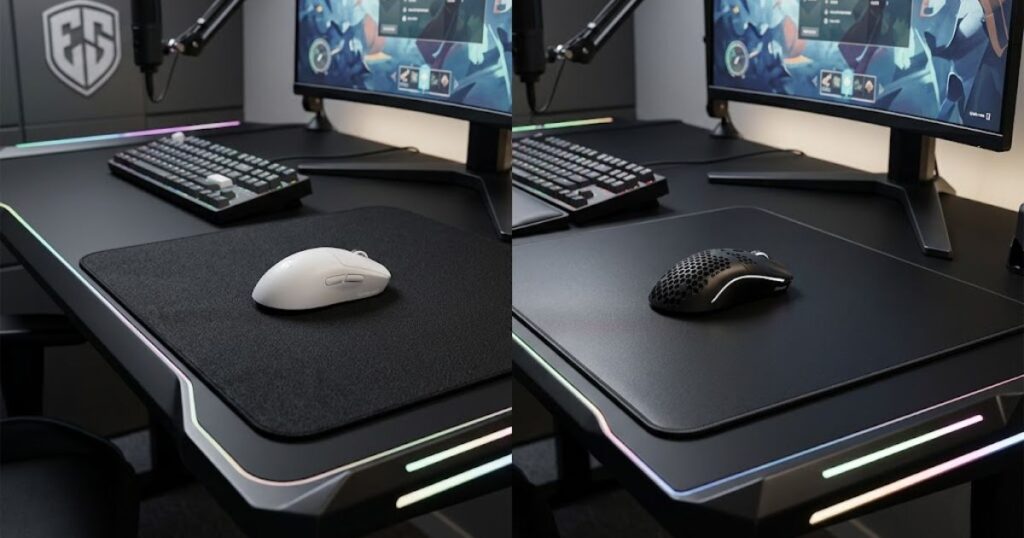
Different mouse pad styles create noticeably different movement characteristics:
In short, the ideal balance between speed and control depends entirely on how a player aims and what type of movement feels most repeatable to them.
The table below compares control and speed mouse pads for aiming consistency:
| Factor | Control Pad | Speed Pad |
|---|---|---|
| Stopping Power | High | Low |
| Tracking Fluidity | Medium | High |
| Micro-Adjustments | Excellent | Good |
| Large Swipes | Good | Excellent |
| Learning Curve | Easier | Higher |
The comparison demonstrates that neither category automatically guarantees better consistency. Each surface type supports different movement behaviors and aiming preferences.
Choosing between speed and control should therefore focus on personal performance rather than assumptions about which category is universally superior.
In summary, consistency is influenced by how well a surface matches a player’s mechanics. The best mouse pad is usually the one that makes movement feel predictable rather than simply fast or slow.
Why Some Players Experience Inconsistent Aim on the Same Sensitivity
Players can experience inconsistent aim on the same sensitivity because sensitivity is only one part of the aiming equation. Surface condition, muscle memory, environmental factors, and hardware interaction all help influence how consistent mouse movement feels during gameplay.
Many FPS players immediately adjust their sensitivity settings when aim starts feeling off. However, if the mouse pad behaves differently from one session to another, changing sensitivity often treats the symptom rather than the cause.
Aiming consistency depends on creating a stable environment where mouse movement remains predictable. When that environment changes, performance can fluctuate even if every in-game setting remains identical.
Understanding these hidden variables can help players identify the real source of inconsistency before making unnecessary adjustments.
How Muscle Memory Depends on Surface Feel
Muscle memory is the brain’s ability to repeat learned movements automatically. Muscle memory helps players perform aiming actions consistently when the physical feel of the mouse movement remains stable.
Every swipe, flick, and micro-adjustment teaches the brain how much force is required to move the crosshair a certain distance. Over time, these movements become automatic and require less conscious effort.
However, muscle memory is heavily connected to physical feedback. If friction levels change, the same hand movement may no longer produce the same result. The brain continues expecting one outcome while the surface delivers another.
This mismatch can create the feeling that sensitivity has changed even when every software setting remains untouched. In reality, the player is adapting to altered physical conditions rather than altered sensitivity.
For this reason, consistency is often easier to maintain when using the same surface for long periods instead of frequently switching mouse pads.
In short, muscle memory relies on predictable physical feedback, making surface consistency an important factor in long-term aim development.
How Environmental Conditions Affect Mouse Pads
Environmental conditions are external factors such as humidity, temperature, and dust. Environmental conditions help explain why a mouse pad can feel different despite appearing unchanged.
Cloth mouse pads are particularly affected by humidity because moisture can slightly alter the surface texture and friction characteristics. A pad that feels balanced on a dry day may feel slower when humidity levels rise.
Temperature can also influence materials over time. While the effects are often subtle, competitive players frequently notice even small changes in glide behavior during extended play sessions.
Dust, dirt, and skin oils gradually accumulate on the surface as well. These contaminants can increase friction in certain areas and reduce overall consistency across the pad.
The result is a surface that behaves differently from the conditions under which the player’s muscle memory originally developed.
Ultimately, environmental factors introduce variables that many players overlook when troubleshooting aim consistency problems.
In short, maintaining a clean and stable playing environment can help preserve the consistency of a mouse pad over time.
Why Mouse Feet and Mouse Pads Work Together
Mouse feet and mouse pads form a complete movement system. The interaction between these two components helps determine glide quality, friction levels, and overall movement consistency.
Many players evaluate mouse pads independently, but the mouse feet play an equally important role. The same mouse pad can feel dramatically different depending on the condition and material of the mouse feet.
Worn mouse feet may create uneven contact with the surface, increasing friction and reducing movement predictability. Scratched or damaged feet can also create inconsistent glide patterns across the mouse pad.
Likewise, high-quality mouse feet often perform best when paired with a clean and uniform surface. Both components contribute to the overall aiming experience.
When troubleshooting aim consistency issues, it is important to inspect both the mouse pad and the mouse feet rather than assuming one component is solely responsible.
In summary, reliable aim depends on a healthy interaction between the mouse feet and the surface beneath them.
The factors below explain why aim may feel inconsistent despite using the same sensitivity:
- Humidity: Increased moisture can change friction and glide characteristics.
- Surface Wear: Worn areas may create slow spots and inconsistent movement.
- Dirty Mouse Feet: Dirt buildup can alter glide behavior and increase resistance.
- Dust Accumulation: Surface contamination may affect movement predictability.
- Temperature Changes: Material properties can shift slightly under different conditions.
- Uneven Pressure: Different hand pressure can change how the mouse interacts with the surface.
These factors demonstrate that aiming consistency depends on more than software settings alone. Physical conditions often play a larger role than many players realize.
In summary, inconsistent aim on the same sensitivity is frequently caused by changes in the physical environment rather than changes in the game itself.
Signs Your Mouse Pad Is Hurting Aim Consistency
A mouse pad can hurt aim consistency when its surface no longer provides predictable movement characteristics. Visible wear, uneven glide, and inconsistent tracking behavior often indicate that the surface is becoming a performance limitation.
Many players continue using the same mouse pad long after its performance has started to decline. Because wear occurs gradually, the changes are often difficult to notice until aim consistency begins suffering.
Recognizing the warning signs early can help players determine whether replacing the mouse pad may improve overall performance.
Tracking Feels Different Across Areas of the Pad
Different tracking behavior across the surface is one of the clearest signs of mouse pad degradation. Surface inconsistency helps create unpredictable movement patterns that interfere with reliable aiming.
A healthy mouse pad should feel relatively uniform from edge to edge. While minor variations may exist, movement should remain largely predictable regardless of where the mouse is positioned.
When certain areas feel slower, rougher, or more resistant than others, muscle memory becomes harder to maintain. The same physical movement may produce different outcomes depending on location.
This issue often appears first in high-use areas near the center of the pad where friction and wear accumulate most rapidly.
Ultimately, inconsistent tracking zones reduce confidence because players can no longer trust that the mouse will behave identically throughout the entire surface.
In short, noticeable differences between sections of the mouse pad usually indicate declining surface consistency.
The Mouse Stops Differently During Flicks
Inconsistent stopping behavior is a common symptom of surface wear. Differences in friction help create uncertainty when attempting to stop the crosshair precisely on a target.
Players often describe this issue as the mouse feeling unpredictable during flick shots. Sometimes the mouse stops exactly where expected, while other times it travels slightly farther or shorter than intended.
This variation can gradually reduce confidence during aiming because players no longer receive consistent feedback from the surface.
Stopping power is particularly important in tactical FPS games where precise target acquisition often determines whether an engagement is won or lost.
As surface conditions deteriorate, maintaining reliable stopping precision becomes increasingly difficult.
Ultimately, inconsistent stopping behavior is often a warning sign that the mouse pad is no longer performing as intended.
In summary, predictable stopping power is a major component of aim consistency, making changes in stopping behavior difficult to ignore.
You Constantly Change Sensitivity Settings
Frequent sensitivity adjustments are often a sign that players are trying to solve a consistency problem rather than a sensitivity problem. Constant changes help create an endless cycle of adaptation that makes it harder to develop reliable muscle memory.
When aim feels inconsistent, many players immediately assume their sensitivity settings are incorrect. As a result, they repeatedly increase or decrease sensitivity in search of a solution.
However, if the real issue originates from the mouse pad surface, changing sensitivity will rarely provide lasting improvement. The player may temporarily feel better because the adjustment creates a fresh experience, but the underlying problem remains.
This pattern often becomes obvious when aim quality fluctuates despite using multiple sensitivity settings. No matter what value is chosen, performance eventually feels inconsistent again.
Before changing settings, players should first evaluate the condition of their mouse pad, mouse feet, and overall setup environment.
Ultimately, constant sensitivity adjustments can sometimes indicate that the surface itself has become unreliable.
In short, if sensitivity changes never seem to solve the problem permanently, the mouse pad may deserve closer inspection.
The signs below indicate a mouse pad may be hurting aim consistency:
- Uneven Glide: Different parts of the pad feel noticeably faster or slower.
- Slow Spots: Certain areas create additional resistance during movement.
- Surface Discoloration: Heavy wear has altered the texture of the material.
- Frayed Fabric: Physical deterioration affects long-term surface uniformity.
- Tracking Inconsistency: The mouse feels less predictable during aiming.
- Constant Sensitivity Changes: Players continually adjust settings without finding a lasting solution.
These warning signs do not automatically mean a mouse pad must be replaced immediately. However, they often indicate that the surface is no longer providing the same level of consistency it once did.
In summary, identifying surface-related issues early can help players maintain reliable aim and avoid unnecessary adjustments to other parts of their setup.
Do Professional FPS Players Care About Mouse Pads?
Professional FPS players care about mouse pads because surface consistency directly affects aiming performance. A predictable mouse pad helps create reliable muscle memory, stable tracking behavior, and repeatable results during competition.
At the highest level of play, even small differences in equipment can influence performance. Because professional players depend heavily on consistency, they often pay close attention to the surfaces they use.
While casual players may view mouse pads as accessories, professional competitors frequently consider them essential parts of their aiming setup.
Understanding why professionals value mouse pads helps illustrate how important surface consistency can become as skill levels increase.
Why Pros Keep the Same Mouse Pad for Years
Many professional players use the same mouse pad for extended periods because familiarity supports consistent muscle memory. Long-term use helps players develop highly predictable movement expectations.
Professional FPS players often prioritize familiarity and consistency over constant equipment changes:

Competitive aiming relies on repetition. Every practice session reinforces movement patterns that become deeply connected to the physical characteristics of the surface being used.
Switching mouse pads frequently introduces new variables. Differences in friction, texture, and stopping power require adaptation, which can temporarily disrupt established movement habits.
This is one reason many professionals remain loyal to specific mouse pad models even when newer alternatives become available. Familiarity often provides greater value than novelty.
The goal is not necessarily to find the fastest or most advanced surface. The goal is to preserve an environment where movement remains predictable under pressure.
In short, long-term familiarity helps players maintain stable performance and avoid unnecessary adaptation periods.
Why Consistency Matters More Than Specifications
Consistency matters more than specifications because predictable performance produces more reliable results than theoretical advantages. Stable behavior helps players trust their movements during competition.
Marketing often emphasizes speed, advanced materials, or unique surface technologies. While these features can be useful, they are not always the factors that determine competitive performance.
Professional players frequently prioritize surfaces that feel familiar and dependable rather than surfaces that offer the most impressive specifications on paper.
A mouse pad that behaves consistently every day allows players to focus entirely on decision-making and execution instead of adapting to changing movement characteristics.
This philosophy applies to many areas of competitive gaming. Reliability often creates more value than chasing marginal performance improvements.
Ultimately, consistency supports confidence, and confidence supports better gameplay.
In summary, predictable behavior is usually more important than raw specifications when aiming performance is the primary goal.
Common Mouse Pad Preferences Among Professional Players
Professional players often prefer surfaces that balance control, consistency, and durability. These characteristics help create stable aiming conditions over thousands of hours of practice.
Although preferences vary between individuals, many professionals prioritize surfaces that maintain predictable friction levels and uniform texture across the entire pad.
Large mouse pads are also common because they provide additional room for low-sensitivity aiming styles. Extended movement space helps reduce interruptions during wide arm movements and tracking scenarios.
Players researching potential upgrades often explore guides featuring the top best gaming mouse pads for FPS games in 2026 to compare surface characteristics, durability, and overall suitability for competitive play.
Despite differences in preferences, the underlying objective remains the same. Professional players want surfaces that behave predictably every time they touch the mouse.
In short, consistency and reliability remain the most common themes behind professional mouse pad choices.
The table below explains why professional FPS players prioritize mouse pads:
| Factor | Importance | Reason |
|---|---|---|
| Muscle Memory | Very High | Supports repeatable movement patterns. |
| Tracking Consistency | Very High | Creates predictable sensor behavior. |
| Surface Familiarity | High | Reduces adaptation requirements. |
| Durability | High | Preserves performance over time. |
| Comfort | Medium | Improves long practice sessions. |
The table highlights that consistency-related factors dominate professional priorities. Players value surfaces that support reliable performance rather than unpredictable experimentation.
As skill levels increase, even minor inconsistencies become more noticeable. This explains why mouse pads remain an important part of competitive FPS setups.
In summary, professional players care about mouse pads because surface consistency contributes directly to long-term aiming reliability and confidence.
Should You Upgrade Your Mouse Pad Before Your Mouse?
Upgrading a mouse pad before a mouse is often the better choice when aim consistency problems originate from the surface rather than the sensor. A high-quality mouse pad helps create a stable foundation for tracking, movement, and muscle memory without requiring major changes to existing settings.
Many players immediately assume that poor aiming performance is caused by an outdated mouse. While sensors and hardware certainly matter, modern gaming mice are already capable of delivering excellent tracking performance on suitable surfaces.
If the mouse itself is functioning properly, upgrading the surface may provide a more noticeable improvement than replacing the mouse entirely.
Understanding when the mouse pad is the limiting factor can help players make more effective upgrade decisions.
When a New Mouse Pad Creates Bigger Improvements
A new mouse pad creates bigger improvements when the existing surface has become inconsistent or heavily worn. Replacing a degraded surface helps restore predictable movement and tracking behavior.
Many players continue using mouse pads long after the surface has begun deteriorating. Because wear develops gradually, the decline in performance often goes unnoticed until aiming consistency becomes a problem.
Replacing a worn surface can immediately eliminate slow spots, uneven friction, and inconsistent glide characteristics. These improvements often make the mouse feel more reliable without changing any hardware settings.
A new surface may also restore confidence. When players trust how the mouse behaves, they can focus more on execution and less on adapting to unpredictable movement.
This is particularly relevant for competitive FPS players who rely heavily on muscle memory and repeatable aiming patterns.
In short, a fresh and consistent surface can sometimes produce larger practical benefits than upgrading from one modern gaming mouse to another.
Situations Where the Mouse Is the Real Problem
The mouse is the real problem when hardware limitations directly affect tracking accuracy or responsiveness. Hardware issues help create performance problems that cannot be solved through a better mouse pad alone.
Examples include damaged sensors, faulty switches, severe wireless connectivity issues, or excessively worn mouse feet. In these situations, replacing the mouse or repairing the hardware may be necessary.
Older office mice can also become limiting factors because they often lack the tracking precision and responsiveness expected for competitive gaming.
However, these situations are less common than many players assume. Most modern gaming mice already provide excellent sensor performance when paired with a suitable surface.
This is why troubleshooting should focus on identifying the true source of the issue rather than automatically purchasing new hardware.
Ultimately, the best upgrade is the one that solves the actual problem rather than the one with the most impressive specifications.
In summary, hardware upgrades become worthwhile when genuine mouse-related limitations are preventing consistent performance.
The following process can help determine what to upgrade first:
- Inspect the Surface: Check for wear, discoloration, slow spots, and uneven glide behavior.
- Test Tracking Consistency: Perform repeated flicks and tracking exercises to identify irregular movement patterns.
- Examine Mouse Feet: Look for scratches, flattening, or uneven wear that may affect glide quality.
- Compare With Another Surface: Test the mouse on a different mouse pad to isolate the source of the issue.
- Evaluate Hardware Performance: Determine whether tracking issues persist after surface-related variables are removed.
- Upgrade the Limiting Component: Replace the component that is creating the most noticeable performance bottleneck.
Following a structured process helps avoid unnecessary purchases and makes it easier to identify the true cause of aiming inconsistency.
In summary, troubleshooting systematically is usually more effective than immediately replacing hardware based on assumptions.
How to Choose a Mouse Pad for Better Aim Consistency
Choosing a mouse pad for better aim consistency is about finding a surface that matches your aiming style and remains predictable over time. The best mouse pad helps create reliable movement patterns instead of forcing constant adaptation.
Many players focus exclusively on speed or control, but consistency is usually influenced by a combination of surface behavior, size, durability, and personal preference.
The goal is not to find a universally perfect mouse pad. The goal is to find a surface that allows your movements to remain stable and repeatable across different gaming sessions.
Choose Surface Type Based on Playstyle
Surface type should match the way you naturally aim. Different surfaces help support different movement patterns, levels of friction, and tracking preferences.
Players who prioritize stopping accuracy often prefer control-oriented surfaces because they provide additional resistance during movement. This resistance can help create more precise flick endings and micro-adjustments.
Players who rely heavily on tracking may prefer faster surfaces because they allow smoother movement with less physical effort. Reduced friction can help maintain fluid motion during extended engagements.
The key is consistency. A surface should complement existing mechanics rather than force a player to rebuild them completely.
Ultimately, choosing a surface that matches natural movement habits often produces better results than simply following trends.
In short, surface type should support the player’s aiming style instead of working against it.
Consider Pad Size for Low-Sensitivity Aiming
Mouse pad size is the amount of usable movement space available during gameplay. Larger surfaces help support low-sensitivity aiming styles by providing more room for arm movement.
Low-sensitivity FPS players often perform wide swipes that extend far beyond the center of the pad. Limited space can interrupt movement and create unnecessary inconsistencies.
A larger surface allows players to maintain the same movement patterns without worrying about reaching the edge of the mouse pad. This supports smoother tracking and more reliable muscle memory.
For players exploring broader mouse pad fundamentals, a complete gaming mouse pad for FPS games guide can provide additional context about sizing, surface types, and setup considerations.
While larger is not always better, having enough space to perform natural movements is important for maintaining consistency.
In summary, adequate surface area helps eliminate movement restrictions and supports more reliable aiming performance.
Prioritize Consistency Over Marketing Claims
Consistency is more important than marketing claims because predictable performance creates better long-term results. Stable surfaces help players build confidence and maintain reliable muscle memory.
Many products advertise extreme speed, advanced coatings, or revolutionary technologies. While some features may provide benefits, they do not automatically guarantee better aim consistency.
A surface that behaves the same way every day is usually more valuable than one that promises marginal performance improvements but changes significantly over time.
Professional players frequently prioritize familiarity, durability, and predictable glide characteristics rather than chasing every new release.
The most effective mouse pad is often the one that disappears from conscious thought because it behaves exactly as expected during every session.
Ultimately, consistency should remain the primary objective when evaluating mouse pad options.
In short, stable performance is generally more valuable than impressive marketing terminology.
The table below helps FPS players choose the right mouse pad based on their playstyle:
| Player Type | Recommended Surface | Main Benefit |
|---|---|---|
| Tactical FPS Player | Control Pad | Improved stopping precision. |
| Tracking-Focused Player | Speed Pad | Smoother continuous movement. |
| Balanced FPS Player | Hybrid Surface | Mix of control and glide. |
| Low-Sensitivity Player | Large Control or Hybrid Pad | Additional movement space. |
| Beginner FPS Player | Control Pad | Easier movement management. |
The recommendations above should be viewed as starting points rather than absolute rules. Personal preference always plays a significant role in determining what feels most consistent.
Testing different surfaces and identifying which one produces the most repeatable results is often the most effective approach.
In summary, choosing the right mouse pad is less about finding the fastest option and more about finding the most predictable one.
Final Verdict: Do Mouse Pads Really Affect Aim Consistency?
Mouse pads do affect aim consistency because they influence friction, tracking stability, movement predictability, and muscle memory development. A consistent surface helps create reliable aiming behavior, while an inconsistent surface can introduce unnecessary variability into every movement.
Although many players focus primarily on sensitivity settings and mouse specifications, the surface beneath the mouse remains one of the most important parts of the aiming system. Every flick, micro-adjustment, and tracking movement depends on how predictably the mouse interacts with that surface.
Whether a player prefers a control pad, speed pad, or hybrid surface, the most important factor is consistency. A surface that behaves predictably over time allows muscle memory to develop naturally and helps reduce performance fluctuations.
The key takeaways below summarize the article:
- Mouse Pads Affect Friction: Surface resistance influences stopping power and movement control.
- Mouse Pads Affect Tracking: Consistent surfaces support more reliable sensor behavior.
- Mouse Pads Affect Muscle Memory: Predictable movement helps reinforce repeatable aiming patterns.
- Surface Wear Matters: Degraded surfaces can create inconsistent glide and tracking performance.
- Consistency Beats Raw Speed: Reliable movement is generally more valuable than maximum glide speed.
- Surface Choice Is Personal: Different aiming styles benefit from different surface characteristics.
These principles explain why experienced FPS players often view the mouse pad as a performance component rather than a simple accessory.
Ultimately, aim consistency is built on repeatability. The more predictable the surface, the easier it becomes to trust every movement and perform at a stable level over time.
In summary, mouse pads absolutely affect aim consistency, making surface quality and long-term predictability important considerations for any competitive FPS player.
Frequently Asked Questions About Mouse Pads and Aim Consistency
The frequently asked questions below answer common concerns FPS players have about mouse pads and aiming consistency.
Can a mouse pad improve aim without changing sensitivity?
Yes, a mouse pad can improve aim without changing sensitivity because it affects how consistently the mouse moves across the surface. A more predictable surface often makes aiming feel more reliable even when all settings remain unchanged.
Do expensive mouse pads always provide better aim consistency?
No, expensive mouse pads do not automatically provide better aim consistency. Surface consistency, durability, and compatibility with a player’s aiming style are usually more important than price alone.
How long does a mouse pad typically stay consistent?
A quality mouse pad can remain consistent for months or years depending on usage and maintenance. Heavy daily use may accelerate wear and gradually change glide characteristics over time.
Can cleaning a mouse pad improve aim consistency?
Yes, cleaning a mouse pad can improve aim consistency because it removes dirt, oils, and debris that affect friction. Regular cleaning helps maintain more predictable surface behavior.
Do hard mouse pads affect aim consistency differently than cloth pads?
Yes, hard and cloth mouse pads affect aim consistency differently because they create different friction levels and movement characteristics. Neither option is universally better for every player.
Can humidity make a mouse pad feel slower?
Yes, humidity can make some mouse pads feel slower because moisture changes surface friction. Cloth surfaces are generally more affected by humidity than hard surfaces.
Why does my aim feel different on certain areas of the mouse pad?
Aim may feel different across the surface because some areas have worn more than others. Uneven wear can create differences in friction and glide behavior.
Does mouse pad thickness affect aim consistency?
Mouse pad thickness can affect aim consistency by influencing comfort and surface stability. However, texture and friction usually have a greater impact on aiming performance.
Should FPS beginners use a control mouse pad?
Many FPS beginners benefit from control mouse pads because they provide additional stopping power. Increased control can make it easier to develop consistent aiming habits.
Can a bad mouse pad make a good gaming mouse feel worse?
Yes, a poor-quality surface can make even a high-end gaming mouse feel less consistent. Sensors perform best when paired with predictable tracking surfaces.
Do professional FPS players replace mouse pads often?
Some professional players replace mouse pads regularly, while others use the same model for years. The deciding factor is usually maintaining consistent surface behavior rather than following a schedule.
What is the most important mouse pad feature for aim consistency?
Surface consistency is the most important feature for aim consistency because it supports predictable movement and reliable muscle memory. A surface that behaves the same way every day helps create repeatable aiming performance.
These questions highlight a common theme: aim consistency is closely connected to surface predictability. While no mouse pad can replace practice, the right surface can help players build more reliable aiming habits over time.
Conclusion
Mouse pads do affect aim consistency because they influence how predictably a mouse moves, tracks, and stops during gameplay. While sensitivity, mouse sensors, and aiming technique all contribute to performance, the surface underneath the mouse remains a critical part of the overall aiming system.
A consistent mouse pad helps create reliable muscle memory, stable tracking behavior, and repeatable movement patterns. In contrast, worn surfaces, uneven friction, and inconsistent glide characteristics can introduce variables that make aiming feel less predictable over time.
For most FPS players, the goal should not be finding the fastest or most expensive mouse pad. The goal should be finding a surface that behaves consistently every day and supports their natural aiming style. Whether that means choosing a control pad, speed pad, or hybrid surface depends on personal preference and gameplay requirements.
Ultimately, aim consistency is built on repeatability. The more predictable the surface, the easier it becomes to trust every movement, develop reliable muscle memory, and perform consistently in competitive FPS games.
Thanks for reading, and I hope this guide helps you build a more consistent FPS setup.