
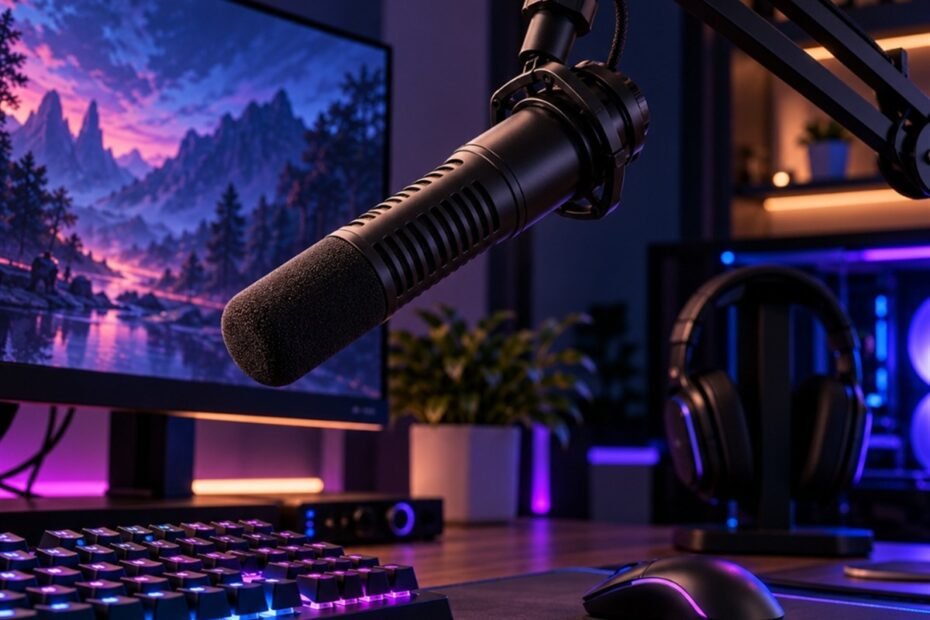
Deploying a dedicated shotgun microphone for gaming has emerged as a premier acoustic upgrade for competitive FPS players, content creators, and broadcast streamers seeking crystal-clear voice communication. Tactical shooters like Counter-Strike 2, Valorant, and Apex Legends demand rapid verbal callouts where sudden mechanical keyboard clatter, rapid mouse clicks, and high-RPM computer case fans can severely degrade team audio channels.
While standard broadcast capsules struggle in noisy desktop environments, shotgun microphones leverage specialized acoustic wave cancellation to isolate your speech with surgical precision. Expanding upon our foundational guide to types of gaming microphones, this comprehensive analysis explores how acoustic interference tubes, extreme off-axis rejection, and lobar polar geometry perform in everyday gaming battlestations.
Acoustic Interference Tube Mechanics: Phase Cancellation and Extreme Directionality
Shotgun microphones achieve extreme directional focus by pairing a directional condenser capsule with a slotted acoustic interference tube that uses destructive phase interference to cancel off-axis ambient sound waves before they reach the diaphragm.
Phase Cancellation Physics in Slotted Acoustic Interference Tubes
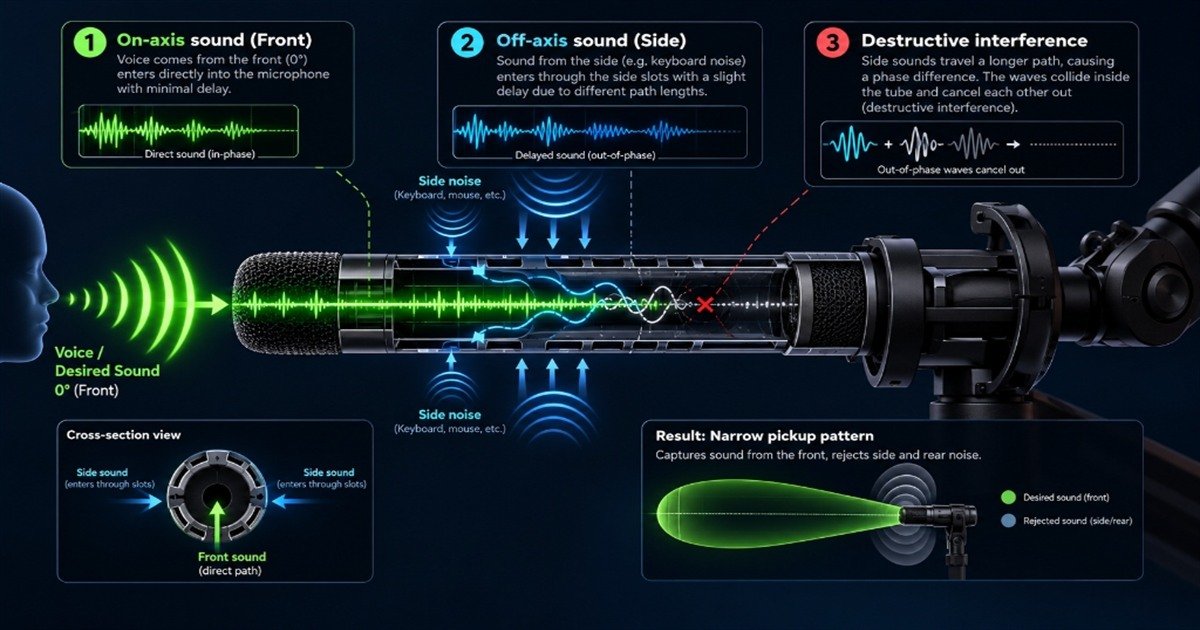
Unlike standard desktop microphones that expose their capsule directly to incoming sound waves, a shotgun microphone encloses its condenser transducer behind a long, slotted barrel known as an acoustic interference tube. Sounds arriving on-axis directly along the barrel centerline travel unobstructed through the tube interior, striking the diaphragm at zero phase discrepancy.
Conversely, acoustic noise originating from the sides, ceiling, or desktop enters the interference tube through precision-engineered lateral slots along the barrel perimeter. Because sound waves entering through different slots travel varying path lengths before reaching the internal capsule, they collide with opposing polarities. This physical collision causes destructive acoustic phase cancellation, attenuating lateral ambient noise by 15 to 25 decibels before conversion into an electrical audio signal.
Supercardioid and Lobar Polar Geometry on Gaming Desks
The acoustic interference tube narrows the microphone front pickup pattern from a standard supercardioid shape into an ultra-tight lobar polar envelope. While a typical cardioid microphone captures voice across a wide 120-degree forward arc, a lobar shotgun microphone restricts its primary sensitivity cone to approximately 30 to 50 degrees.
This narrow pickup corridor allows gamers to position the microphone further away from their face without losing vocal volume or acoustic intimacy. By aiming this tight listening cone directly at your mouth, the microphone acts like an acoustic telephoto lens, capturing every verbal nuance while treating the rest of your room as silence.
Ambient Desk Noise Rejection: Neutralizing Mechanical Keyboards and PC Fans
Shotgun microphones passively eliminate mechanical keyboard switches and desktop fan noise by placing peripheral desk clutter directly into their lateral 90-degree phase-cancellation acoustic nulls.
Lateral Off-Axis Rejection Against Mechanical Switches and Mouse Clicks
Tactile and clicky mechanical keyboard switches generate sharp, high-frequency acoustic transients between 70 and 80 decibels sound pressure level. In competitive gaming rooms, these rapid clicks easily trigger software noise gates, cutting off critical vocal callouts mid-sentence.
Because a shotgun microphone exhibits its deepest acoustic attenuation at 90 degrees and 270 degrees perpendicular to its barrel, positioning the microphone directly above or in front of your battlestation ensures keyboard clatter lands entirely in the side-cancellation zone. Keystroke vibrations entering the side vents cancel themselves out, providing cleaner passive isolation than digital noise filters.
The Rear Sensitivity Lobe Dilemma and Acoustic Positioning
Due to the underlying physics of supercardioid capsules operating within interference tubes, shotgun microphones possess a small secondary sensitivity lobe extending directly out their rear base at 180 degrees. If you angle the microphone barrel downward with its rear base pointing directly at a mechanical keyboard, keystroke noise will enter this rear lobe directly.
To prevent unwanted rear bleed, experienced gamers position shotgun microphones overhead on an articulated boom arm, angling the barrel downward toward their mouth at a 45-degree angle. This orientation points the rear sensitivity lobe upward toward the ceiling, where acoustic reflection is minimal.
The Rear Lobe Trapping Rule: A shotgun microphone does not cancel audio completely from behind; its primary nulls reside at the sides (90 degrees). Never position the rear base of a shotgun microphone flat against your desk or monitor backboard. Angling the rear toward open air or ceiling space ensures your keyboard noise remains trapped in the lateral cancellation slots.
Shotgun Microphone vs Cardioid Microphone for Competitive Gaming
Shotgun microphones provide greater working distance and clean off-camera positioning compared to cardioid microphones, but demand strict head alignment within their narrow pickup corridor.
Working Distance and Off-Camera Positioning Advantages
Standard cardioid studio microphones must sit within 5 to 15 centimeters of your mouth to deliver warm, broadcast-grade vocal richness via the proximity effect. However, having a bulky microphone suspended in front of your face can block your line of sight to a 240Hz or 360Hz gaming monitor, hindering peripheral vision during intense firefights.
A shotgun microphone solves this workspace constraint by maintaining vocal clarity at distances between 30 and 60 centimeters. Gamers and streamers can position the microphone completely out of their webcam frame and away from their gaming monitor, preserving an unobstructed field of view while achieving broadcast-quality speech.
Head Movement Tolerance and The Laser-Beam Sweet Spot
The primary operational compromise of a shotgun microphone is its unforgiving sweet spot. Because the lobar pickup angle spans only 30 to 50 degrees, moving your head slightly off-center causes immediate high-frequency roll-off and vocal volume drops.
Competitive gamers who maintain steady, focused posture during ranked matches thrive with shotgun microphones. However, expressive streamers who frequently turn their heads toward chat monitors or lean backward will experience uneven vocal projection compared to the forgiving, wide-angle coverage of a standard cardioid capsule.
Technical Specification Matrix: Shotgun vs Standard Studio Gaming Microphones
Evaluating acoustic transducers across polar patterns, directional focus, working distance, and noise suppression reveals whether a shotgun microphone aligns with your room setup.
Electroacoustic specification and gaming performance matrix across microphone types:
| Acoustic Metric | Shotgun Microphone (Lobar) | Cardioid Microphone | Omnidirectional Microphone |
|---|---|---|---|
| Polar Pickup Geometry | Narrow Lobar (30 to 50 degrees) | Heart-Shaped (120 degrees) | Spherical (360 degrees) |
| Phase Cancellation Mechanism | Acoustic Interference Tube Slots | Rear Acoustic Labyrinth Delay | None (Pure Pressure Chamber) |
| Lateral Noise Rejection (90 Deg) | Extreme (15 to 25 dB Reduction) | Moderate (6 dB Reduction) | Zero (0 dB Reduction) |
| Rear Rejection Behavior (180 Deg) | Small Sensitivity Lobe Present | Deep Acoustic Null (20 to 25 dB) | Zero Rejection (Full Pickup) |
| Optimal Distance from Mouth | 30 to 60 centimeters | 5 to 15 centimeters | 10 to 30 centimeters |
| Head Movement Forgiveness | Very Strict (Narrow Axis) | Moderate (Wide Forgiveness) | Total (Complete Freedom) |
| Room Reverberation Sensitivity | High Risk of Comb Filtering | Moderate Room Echo Rejection | Severe Room Echo Pickup |
| Visual Monitor Obstruction | Zero (Off-Camera Placement) | High (In Front of Face) | Low to Moderate |
This technical breakdown illustrates that while shotgun microphones lead in off-axis isolation and distance flexibility, cardioid microphones remain superior for gamers in acoustically untreated rooms where wall reflections bounce into the interference tube slots.
Room Acoustic Pitfalls: Comb Filtering in Small Untreated Rooms
Shotgun microphones can produce hollow, metallic comb filtering in small, acoustically untreated rooms when lateral wall reflections enter the interference tube out of phase with direct speech.
Hard Surface Reflections and Destructive Acoustic Interference
The acoustic interference tube relies on sound waves arriving in a predictable physical path to cancel noise. In small residential bedrooms featuring bare drywall, hardwood flooring, and glass windows, vocal sound waves reflect off hard boundaries within milliseconds.
When these early room reflections bounce into the tube lateral slots at odd angles, they interfere destructively with your direct vocal signal. This causes comb filtering, an acoustic distortion that introduces periodic frequency notches across the midrange, making your voice sound hollow, nasal, and distant.
Minimum Room Treatment Guidelines for Lobar Transducers
To avoid comb filtering with a shotgun microphone, gamers must implement basic acoustic absorption around their desk setup. Placing a thick desk mouse pad, hanging heavy blackout curtains, or positioning a dense acoustic foam panel directly behind your monitor absorbs early reflections before they enter the interference tube.
In rooms with severe flutter echo and zero soft furnishings, a directional dynamic cardioid microphone remains a safer choice because its simple acoustic labyrinth is less susceptible to destructive phase distortion from nearby drywall reflections.
The Low-Ceiling Danger: When mounting a shotgun microphone overhead on a desk boom arm, ensure the capsule is positioned at least 30 centimeters below a drywall ceiling. Positioning an interference tube directly against a low ceiling reflects sound waves straight into the top slots, degrading voice callouts with harsh metallic comb filtering.
Desk Mounting, Boom Arm Angles, and Hardware Requirements
Optimizing a gaming shotgun microphone requires an articulated boom arm angled at 45 degrees, a dedicated shock mount to absorb desk vibrations, and clean preamplifier gain.
Overhead Suspension vs Low-Profile Desk Boom Mounting
Because shotgun microphones feature extended barrels measuring 15 to 25 centimeters in length, using a basic desk stand is impractical. Tabletop stands position the capsule too close to mechanical keyboards while pointing the barrel straight into desktop reflections.
An articulated overhead scissor boom arm is the gold standard for shotgun microphone deployment. Suspended from above, the microphone points downward at your mouth from 40 centimeters away, keeping your monitor view unobstructed while aligning the lateral cancellation nulls directly parallel to your mouse pad and keyboard switches.
Preamplifier Gain and XLR Signal Chain Requirements
Most professional shotgun microphones utilize XLR analog connections and require 48V phantom power to charge their sensitive condenser diaphragms. Due to the extended working distance between your mouth and the capsule, you will need a clean audio interface with low-noise microphone preamplifiers offering at least 50 to 55 decibels of gain.
Entry-level USB gaming audio inputs with noisy analog-to-digital converters can introduce audible hiss when gain is pushed to capture distant speech. Pairing your shotgun microphone with a dedicated XLR interface ensures pristine, broadcast-ready signal-to-noise ratios during ranked Discord comms.
Frequently Asked Questions About Shotgun Microphones for Gaming
Essential answers to common questions regarding shotgun microphone acoustic mechanics, desk positioning, and competitive gaming voice performance:
What is a shotgun microphone in gaming audio?
A shotgun microphone is a highly directional audio transducer featuring a slotted acoustic interference tube that cancels off-axis noise to isolate voice communications from extended distances.
Gamers and broadcast streamers use shotgun microphones to capture broadcast-grade voice callouts without placing a bulky microphone directly in front of their faces or blocking their view of the gaming monitor.
How does an acoustic interference tube work on a shotgun mic?
An acoustic interference tube uses precision lateral slots to route off-axis sound waves into phase collisions, destructively canceling ambient room noise before reaching the internal capsule.
On-axis speech enters the open front of the barrel unobstructed, striking the condenser diaphragm at full acoustic energy while peripheral noises cancel out inside the tube labyrinth.
What is a lobar polar pickup pattern?
A lobar polar pickup pattern is an ultra-narrow directional envelope with a primary listening corridor of 30 to 50 degrees, created by superimposing an interference tube over a directional capsule.
This tight acoustic corridor provides significantly greater ambient rejection than standard cardioid patterns, but requires the speaker to remain centered on-axis.
What is the difference between a shotgun mic and a cardioid mic?
A shotgun mic provides a tight 30 to 50 degree pickup angle with extreme side rejection, whereas a cardioid mic captures sound in a broad 120 degree forward arc.
Cardioid microphones require close mouth proximity (5 to 15 centimeters) to prevent room echo, while shotgun microphones maintain vocal presence from 30 to 60 centimeters away.
Why do shotgun microphones cancel mechanical keyboard noise so effectively?
Shotgun microphones cancel keyboard noise by positioning desktop clatter in their lateral 90-degree acoustic nulls, where interference tube slots deliver maximum phase cancellation.
When mounted overhead and angled at the mouth, mechanical switch sounds entering the side vents cancel each other out before reaching the audio interface preamplifier.
What causes comb filtering distortion when using shotgun mics in untreated rooms?
Comb filtering occurs when early acoustic reflections from bare drywall and glass bounce into the tube lateral slots out of phase, creating harsh metallic frequency notches in your voice.
In untreated residential rooms, sound reflections entering through side vents interfere destructively with direct vocal sound waves, resulting in a hollow, thin tone.
What is the rear lobe sensitivity on a shotgun gaming microphone?
The rear lobe is a small acoustic sensitivity zone extending directly behind the microphone base at 180 degrees, characteristic of supercardioid capsules inside interference tubes.
Pointing the rear base of a shotgun microphone flat at a keyboard will capture keystroke noise; angling the rear toward the ceiling eliminates this problem.
Why do shotgun microphones require more preamplifier gain than dynamic mics?
Shotgun microphones operate at longer working distances (30 to 60 centimeters), requiring clean preamplifier gain of 50 to 55 decibels to amplify the lower sound pressure reaching the capsule.
Using a low-noise XLR audio interface prevents audible background hiss from degrading voice communication during quiet tactical gameplay moments.
Can a shotgun microphone be mounted off-camera while maintaining voice clarity?
Yes, shotgun microphones excel at off-camera placement, capturing rich, articulate voice callouts from 45 to 60 centimeters away without appearing in webcam frames.
This off-camera flexibility keeps streaming battlestations visually clean while providing unhindered visibility to competitive gaming displays.
Does a shotgun microphone require dedicated room acoustic treatment?
Basic acoustic treatment like desk mouse pads and heavy curtains is recommended to prevent wall reflections from causing destructive comb filtering in the tube slots.
In completely bare, highly reverberant rooms with hard floors, a directional dynamic cardioid microphone remains a more forgiving option.
Which competitive games benefit most from shotgun microphone voice chat?
Tactical shooters like Counter-Strike 2, Valorant, and Apex Legends benefit most because rapid, urgent callouts remain intelligible over frantic keyboard clicking and mouse flicking.
Passive acoustic suppression prevents team Discord audio from cluttering during clutch rounds and high-intensity firefights.
Is a boom arm mandatory for operating a shotgun microphone at a gaming desk?
Yes, an articulated boom arm is mandatory to suspend the shotgun microphone overhead at a 45-degree angle and maintain optimal distance without desk clutter.
Desktop stands position shotgun barrels incorrectly, capturing keyboard transients and surface vibrations directly into the acoustic transducer.
Final Verdict: Matching Shotgun Acoustics to Your Battlestation Setup
A shotgun microphone is the ultimate choice for gamers who demand clean, off-camera vocal clarity and passive keyboard rejection, provided their room has basic acoustic absorption and they maintain disciplined on-axis posture.
For gamers battling loud mechanical switch clatter in moderately furnished rooms, a shotgun microphone suspended on an overhead boom arm delivers an unmatched combination of visual freedom and surgical voice isolation. However, if your room suffers from severe drywall flutter echo, exploring our guide to dynamic vs condenser microphones or reviewing standard directional mechanics in our cardioid vs omnidirectional microphone comparison will help you select the ideal acoustic transducer for your competitive battlestation.