
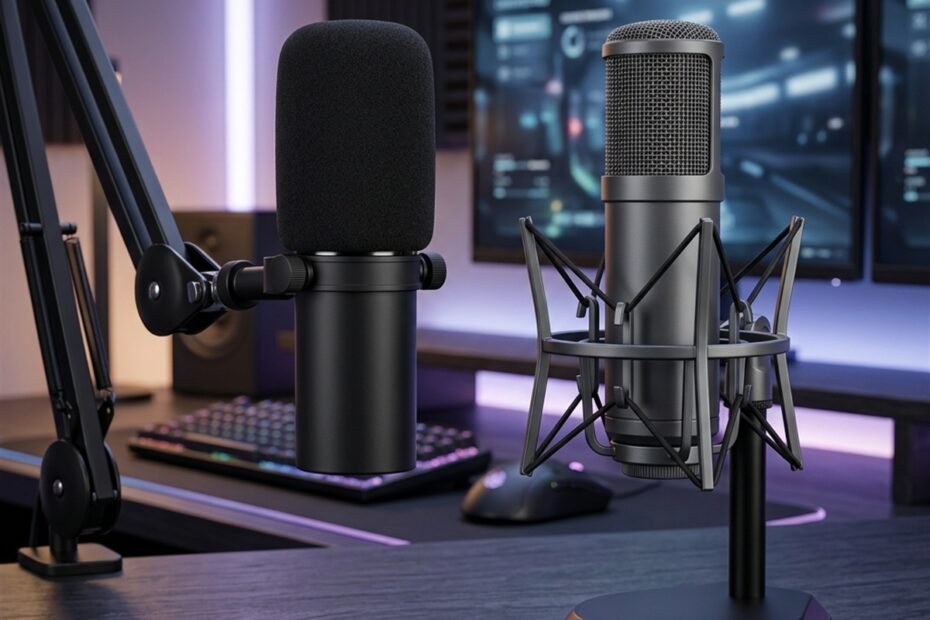
Navigating the choice between a dynamic vs condenser microphone is a fundamental technical decision for competitive gamers, streamers, and audio creators striving for articulate voice transmission. In high-stakes tactical shooters like Counter-Strike 2 and Valorant, team communication frequently contends with loud mechanical keyboard clicks, high-RPM PC chassis fans, and reverberant room echoes that degrade voice intelligibility.
Understanding the core electroacoustic distinctions between heavy moving-coil dynamic diaphragms and ultralight electrostatic condenser plates allows you to select the ideal acoustic transducer for your battlestation acoustics. Expanding upon our foundational guide to types of gaming microphones, this engineering analysis evaluates sensitivity ratings, transient response metrics, ambient room noise rejection, and preamp gain requirements to help you configure an optimal voice setup.
Transducer Physics: Electromagnetic Induction vs Electrostatic Capacitance
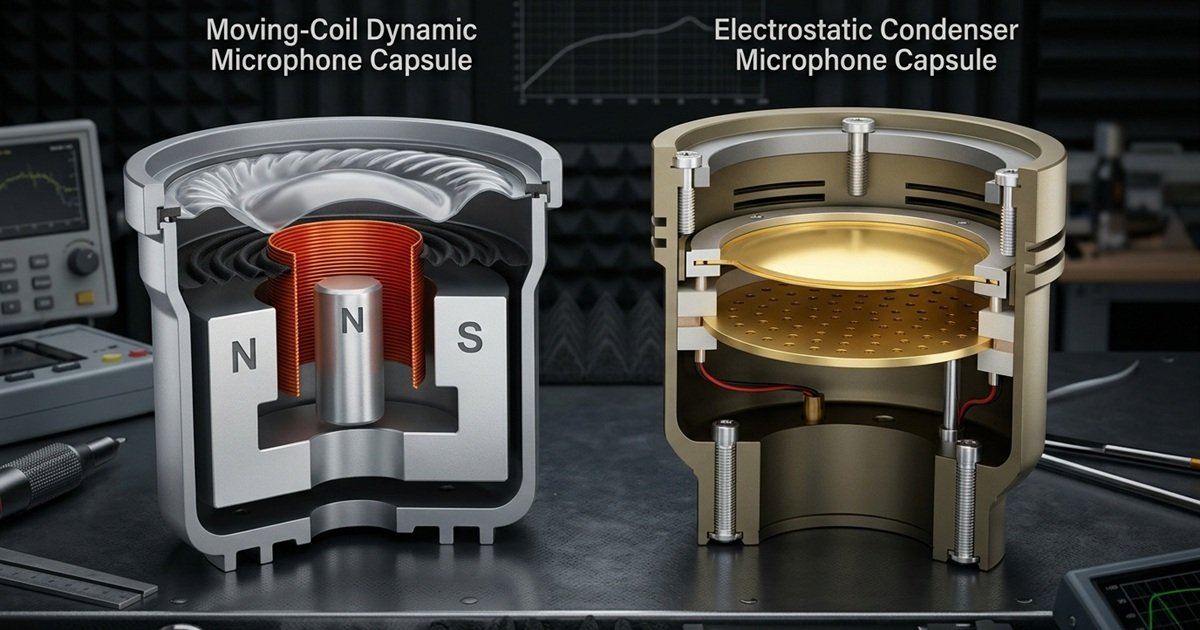
Dynamic microphones generate audio signals through electromagnetic induction via a voice coil attached to a heavy mylar diaphragm, whereas condenser microphones detect sound waves through variable capacitance across an ultralight gold-sputtered diaphragm and a charged backplate.
Moving-Coil Dynamic Microphones: Heavy Diaphragms and Electromagnetic Induction
A dynamic microphone operates on the physical principle of electromagnetic induction, identical to an audio loudspeaker operating in reverse. Inside the capsule, a relatively thick plastic mylar diaphragm is permanently glued to a finely wound copper voice coil. This voice coil is suspended inside a tight magnetic field created by a permanent neodymium or ferrite magnet.
When acoustic sound pressure waves strike the diaphragm, the attached copper coil vibrates forward and backward through the magnetic lines of force. This physical mechanical displacement induces a miniature electrical voltage proportional to the acoustic wave velocity. Because the voice coil adds significant physical mass to the moving assembly, dynamic capsules require substantial acoustic energy to initiate movement, making them naturally insensitive to faint, distant environmental noises.
Condenser Microphones: Ultralight Gold-Sputtered Diaphragms and Variable Capacitance
A condenser microphone operates on electrostatic capacitance principles rather than magnetic induction. The capsule houses a micro-thin, flexible membrane, typically crafted from gold-sputtered mylar measuring less than 3 microns in thickness. This membrane is positioned parallel to a solid, stationary metal plate separated by a microscopic air gap, forming an electrical capacitor.
An electrical polarization charge, supplied either by external 48-volt phantom power or a permanently charged electret material, is maintained across the capacitor plates. When sound waves hit the ultra-thin front membrane, the distance between the two plates fluctuates rapidly, modulating electrical capacitance and generating a delicate audio signal. Because the membrane possesses virtually negligible physical inertia, it reacts instantaneously to even the most subtle, high-frequency acoustic fluctuations.
Acoustic Sensitivity and Background Noise Rejection
Dynamic microphones feature lower sensitivity (-55 dBV) and heavier diaphragm mass that naturally suppress ambient keyboard clicks and fan hum, whereas condenser microphones feature high sensitivity (-35 dBV) that captures room reverberation.
Diaphragm Mass, Inertia, and Transient Response
The stark disparity in diaphragm mass between the two transducer architectures directly governs their acoustic sensitivity and transient response. Transient response defines how quickly a microphone diaphragm accelerates when struck by a sudden acoustic wave front and how rapidly it settles back to complete rest after the wave passes.
Because a condenser diaphragm has minimal physical mass, its acceleration and deceleration curves are nearly instantaneous. This mechanical speed yields an extended frequency response ranging from 20 Hz to 20 kHz with sparkling high-frequency clarity. Conversely, the substantial inertia of a dynamic moving-coil assembly acts as a physical acoustic dampener, attenuating sharp transient spikes such as bottom-out mechanical switch clatter.
Acoustic Room Acoustics and Mechanical Keyboard Rejection
In standard, unpadded home gaming rooms with bare drywall, wooden desk surfaces, and hardwood floors, acoustic energy reflects repeatedly between walls, creating flutter echo and standing room reverberation. When competitive gamers speak into a condenser microphone in untreated spaces, the hyper-sensitive capsule captures both direct vocal energy and reflected room bounce, producing a hollow, distant voice quality on Discord voice servers.
Dynamic microphones mitigate room reflections through their inherently low acoustic output sensitivity. Because sound wave intensity diminishes exponentially over distance according to the inverse-square acoustic law, distant reflections from computer case fans and room boundaries lack the kinetic energy necessary to physically displace the heavy dynamic diaphragm assembly, resulting in pristine vocal isolation.
Diaphragm mass dictates environmental noise isolation: The physical weight of a copper voice coil in a dynamic capsule acts as a passive mechanical noise gate. It rejects background PC fan hum and tactile switch chatter without requiring aggressive digital noise suppression algorithms that clip vocal frequencies during high-intensity tactical comms.
Proximity Effect and Working Distance Dynamics
Dynamic microphones require close physical proximity of 5 to 10 centimeters to leverage the proximity effect for full broadcast vocal warmth, whereas condenser microphones allow flexible speaking distances of 15 to 30 centimeters.
The Proximity Effect: Bass Boost and Vocal Intimacy
The proximity effect is an acoustic phenomenon inherent to all pressure-gradient directional microphones, wherein lower audio frequencies experience an artificial bass boost as the speaker moves closer to the capsule. Because dynamic microphones require close mouth placement due to their low sensitivity, speakers can harness the proximity effect to impart rich, authoritative radio-broadcast warmth to their voice communications.
When operating a dynamic microphone at a distance of 5 to 8 centimeters, vocal fundamentals between 80 Hz and 250 Hz gain up to 6 to 10 decibels of natural acoustic enhancement. This low-end reinforcement provides substantial vocal body during tactical callouts. However, speaking too close without an integrated foam windscreen or external pop filter can trigger harsh plosive distortion from burst consonants like P and B sounds.
Working Distance and Desk Ergonomics
Working distance dramatically influences desk ergonomic arrangements and monitor visibility. Operating a dynamic microphone demands dedicated placement on an articulated boom arm that positions the capsule directly in front of the mouth, keeping the microphone within the critical 5 to 10 centimeter operational zone throughout lengthy gaming sessions.
In contrast, a condenser microphone functions effectively at a working distance of 20 to 35 centimeters, allowing gamers to position the device further back on the desktop or underneath the primary monitor viewing angle. However, increasing the working distance also increases the ratio of ambient background room noise to direct vocal sound, making clean audio capture contingent upon a quiet environment.
Dynamic vs Condenser Microphone: Technical Specification Comparison
Evaluating fundamental electroacoustic specifications reveals that dynamic microphones excel in passive noise rejection and durability, while condenser microphones deliver wider frequency response and superior sensitivity.
The following technical matrix outlines the key electroacoustic differences between dynamic and condenser microphone architectures:
| Acoustic Metric | Dynamic Moving-Coil | Condenser Electrostatic | Gaming and Voice Chat Impact |
|---|---|---|---|
| Operating Principle | Electromagnetic Induction | Variable Capacitance | Dynamic uses coil movement; condenser uses electrostatic plate charge. |
| Sensitivity Rating | Low (-58 to -50 dBV/Pa) | High (-40 to -30 dBV/Pa) | Dynamic requires loud direct voice; condenser detects faint ambient whispers. |
| Frequency Response | 40 Hz to 16 kHz (Tuned mids) | 20 Hz to 20 kHz (Full spectrum) | Dynamic emphasizes voice intelligibility; condenser captures airy highs. |
| Transient Response | Moderate (High coil inertia) | Ultra-fast (Near-zero mass) | Dynamic softens sharp key clicks; condenser captures fast percussive transients. |
| Background Noise Pickup | Low (Natural room rejection) | High (Picks up fan hum and echo) | Dynamic is optimal for untreated rooms; condenser demands acoustic treatment. |
| Power Requirement | Passive (No power needed) | Active (+48V or USB 5V charge) | Dynamic XLR needs no power; condenser requires phantom power to bias plates. |
| Optimal Distance | 5 to 10 cm (Close proximity) | 15 to 30 cm (Moderate distance) | Dynamic requires boom arm positioning; condenser allows desktop stand use. |
| Preamp Gain Demand | High (55 to 65 dB clean gain) | Low to Moderate (35 to 45 dB gain) | Dynamic XLR mics require powerful audio interfaces or in-line preamps. |
| Physical Durability | Extremely rugged and drop-resistant | Delicate internal capsule assembly | Dynamic withstands travel and accidental drops; condenser requires care. |
| Cost Profile | 50 to 400 USD | 40 to 1000+ USD | Both categories offer excellent competitive options at entry and pro levels. |
This comparative baseline illustrates why hardware selection should correlate directly with your physical room environment. For competitive esports setups situated near computer exhaust fans and clacking tactile switches, the acoustic dampening inherent to dynamic capsules offers a distinct competitive advantage.
Preamp Gain, Power Requirements, and Signal Chains
Condenser microphones require +48V phantom power to charge internal capacitor plates and impedance converters, whereas dynamic microphones are passive but demand 55 to 65 dB of clean preamplifier gain.
Phantom Power (+48V) Requirements for Active Condenser Capsules
All condenser microphone capsules represent active electrical circuits that require steady direct-current voltage to operate. In professional studio setups, this electrical power is delivered via standard 3-pin XLR cables as +48-volt phantom power, supplied directly by an external audio interface or mixing console. The voltage serves two distinct duties: biasing the electrostatic capsule plates and powering an internal preamplifier or impedance-converting field-effect transistor.
In consumer USB condenser microphones, this operating voltage is down-regulated internally from the computer USB port 5-volt power bus. Without active electrical current, a condenser capsule cannot generate an audio signal. In contrast, passive dynamic microphones contain no active electrical components and operate completely independently of phantom power supplies.
High Preamp Gain Demand and In-Line Boosters for Dynamic Microphones
Because moving-coil dynamic capsules produce remarkably low electrical output voltages (often around -55 to -58 dBV), connecting a dynamic microphone to an audio interface requires substantial analog preamplifier gain to elevate the mic-level signal to standard digital recording levels. Competitive voice comms typically require between 55 and 65 decibels of clean, uncolored preamp amplification.
Budget audio interfaces often introduce audible background electronic hiss or circuit noise when pushed beyond 80 percent of their maximum gain capacity. Gamers deploying dynamic microphones frequently pair their setup with an in-line gain booster or invest in robust audio interfaces, as detailed in our comprehensive guide comparing USB vs XLR microphones for gaming voice setups.
Practical Decision Framework: Which Transducer Fits Your Battlestation?
Select a dynamic microphone if your gaming desk resides in an untreated room with mechanical keyboards and PC fan noise, or choose a condenser microphone if you speak in a treated, quiet space.
Follow this sequential evaluation process to determine the optimal microphone capsule for your desktop gaming environment:
- Audit Ambient Room Noise: Listen carefully to your gaming room during peak hours. If you hear PC chassis fan whine, air conditioning air movement, mechanical keyboard clicks, or distant street traffic, select a dynamic microphone for passive environmental rejection.
- Inspect Room Reverberation and Wall Reflections: Clap your hands firmly in front of your computer monitor. If you detect a sharp flutter echo or hollow metallic ring reflecting off bare walls and hard floors, a dynamic microphone will isolate your voice without capturing muddy room reverberation.
- Assess Boom Arm Mounting and Monitor Visibility: Determine whether you can comfortably mount an articulated boom arm to position a microphone capsule within 5 to 10 centimeters of your mouth without obstructing your primary gaming display. If boom arm placement is impractical, a condenser microphone accommodates greater working distance.
- Evaluate Signal Chain and Hardware Budget: Factor in audio interface preamp capabilities. If you select an XLR dynamic microphone, verify that your audio interface delivers at least 60 decibels of clean gain, or allocate budget for an in-line signal booster.
The Competitive Gamer Golden Rule: An untreated room paired with a dynamic microphone delivers substantially cleaner voice communication than a 500-dollar condenser microphone operating in an untreated space. Acoustic isolation at the capsule level always outperforms software noise suppression filters.
Frequently Asked Questions: Dynamic vs Condenser Microphones
Explore detailed technical answers to the most common questions regarding dynamic and condenser microphone architectures, sensitivity ratings, and gaming voice chat performance:
What is a dynamic microphone?
A dynamic microphone is an electroacoustic transducer that converts sound waves into electrical audio signals using electromagnetic induction, utilizing a plastic mylar diaphragm attached to a copper voice coil suspended within a magnetic field.
What is a condenser microphone?
A condenser microphone is an electrostatic transducer that captures acoustic sound pressure via variable capacitance between a micro-thin conductive diaphragm and an electrically charged backplate, requiring electrical power to operate.
What is the main difference between dynamic and condenser microphones?
The primary difference lies in capsule mechanics: dynamic microphones use moving voice coils with heavier mass for passive noise isolation, whereas condenser microphones utilize electrostatic diaphragms with near-zero mass for higher sensitivity and wider frequency detail.
What is microphone sensitivity and how is it measured?
Microphone sensitivity measures the electrical voltage output generated by a capsule when subjected to a standardized acoustic sound pressure level of 94 dB SPL (1 Pascal) at 1 kHz, expressed in negative decibels relative to 1 volt (dBV/Pa).
Why do dynamic microphones reject background noise better than condenser microphones?
Dynamic microphones reject ambient noise because their heavy diaphragm and voice coil assembly require substantial acoustic sound pressure to overcome inertia, naturally ignoring distant, lower-energy sound waves like fan hum and wall reflections.
What is transient response in gaming voice communication?
Transient response measures how rapidly a microphone diaphragm starts and stops moving in response to sudden acoustic impulses. Fast condenser transients capture articulate vocal nuances but also amplify sharp mechanical switch clicks.
Do dynamic microphones require 48V phantom power?
No, standard passive dynamic microphones operate entirely via electromagnetic induction and require no external electrical power. Supplying phantom power will not damage modern balanced dynamic microphones, but it provides no functional operational benefit.
What is the proximity effect in vocal microphones?
The proximity effect is an acoustic phenomenon in directional microphones that progressively amplifies low-frequency bass response as the sound source moves closer to the capsule, adding warm broadcast depth at distances under 10 centimeters.
Which microphone type is better for noisy gaming environments with mechanical keyboards?
A dynamic microphone is substantially better for noisy gaming spaces because its lower sensitivity and heavy moving-coil diaphragm passively attenuate high-frequency mechanical switch clatter and PC fan whine before the signal reaches software voice chat.
Can you use a condenser microphone without acoustic room treatment?
Yes, but high capsule sensitivity will inevitably capture ambient room reverberation, flutter echoes, and computer fan hum, often requiring aggressive software noise gate suppression that can clip and distort natural vocal communication.
Why do radio broadcasters and podcasters prefer dynamic microphones?
Broadcasters rely on dynamic microphones because their durable capsules provide exceptional off-axis sound rejection, consistent vocal warmth via close-proximity speaking, and immunity to high sound pressure level distortion during loud vocal peaks.
Does a condenser microphone sound more natural than a dynamic microphone?
In acoustically treated sound booths, condenser microphones deliver a more natural, airy, and realistic vocal representation due to flat extended high-frequency response; however, in untreated home rooms, dynamic microphones produce cleaner, more focused speech.
Final Verdict: Choosing Between Dynamic and Condenser Capsules
Choose a dynamic microphone if you game in an everyday home room with mechanical keyboards, PC fans, and untreated walls; choose a condenser microphone if you operate in a quiet, acoustic-treated studio and prioritize airy vocal nuances.
Selecting the proper microphone transducer architecture establishes the bedrock of professional vocal quality for competitive gaming and streaming. While condenser microphones shine in controlled recording studios, the rugged reliability, heavy diaphragm inertia, and passive room rejection of moving-coil dynamic microphones make them the premier choice for demanding battlestations.
Thank you for reading GearTP. We hope this comprehensive engineering guide between dynamic and condenser microphones empowers you to equip your setup with the exact audio hardware needed for crystal-clear tactical voice communication.