
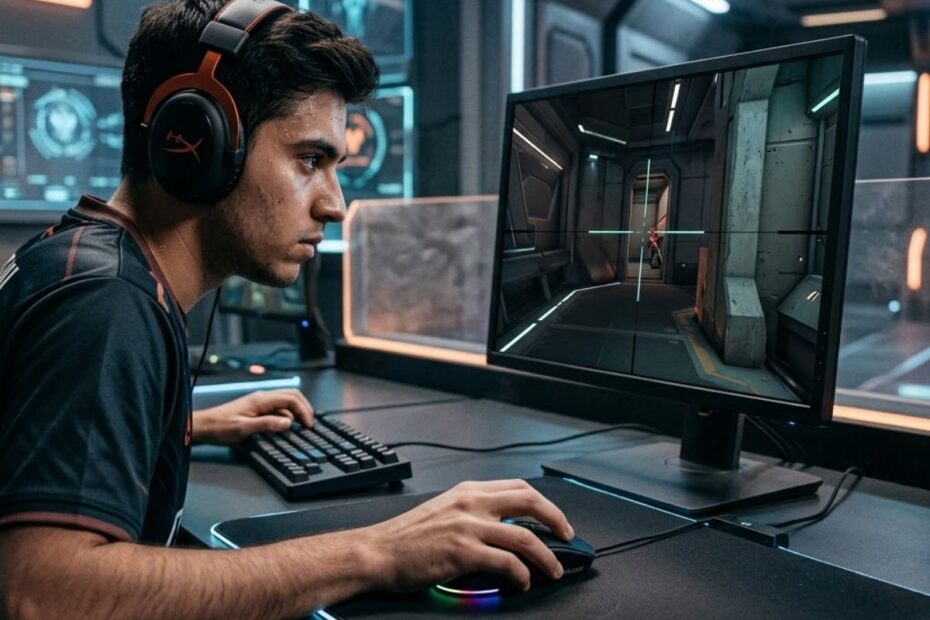
Crosshair placement in Valorant is the skill of keeping your crosshair positioned where enemies are most likely to appear before they peek, and it helps reduce reaction time, improve headshot consistency, and increase the chance of winning gunfights before opponents can react.
Many Valorant players spend hours changing sensitivity settings or buying new gear while ignoring the mechanic that actually decides most fights. Even players with average aim can outperform mechanically gifted opponents if their crosshair is already positioned correctly before the duel starts.
This guide explains how crosshair placement works in Valorant, why it matters more than flicking in tactical FPS games, and how to train it correctly. You will also learn common mistakes, map positioning habits, pre-aiming techniques, and how mouse settings affect precision during real matches.
“Good tactical aim is less about speed and more about preparation before the fight even starts.”
That idea perfectly explains why crosshair placement is such a dominant mechanic in Valorant. Tactical shooters reward prediction and positioning far more than random fast movements.
Why Crosshair Placement Matters More Than Flick Aim
Crosshair placement is the habit of keeping your crosshair ready at likely enemy positions, and it helps players react faster than relying on last-second flick shots. In Valorant, most gunfights are decided before the crosshair starts moving, making preparation more valuable than emergency corrections.
The comparison below shows the difference between a prepared crosshair position and a reactive flick. One player starts with the crosshair already near the target, while the other must make a large correction after spotting the enemy:
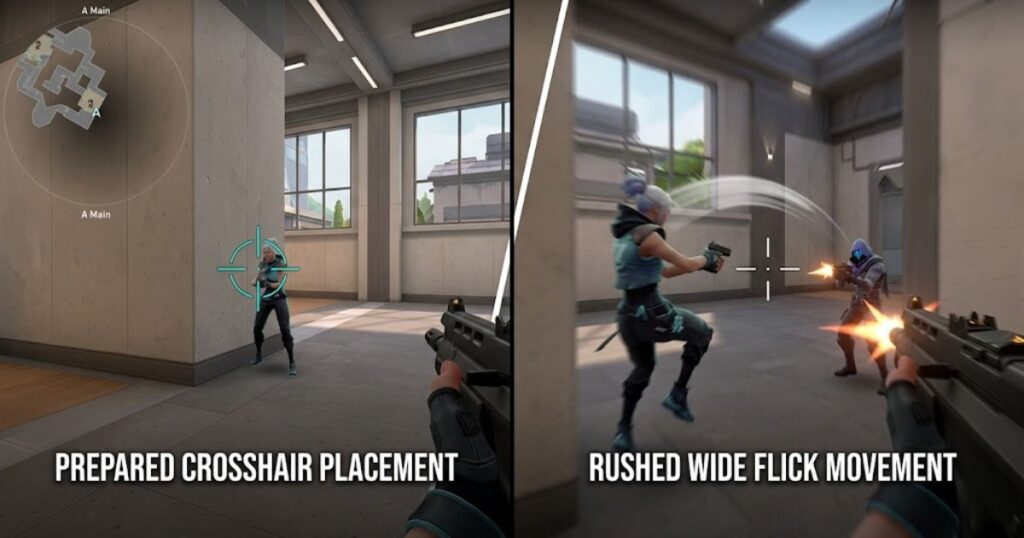
A lot of players think professional aim comes from impossible reflexes. In reality, most high rank players simply minimize unnecessary mouse movement. Their crosshair stays prepared before the fight begins, which makes aiming look effortless.
This is also why many tactical FPS players focus heavily on positioning and prediction instead of flashy highlight plays. Consistency wins more rounds than occasional flick shots.
The table below summarizes how different aiming styles affect reaction speed, movement efficiency, and consistency during real Valorant gunfights:
| Aiming Style | Result in Valorant | Consistency |
|---|---|---|
| Good crosshair placement | Small adjustments before shooting | High |
| Reactive flick aiming | Large emergency movements | Medium |
| Random crosshair movement | Late reaction timing | Low |
Key takeaway: Players who rely on good crosshair placement usually need fewer mouse adjustments, while reactive flick aiming often introduces unnecessary movement and inconsistency.
Players who struggle with inconsistent aim usually have poor preparation before enemy contact. Their crosshair drifts toward the floor, walls, or empty space instead of likely enemy positions.
If you are still trying to build a stable aiming foundation, reading tactical aiming in valorant can help you understand how positioning and preparation work together during real matches.
Valorant Rewards Precision Over Speed
Valorant rewards precision over speed because accurate first shots and proper crosshair placement often decide fights before extended tracking or reactive flicking becomes necessary. Players who position their crosshair correctly can eliminate opponents faster with fewer adjustments.
This creates a gameplay loop where preparation matters more than panic reactions. Players who constantly rely on fast flicks usually lose consistency over long sessions because every duel requires larger corrective movements.
Professional players often appear calm during fights because their crosshair already covers the most dangerous angle before enemies appear. Their success comes from prediction and positioning rather than raw reaction speed alone.
Most Fights Are Won Before the Enemy Appears
Most fights in Valorant are won before the enemy appears because experienced players already predict likely enemy positions, peek timing, and head-level locations before visual contact occurs. Good crosshair placement helps players prepare for danger instead of reacting to it after it appears.
This means crosshair placement is closely connected to map awareness, positioning, and game sense. Your crosshair should constantly reflect where an opponent is most likely to emerge rather than following empty space.
As players gain experience, they begin to anticipate common movement paths and dangerous angles. This allows them to keep their crosshair ready before a duel starts, reducing the need for large corrections during combat.
For most players, improving crosshair placement creates a bigger impact on consistency than trying to increase reaction speed alone.
What Good Crosshair Placement in Valorant Looks Like
Good crosshair placement is the habit of keeping your crosshair at head level and aligned with likely enemy positions, and it helps reduce unnecessary mouse movement after spotting an opponent. The goal is to make small adjustments instead of relying on large reactive flicks during a duel.
The example below compares disciplined crosshair placement with a rushed reactive flick. Notice how the prepared crosshair starts much closer to the enemy’s head before the engagement begins:
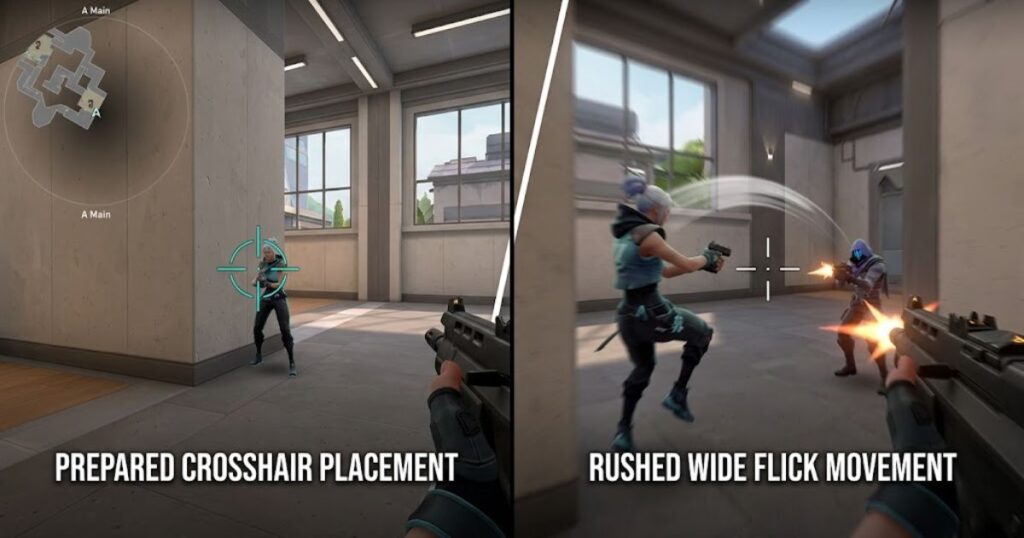
Many players misunderstand this mechanic and simply stare at random walls near corners. Real crosshair placement involves distance management, angle prediction, and movement discipline.
Strong players constantly adjust their crosshair based on position changes across the map.
The table below highlights several crosshair placement habits that experienced Valorant players use to improve consistency and reaction speed:
| Good Habit | Why It Works |
|---|---|
| Keeping crosshair at head height | Improves first bullet accuracy |
| Holding wider against fast peeks | Prevents overflicking |
| Clearing one angle at a time | Reduces mental overload |
| Keeping crosshair near danger zones | Improves reaction speed |
These habits may look simple, but together they reduce unnecessary movement and help players maintain more reliable aim throughout a match.
Players with disciplined crosshair placement often appear smoother and more controlled because they spend less time correcting mistakes and more time taking accurate shots.
Head Level Placement in Valorant
Head level placement is the practice of keeping your crosshair aligned with where an enemy’s head is most likely to appear, and it helps reduce the amount of adjustment needed before taking a shot. This habit improves first-bullet accuracy and makes headshots more consistent during real matches.
Most maps include visual references that help maintain correct head-level alignment. Boxes, wall lines, door handles, and environmental textures can all serve as useful guides while moving around the map.
Experienced players gradually learn these visual anchors and use them automatically to maintain accurate crosshair placement without constantly thinking about it.
As a result, head-level positioning becomes one of the simplest ways to improve aiming consistency without changing sensitivity or equipment.
How Far Should Your Crosshair Be From Corners?
Crosshair distance from corners is the space between your crosshair and the edge of a wall, and it helps you react correctly to different peek speeds. A wider gap usually works better against fast swings, while a tighter gap may be enough against slow peeks.
One of the most common mistakes among lower-ranked players is holding the crosshair directly against a wall. When an enemy swings wide, they often need a large correction before they can shoot accurately.
Adjusting crosshair distance based on the situation allows you to cover more realistic enemy movement paths and maintain better control during engagements.
In many situations, a slightly wider crosshair position provides more consistent results against aggressive opponents.
How to Position Your Crosshair While Moving Around the Map in Valorant
Maintaining good crosshair placement while moving around the map means keeping your crosshair focused on the next dangerous angle, and it helps you stay prepared for unexpected enemy contact during rotations. Strong players treat every movement path as a potential engagement rather than a safe transition.
A common low-rank mistake is relaxing the crosshair while moving between locations. Experienced players remain ready throughout the round because opponents can appear at any moment, especially during rotations and map control battles.
Crosshair discipline should stay active whether you are entering a site, rotating, defending, or holding post-plant positions.
The table below shows how crosshair positioning should change across different movement situations in Valorant:
| Movement Situation | Best Crosshair Behavior |
|---|---|
| Entering site | Clear common angles one by one |
| Rotating | Keep crosshair near likely peek spots |
| Holding post plant | Pre aim expected enemy entry points |
| Defending choke points | Hold slightly wider against swings |
Adapting your crosshair to the situation reduces unnecessary corrections and helps maintain consistent readiness throughout the round.
Crosshair placement becomes significantly easier when combined with smart pathing, map awareness, and an understanding of likely enemy positions. The better you understand the map, the easier it becomes to keep your crosshair where threats are most likely to appear.
How to Clear Angles Properly in Valorant
Proper angle clearing is the process of checking one threat at a time while moving through the map, and it helps reduce exposure to multiple enemies during a fight. Good crosshair placement should smoothly transition between likely enemy positions as you clear each angle.
Rushing into sites without controlled clearing often creates situations where large flicks become necessary. In contrast, tactical shooters reward players who gather information methodically before committing to a duel.
Strong angle-clearing habits allow players to maintain better crosshair discipline and make more confident decisions when entering contested areas.
Over time, disciplined clearing becomes one of the simplest ways to reduce unnecessary deaths and improve consistency in ranked matches.
Understanding Common Enemy Positions in Valorant
Understanding common enemy positions is the ability to recognize where opponents are most likely to hold angles, and it helps players pre-aim before visual contact occurs. Many defensive setups repeat across matches, especially in ranked play.
Defenders frequently use predictable off-angles, head-glitch positions, and choke points to control space. Experienced players automatically move their crosshair toward these locations before peeking.
This predictive approach reduces reaction time because the crosshair is already positioned near the most likely threat instead of searching for targets after they appear.
As map knowledge improves, crosshair placement becomes more efficient and gunfights become noticeably cleaner and more controlled.
Common Crosshair Placement Mistakes in Valorant
Common crosshair placement mistakes are habits that place the crosshair away from likely enemy positions, and they increase reaction time, reduce aiming consistency, and force unnecessary corrections during gunfights. Many of these errors happen while moving, rotating, or clearing angles under pressure.
The comparison below highlights several crosshair placement errors that frequently appear in ranked matches. Small positioning mistakes can create large aiming corrections when an enemy suddenly enters view:
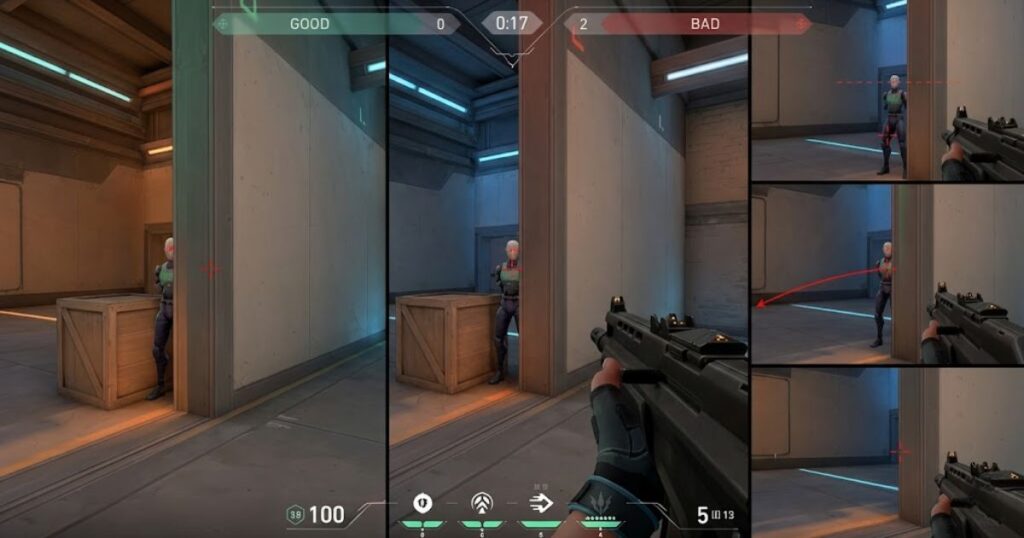
The good news is that most crosshair placement mistakes are highly fixable through awareness and repetition. Many players improve faster by correcting bad habits than by changing sensitivity settings or buying new equipment.
Fixing these issues often produces immediate improvements because the crosshair spends more time near likely enemy positions.
The table below summarizes several common crosshair placement mistakes and the problems they create during real Valorant matches:
| Mistake | Problem Created |
|---|---|
| Aiming at the floor | Slow upward correction |
| Holding corners too tightly | Overflicking against wide swings |
| Ignoring head level | More body shots |
| Crosshair drifting away from likely enemy positions | Poor readiness |
| Overclearing empty space | Late reactions |
Players can usually reduce these mistakes by focusing on a few simple habits:
- Keep the crosshair at head level whenever possible.
- Adjust crosshair distance based on peek speed.
- Pre-aim common enemy positions before turning corners.
- Maintain crosshair discipline during rotations.
- Avoid staring at empty space while moving.
Most aiming problems are not caused by slow reactions. They are often the result of poor crosshair positioning before the engagement begins.
Looking at the Ground
Looking at the ground is one of the most common crosshair placement mistakes in Valorant, and it forces players to make larger upward corrections before taking a shot. Many players unconsciously lower their crosshair while moving around the map without realizing how much reaction time they lose.
This extra travel distance becomes a major disadvantage because Valorant gunfights are often decided within a fraction of a second. Even small adjustments can determine who lands the first accurate shot.
Players who consistently keep their crosshair below head level usually lose more instant headshot duels and spend more time correcting their aim during fights.
Developing the habit of maintaining head-level crosshair placement is often one of the fastest ways to improve aiming consistency.
Over Flicking Every Fight
Over flicking is the habit of relying on large reactive mouse movements after spotting an enemy, and it reduces aiming consistency compared to proper crosshair preparation. Players who constantly depend on emergency flicks often struggle to reproduce the same result under pressure.
Good crosshair placement minimizes the need for dramatic corrections because the crosshair already starts near the expected target location. As a result, the required movement before shooting becomes much smaller.
Many of the best Valorant players appear calm during gunfights because their crosshair barely moves before securing a kill. Their success comes from preparation rather than reaction alone.
In ranked matches, consistency usually produces better long-term results than flashy mechanical plays.
Ignoring Enemy Movement Speed
Ignoring enemy movement speed is a common positioning mistake that causes players to hold the wrong crosshair distance from corners, and it makes reacting to different peek styles more difficult. Effective crosshair placement should always account for how an opponent is likely to move.
Fast wide swings typically require a wider crosshair position, while slow jiggle peeks and tighter angles often allow a closer hold. Using the same crosshair placement for every situation can leave players unprepared for unexpected movement.
Players who fail to adjust their crosshair distance become easier to predict and frequently need larger corrections when enemies appear.
Learning to adapt to enemy habits is an important part of advanced crosshair placement and overall game sense..
How Mouse Sensitivity Affects Crosshair Placement in Valorant
Mouse sensitivity is the setting that determines how far the crosshair moves in response to mouse movement, and it helps players maintain better crosshair placement when matched to their aiming style. Extremely high sensitivity often makes precise positioning harder, while extremely low sensitivity can reduce mobility.
The example below illustrates a typical Valorant setup focused on stable mouse control and precise crosshair adjustments. Consistent sensitivity settings make it easier to maintain accurate crosshair placement during real :matches.
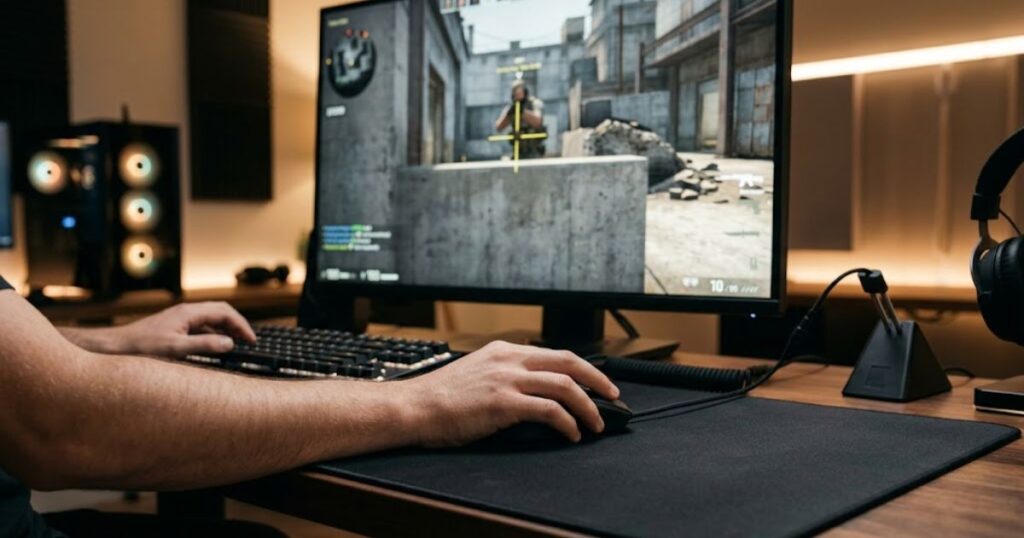
The ideal sensitivity allows controlled micro-adjustments without excessive wrist strain. Most professional Valorant players use relatively low to medium sensitivity because it improves consistency and stopping precision.
Crosshair placement becomes much easier when sensitivity supports smooth and predictable movement rather than sudden overcorrections.
The table below compares how different sensitivity ranges can influence crosshair placement control and aiming stability:
| Sensitivity Style | Crosshair Placement Control |
|---|---|
| Very high sensitivity | Harder to stabilize |
| Medium sensitivity | Balanced control |
| Low sensitivity | Excellent precision |
No single sensitivity setting works for every player. The best choice is the one that allows consistent crosshair positioning with minimal correction during engagements.
If you are still experimenting with settings, reading best sensitivity for valorant can help you build a more stable aiming setup around your playstyle.
Why Low Sensitivity Helps Precision
Low sensitivity is an aiming setup that requires more physical mouse movement, and it helps improve precision by allowing smaller and more controlled crosshair adjustments. This makes it easier to maintain accurate crosshair placement during tracking and target transitions.
Many professional Valorant players prefer lower sensitivity because tactical FPS games reward consistency and accuracy more than rapid cursor movement.
Lower sensitivity also reduces accidental overcorrection during stressful fights, helping players keep their crosshair closer to intended targets.
For many players, improved control and consistency outweigh the reduced turning speed associated with lower sensitivity settings.
Mouse Control Still Matters
Mouse control is the ability to make precise and consistent crosshair adjustments, and it helps players apply sensitivity settings effectively during real matches. Even the best settings cannot compensate for poor crosshair placement, weak movement discipline, or inconsistent positioning habits.
Strong aim comes from combining stable settings with good crosshair placement, controlled movement, and accurate prediction. Sensitivity should support your mechanics rather than act as a shortcut for fundamental aiming mistakes.
If small adjustments still feel shaky or inconsistent, your mouse hardware may also play a role. Players looking to improve tracking stability and precision can explore the best gaming mouse for Valorant guide to learn how mouse shape, weight, and sensor performance influence crosshair control in tactical FPS games.
Ultimately, the most effective setup is one that allows you to maintain accurate crosshair placement consistently throughout a match.
How Crosshair Placement Supports Tactical Aiming in Valorant
Crosshair placement is a core part of tactical aiming in Valorant, and it helps players prepare for enemy encounters before visual contact occurs. Tactical aiming focuses on prediction, positioning, and decision-making rather than relying purely on reaction speed.
Strong tactical players constantly evaluate likely enemy locations, peek timing, and map control before a duel begins. Their crosshair placement reflects expected danger zones instead of reacting after an opponent appears.
Because of this, crosshair placement becomes a practical expression of game sense. The more accurately a player predicts enemy behavior, the easier it becomes to maintain efficient crosshair positioning.
The table below shows how several tactical FPS skills directly influence crosshair placement and overall aiming consistency:
| Tactical Skill | Connection to Crosshair Placement |
|---|---|
| Map awareness | Predicts enemy locations |
| Positioning | Controls angle exposure |
| Utility timing | Creates easier peeks |
| Movement discipline | Maintains crosshair stability |
Improving crosshair placement is often easier when tactical fundamentals improve at the same time. Better decisions naturally lead to better crosshair positioning.
Players who want more consistency in ranked matches should focus on tactical fundamentals before chasing advanced mechanical techniques. Better positioning, map awareness, and prediction often produce larger improvements than raw aim training alone.
For a deeper understanding of how positioning and timing influence engagements, the valorant peeker advantage explained guide provides additional context on how players should adjust crosshair placement against aggressive peeks.
Pre Aiming Is More Important Than Raw Reflexes
Pre aiming is the practice of placing your crosshair on a likely enemy position before visual contact occurs, and it helps reduce the amount of reaction speed required during a gunfight. This is one of the most important connections between tactical aiming and crosshair placement.
Players who consistently pre aim common angles often win duels faster because their crosshair starts closer to the target before the engagement begins. Instead of searching for enemies, they are already prepared for likely threats.
Many professional players appear to have exceptional reflexes, but much of their success comes from accurate prediction and preparation. Their crosshair is already positioned where an opponent is expected to appear.
As a result, gunfights often look effortless because the required correction before shooting is extremely small.
Movement and Crosshair Must Work Together
Movement and crosshair placement are closely connected, and they help players maintain consistent aim while navigating the map. Even strong crosshair habits can break down when movement becomes uncontrolled or unpredictable.
Players who strafe carelessly often pull their crosshair away from important angles, forcing additional corrections when enemies appear. This reduces efficiency and creates unnecessary aiming errors during engagements.
Controlled movement allows the crosshair to remain aligned with likely danger zones during peeks, rotations, and site entries. The smoother the movement, the easier it becomes to maintain accurate crosshair positioning.
Good positioning and disciplined movement reduce wasted motion, making every crosshair adjustment more deliberate and efficient.
How Professional Valorant Players Use Crosshair Placement
Professional Valorant players use crosshair placement to reduce uncertainty before a fight begins, and it helps them react faster with fewer aim corrections during engagements. Their crosshair constantly reflects likely enemy positions based on map control, timing, and available information.
One of the biggest differences between professional players and average players is consistency. Top-level players rarely allow their crosshair to drift toward irrelevant areas because every movement is linked to a potential threat.
Each adjustment has a purpose behind it. The same principle often influences gear choices as well, since a mouse that feels stable during controlled movements can make disciplined aiming easier to repeat over long sessions. Players comparing hardware options can explore the top best gaming mouse for FPS games in 2026 guide to understand how shape, weight, and sensor performance support precise crosshair control.
The table below highlights several common crosshair placement habits used by professional Valorant players and the purpose behind each one:
| Pro Player Habit | Purpose |
|---|---|
| Holding head level constantly | Maximizes first bullet efficiency |
| Clearing angles methodically | Reduces exposure |
| Adjusting for enemy swing speed | Improves reaction timing |
| Using map references | Maintains precise height |
What stands out is not how fast professional players move their crosshair, but how rarely they need to make large corrections after spotting an enemy.
Watching professional gameplay in slow motion reveals how little unnecessary movement actually occurs. Most professional players spend more time preparing their crosshair before a duel than correcting it after the fight begins.
Pros Rarely Rely on Random Flicks
Professional players rarely rely on random flicks because effective crosshair placement already positions the crosshair near likely enemy locations, and it helps reduce the need for large emergency corrections during gunfights. Most professional eliminations come from preparation rather than last-second reactions.
Highlight clips often create the impression that professional aim depends entirely on extraordinary reflexes. In reality, many successful engagements begin with accurate positioning and prediction before visual contact occurs.
By keeping the crosshair close to expected threats, professional players can make smaller and more controlled adjustments when an opponent appears.
This approach creates easier shots, more consistent results, and fewer situations where a risky flick becomes necessary.
Crosshair Discipline Never Stops
Crosshair discipline is the habit of maintaining purposeful crosshair positioning throughout the entire round, and it helps players stay prepared for unexpected engagements during rotations, site entries, and repositioning. Professional players rarely allow their crosshair to drift into irrelevant areas.
Even when no enemies are visible, experienced players continue tracking likely danger zones and common peek locations. Their crosshair placement constantly reflects the most immediate threat on the map.
Because high-level opponents punish mistakes instantly, maintaining discipline between fights is often just as important as aiming during a duel.
This constant awareness is one of the key differences between highly consistent players and those who struggle with unpredictable performance.
Best Drills to Improve Crosshair Placement in Valorant
Crosshair placement drills are structured exercises designed to build better positioning habits, and they help players improve consistency through repetition rather than relying on raw reaction speed. The most effective drills focus on real gameplay situations instead of random aim training.
The training example below represents the type of focused practice that develops crosshair discipline, enemy prediction, and positioning awareness in Valorant:
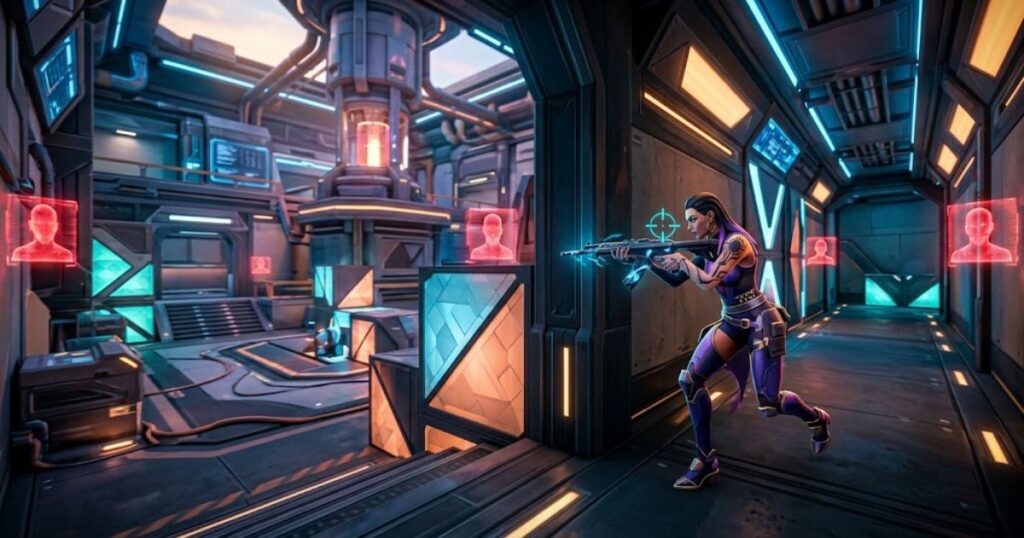
Many players spend hours in aim trainers yet see limited improvement because their practice does not reflect real match situations. Valorant rewards preparation, positioning, and prediction just as much as mechanical aim.
The most effective drills reinforce habits that can be applied immediately during ranked games rather than isolated aiming exercises.
The drills below focus on building practical crosshair placement habits that can be applied during real matches:
- Practice keeping your crosshair at head level during Deathmatch sessions.
- Clear every angle deliberately before increasing movement speed.
- Pre aim common defender positions on each map before peeking.
- Review gameplay footage to identify moments where your crosshair drifted away from likely enemy locations.
- Train movement and crosshair placement together instead of treating them as separate skills.
Consistent repetition of these habits often produces better long-term results than spending additional hours on pure reaction-based aim training.
Deathmatch Crosshair Discipline Drill
A Deathmatch crosshair discipline drill is a practice method that prioritizes crosshair positioning over kill count, and it helps players build habits that transfer directly into competitive matches. The focus is on maintaining head-level placement rather than chasing eliminations.
Instead of paying attention to the scoreboard, concentrate on keeping the crosshair aligned with likely enemy positions throughout the match. Every encounter becomes an opportunity to reinforce proper positioning habits.
Moving slowly and deliberately while clearing angles can be more valuable than playing aggressively during practice sessions. The objective is to develop automatic behaviors that remain consistent under pressure.
With enough repetition, disciplined crosshair placement becomes a natural part of movement and decision-making.
Map Walkthrough Training
Map walkthrough training is the process of exploring maps in custom games while practicing crosshair positioning, and it helps players memorize common angles, head-level references, and likely enemy locations. This type of practice builds familiarity without the pressure of live matches.
Walking through each area allows players to identify visual landmarks that support consistent head-level placement. Boxes, wall lines, railings, and environmental details often serve as useful aiming references.
Repeated exposure to common angles improves subconscious positioning, making it easier to place the crosshair correctly before an engagement begins.
Many experienced players spend time reviewing maps outside ranked games because better map knowledge often leads to cleaner crosshair placement.
VOD Review for Crosshair Mistakes
VOD review is the process of analyzing recorded gameplay to identify positioning errors, and it helps players correct crosshair placement mistakes that are difficult to notice during live matches. Reviewing gameplay often reveals patterns that remain hidden while actively playing.
Pay close attention to situations where the crosshair drifts toward empty walls, the floor, or areas with little threat potential. These moments frequently explain missed opportunities and delayed reactions.
Reviewing deaths and lost duels can also reveal whether poor crosshair placement contributed to the outcome. Even small mistakes become easier to recognize when viewed from a third-person perspective.
Consistent VOD review allows players to make targeted improvements, turning small corrections into meaningful long-term progress.
How Mouse Shape and Grip Influence Crosshair Stability
Mouse shape and grip style influence how stable the crosshair feels during small aiming adjustments, and they help players maintain better control during tracking, pre aiming, and target transitions. Comfortable mouse control often leads to more consistent crosshair placement over long gaming sessions.
Many players underestimate how much ergonomics affect aiming performance in tactical FPS games. An uncomfortable mouse shape or grip can create unnecessary tension, making precise crosshair adjustments more difficult to repeat consistently.
A stable grip supports smoother mouse movement and better control during stressful situations. Because crosshair placement depends heavily on accurate micro adjustments, the mouse should complement FPS aiming habits rather than work against them.
Players looking for a broader setup guide can explore the gaming mouse for FPS games resource to learn how shape, weight, sensor performance, and comfort influence aiming consistency across tactical shooters.
The table below compares common grip styles and their typical impact on crosshair stability:
| Grip Style | Crosshair Stability |
|---|---|
| Palm grip | Very stable movement |
| Claw grip | Balanced speed and control |
| Fingertip grip | Fast but less stable |
Each grip style offers different strengths, but stability and consistency are usually more important than raw speed for crosshair placement in tactical FPS games.
If you are unsure which grip style fits tactical FPS games best, check out best grip style for valorant for a deeper breakdown of aiming comfort and control.
Comfort Improves Consistency
Comfort is an important factor in aiming performance, and it helps players maintain consistent crosshair control during long gaming sessions. Tactical FPS games reward stable precision over time rather than short bursts of speed.
When a setup feels uncomfortable, players often introduce unnecessary tension into their hand and wrist movements. This can make small crosshair adjustments less predictable and harder to repeat consistently.
Players who frequently reposition their grip during matches often struggle to maintain reliable crosshair discipline throughout a round.
Long-term aiming consistency usually starts with a setup that feels natural and comfortable to use.
Mouse Shape Changes Micro Adjustments
Mouse shape influences how easily players perform small aim corrections, and it helps determine how stable crosshair placement feels during tracking and target transitions. Different shapes encourage different movement patterns and grip positions.
Some mice support controlled stopping power more effectively, making it easier to place the crosshair accurately without overshooting targets.
Symmetrical mouse designs remain popular in Valorant because they support balanced movement and work well with multiple grip styles.
Ultimately, the best mouse shape depends on hand size, grip preference, and personal aiming habits.
Crosshair Placement Tips for Different Valorant Roles
Crosshair placement habits vary between Valorant roles, and they help players prepare for the types of engagements they encounter most often. Entry fraggers, lurkers, anchors, and support players all face different fight patterns throughout a round.
Understanding your role improves prediction because different positions on the map create different enemy expectations. Better prediction naturally leads to stronger pre aiming and more efficient crosshair placement.
Role-specific habits allow players to prepare for likely threats instead of reacting after visual contact occurs.
The examples below show how crosshair placement priorities change across different Valorant roles:
- Duelists should prepare for aggressive close-range fights.
- Sentinels should hold disciplined defensive angles.
- Controllers should expect utility-assisted peeks.
- Initiators should clear angles carefully after utility usage.
Duelists Need Aggressive Pre Aim
Duelists are often responsible for creating space during site entries, and they benefit from aggressive pre aiming because first contact usually happens quickly. Their crosshair placement should anticipate defenders holding common angles before entering contested areas.
Fast entries frequently require slightly wider crosshair positioning to account for aggressive defensive peeks and off-angle positions.
Because duelists encounter immediate pressure, accurate prediction and movement timing become essential parts of effective crosshair placement.
Prepared crosshair positioning reduces hesitation and allows more confident site entries.
Sentinels Benefit From Stable Holds
Sentinels specialize in controlling space and defending key areas, and they benefit from stable crosshair placement that remains focused on likely entry points. Defensive play rewards patience and consistency more than rapid movement.
Maintaining head-level positioning and avoiding unnecessary crosshair movement allows sentinel players to react efficiently when attackers commit to an angle.
Strong defensive setups force opponents into predictable engagements, making disciplined crosshair placement even more valuable.
For anchor players, stability and preparation often create greater impact than flashy mechanical plays.
Crosshair Placement and Mental Focus
Mental focus is the ability to maintain attention on likely threats and important angles, and it helps players keep consistent crosshair placement throughout a match. When concentration drops, crosshair discipline often becomes less precise and more reactive.
Many crosshair placement mistakes occur because players stop actively thinking about enemy positions after long sessions, frustrating rounds, or repeated mistakes. Small lapses in attention can gradually lead to poor positioning habits.
Strong aim is not purely mechanical. Awareness, concentration, and decision-making all influence how consistently players maintain proper crosshair placement during real matches.
Players who stay mentally engaged often preserve stronger fundamentals and make fewer positioning errors under pressure.
The table below shows how common mental mistakes can directly affect crosshair placement and aiming consistency:
| Mental Problem | Crosshair Result |
|---|---|
| Tilt | Overaggressive peeking |
| Fatigue | Crosshair drifting downward |
| Panic | Over flicking |
| Lack of focus | Slow reactions |
Mental mistakes often appear as aiming mistakes, even when mechanical skill remains unchanged. Maintaining focus can prevent many unnecessary crosshair placement errors.
Autopilot Ruins Crosshair Discipline
Autopilot gameplay is the habit of making decisions without actively processing enemy threats, and it reduces crosshair placement quality by encouraging lazy positioning and predictable movement. Players stop evaluating danger and begin moving through the map without clear intent.
This often occurs during long ranked sessions, fatigue, or periods of frustration after multiple losses. As attention decreases, crosshair placement gradually drifts away from likely enemy positions.
Without active awareness, players become slower to anticipate threats and more dependent on reactive aiming during engagements.
Taking short breaks and resetting focus can help restore crosshair discipline and improve consistency over long play sessions.
Confidence Improves Crosshair Stability
Confidence is the ability to trust your preparation and decision-making, and it helps players maintain smoother crosshair adjustments during engagements. Confident players are more likely to commit to correct positioning instead of constantly second-guessing themselves.
Hesitation often creates unnecessary corrections because players repeatedly change their crosshair position before a fight begins. This uncertainty can lead to inconsistent aiming under pressure.
Preparation naturally builds confidence. Players who understand common angles, enemy tendencies, and map flow usually feel more ready when contact occurs.
Strong fundamentals reduce panic and allow crosshair placement to remain stable even during stressful situations.
FAQ About Crosshair Placement in Valorant
Crosshair placement is one of the most misunderstood aiming skills in Valorant. The questions below cover practical mistakes, tactical concepts, and setup decisions that directly affect consistency in real matches.
What is crosshair placement in Valorant?
Crosshair placement in Valorant means positioning your crosshair where enemies are most likely to appear before they peek. Good placement reduces reaction time and improves headshot consistency.
Why is crosshair placement more important than flick aim?
Crosshair placement is more important because most fights in Valorant happen very quickly. Small adjustments are more reliable than large emergency flicks during high pressure situations.
How do I keep my crosshair at head level?
Use map objects like boxes, wall lines, and textures as visual references for head height. Practicing in custom games also helps build automatic positioning habits.
Should I hold my crosshair tightly against corners?
Not always. Tight holds can fail against fast wide swings. Holding slightly wider often gives better reaction timing against aggressive players.
Does low sensitivity improve crosshair placement?
Low sensitivity can improve precision and stopping control, but settings alone cannot fix poor habits. Fundamentals still matter more than sensitivity numbers.
How can I practice crosshair placement in Deathmatch?
Focus on head level discipline instead of kill count. Clear angles carefully and avoid random rushing during practice sessions.
What is pre aiming in Valorant?
Pre aiming means positioning your crosshair on likely enemy locations before visual contact happens. This reduces the amount of adjustment needed during fights.
Why do professional players look so smooth when aiming?
Professional players rely heavily on preparation and prediction. Their crosshair is usually already near the correct location before enemies appear.
Can bad movement ruin crosshair placement?
Yes. Poor movement often drags the crosshair away from important angles and creates unstable aim during peeks.
Does mouse grip affect crosshair stability?
Grip style affects comfort and micro adjustment control. Stable grips usually improve consistency during long tactical FPS sessions.
What is the fastest way to improve crosshair placement?
The fastest improvement usually comes from VOD review and focused Deathmatch practice. Watching your mistakes helps identify bad habits quickly.
Can crosshair placement alone improve rank?
Better crosshair placement can significantly improve consistency and duel success. Combined with positioning and game sense, it can strongly impact ranked performance.
Conclusion
Crosshair placement in Valorant is one of the most important aiming fundamentals because it reduces reaction time, improves headshot consistency, and creates cleaner gunfights. Players who maintain disciplined positioning gain a massive advantage over opponents who rely entirely on reactive flicking.
The biggest improvement usually comes from reducing unnecessary movement rather than increasing raw speed. Keeping your crosshair at head level, understanding common enemy positions, and preparing for fights before they happen will improve consistency far more than random sensitivity changes alone.
Strong crosshair placement also connects directly to tactical decision making. Better positioning, map awareness, movement discipline, and angle prediction all contribute to easier shots and more reliable performance during ranked matches.
Improvement takes repetition and conscious awareness. Watching your own gameplay, practicing disciplined angle clearing, and maintaining focus during matches will gradually turn good crosshair habits into automatic behavior.
If you continue building your tactical FPS fundamentals step by step, crosshair placement eventually becomes instinctive rather than something you actively think about every second.
Thanks for reading GearTP.