
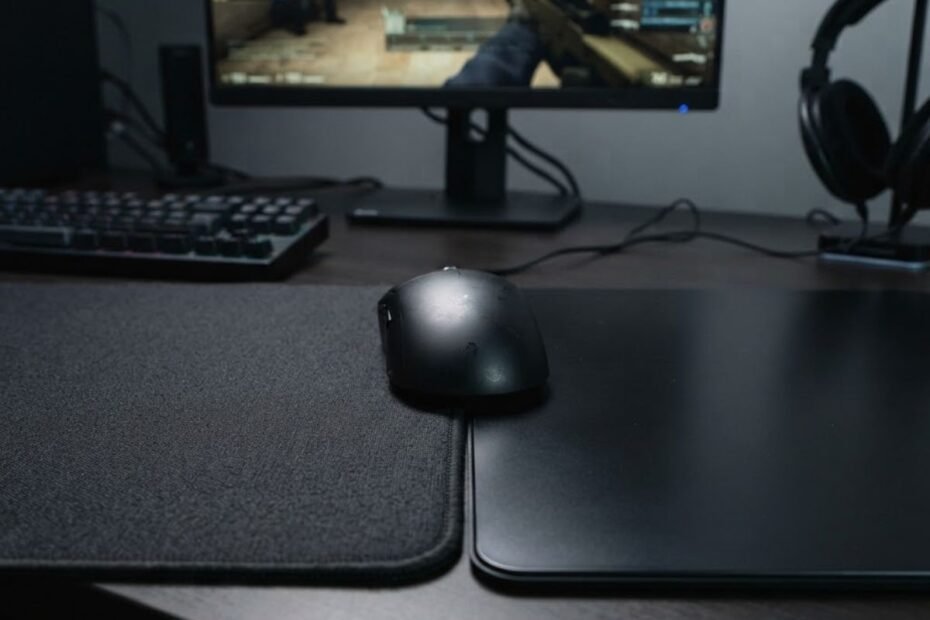
Cloth and hard mouse pads can both work well for CS2, but they create different movement feels. Cloth generally provides more resistance and stopping feedback, while hard surfaces usually offer faster, lower-resistance glide. The better choice depends on whether you prefer a more controlled surface or a freer, faster movement feel.
For CS2 players comparing the two, the most useful distinction is not simply which surface is faster. It is how the surface changes the way the mouse starts moving, glides across the pad, and slows down during aim. Surface construction also matters, so two pads made from the same broad material category can still feel noticeably different.
Cloth vs Hard Mouse Pad for CS2: What Is the Real Difference?
The main difference between cloth and hard mouse pads for CS2 is the amount of resistance and physical feedback they provide during mouse movement. Cloth surfaces generally create a more controlled feel, while hard surfaces typically allow the mouse to glide with less resistance.
The physical difference between the two surfaces is easiest to understand when they are shown side by side:
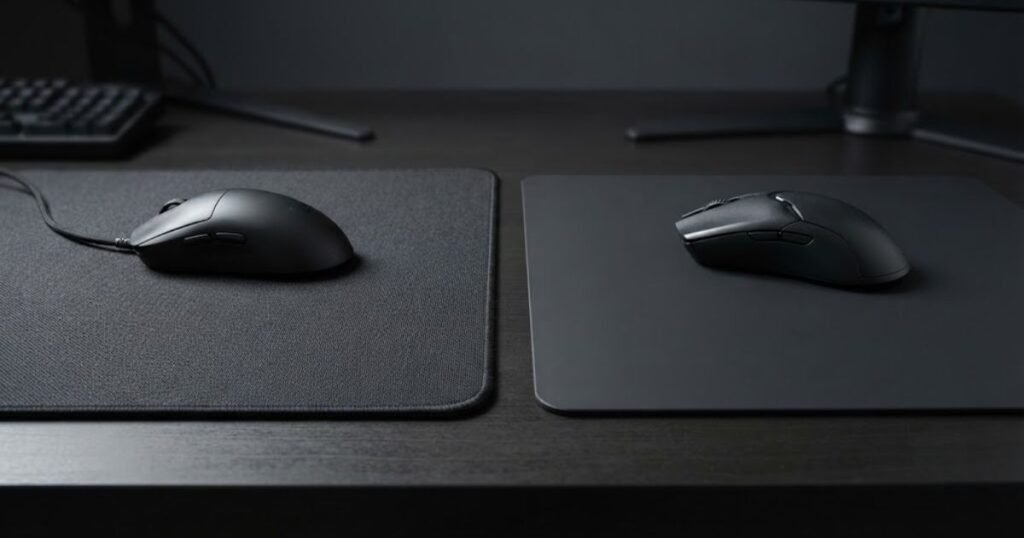
That difference affects the physical sensation of aiming, but it does not automatically determine which surface produces better aim. The goal is to understand what each surface feels like before deciding which movement characteristics fit your play.
How a Cloth Mouse Pad Feels During CS2 Aim
A cloth mouse pad generally feels softer and more controlled during CS2 aim because the fabric surface creates noticeable resistance against the mouse. This resistance can make the transition from movement to stopping feel more deliberate.
Cloth pads are not identical, however. Fabric weave, texture, thickness, and surface construction can change the amount of friction and glide. A smooth cloth pad may feel considerably faster than a rougher control-oriented cloth pad.
The typical characteristics of a cloth surface include:
- More surface resistance: The mouse generally encounters more resistance than it would on a typical hard surface.
- More stopping feedback: The added resistance can make slowing and stopping the mouse feel more noticeable.
- Softer contact: The fabric surface provides a softer physical surface than a rigid pad.
- Controlled glide: Movement can feel less free than on a low-resistance hard surface.
These characteristics make cloth a natural option for players who prefer to feel more resistance underneath the mouse rather than having the mouse move as freely as possible.
In short, a cloth pad gives CS2 players a more resistance-focused movement feel, although the exact speed and friction still depend on the specific pad.
How a Hard Mouse Pad Feels During CS2 Aim
A hard mouse pad generally feels faster and more direct because the rigid surface can provide lower resistance than a typical cloth pad. This allows the mouse to move more freely and can make larger movements feel less restricted.
The exact experience still varies between hard surfaces. Texture and surface treatment can change how much friction the mouse encounters, so “hard” should not be treated as a precise speed rating.
The typical characteristics of a hard surface include:
- Faster glide: The mouse can generally move across the surface with less resistance.
- Firm surface feedback: The rigid construction creates a different physical sensation from fabric.
- Lower resistance: Less resistance can make mouse movement feel more immediate.
- More direct movement: The surface provides less of the cushioning and resistance associated with cloth.
This can appeal to CS2 players who prefer unrestricted mouse movement, but faster glide does not automatically translate into better accuracy.
In short, a hard pad emphasizes freer movement and lower resistance, while the exact glide still depends on the surface design.
Why Surface Speed Alone Does Not Decide CS2 Aim Performance
Surface speed alone does not determine CS2 aim performance because a faster surface can be harder to control for one player while feeling more natural to another. What matters is whether the player can produce predictable movement and stopping responses on that surface.
A mouse pad’s material is only one part of its physical behavior. Surface texture and construction can change friction, which means two pads made from the same general material can produce different movement characteristics.
This is why the useful comparison is not simply “fast versus slow.” A better comparison is how much resistance and feedback you want while moving and stopping the mouse.
For the broader material-level comparison, cloth vs hard gaming mouse pads provides the general context behind how these two surface categories differ beyond CS2.
The key takeaway is that surface speed is only one part of the decision. The more important question is whether the mouse movement feels predictable and controllable to you.
| Factor | Cloth Mouse Pad | Hard Mouse Pad |
|---|---|---|
| Typical glide | More controlled | Faster |
| Surface resistance | Generally higher | Generally lower |
| Stopping feedback | More noticeable | Less resistance-based |
| Surface feel | Soft and fabric-based | Firm and rigid |
| Movement character | More controlled | More free-moving |
Ultimately, cloth and hard mouse pads solve the same basic problem in different ways. Cloth generally gives you more resistance and physical feedback, while hard surfaces generally prioritize freer glide. Neither is universally better for CS2, and the difference in surface feel is the foundation for the sensitivity, aim style, and consistency decisions discussed later in the article.
Is Cloth or Hard Better for CS2 Aim?
Neither cloth nor hard mouse pads is universally better for CS2 aim. A cloth surface can make controlled movement and stopping feel more deliberate, while a hard surface can make mouse movement feel faster and less restricted. The better option depends on which movement characteristics you can control consistently.
The difference becomes more noticeable when the mouse needs to slow down and stop precisely:
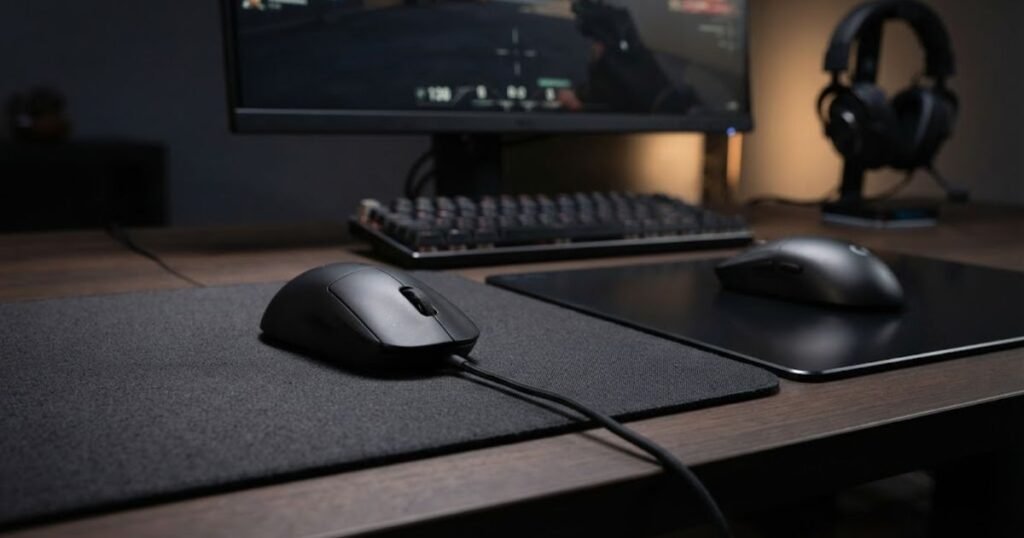
In CS2, aim is not one single type of movement. Players constantly switch between quick flicks, tracking, and small crosshair corrections. Because each movement places different demands on mouse control, the useful question is not which surface has better aim performance in general, but which surface gives you the most predictable response during the movements you perform most often.
Which Surface Helps With CS2 Flicks?
For CS2 flicks, the better surface is the one that lets you move quickly and stop the mouse where you intend. A faster surface can make the initial movement feel easier, while a more resistant surface can provide additional physical feedback when you slow the mouse down.
Flicking is not only about how quickly the mouse travels toward a target. The final part of the movement matters just as much because the crosshair needs to settle at the intended position. If the surface allows the mouse to move too freely for your control style, the final adjustment may feel less predictable. If the surface creates too much resistance, the initial movement may feel unnecessarily restricted.
This is why there is no universal cloth-versus-hard winner for flicking. A player who already has strong control on a fast surface may benefit from its freer movement, while another player may find additional resistance easier to manage.
For flicks, prioritize the surface that lets you accelerate and stop predictably rather than simply choosing the fastest option.
Which Surface Is Better for Tracking and Micro-Corrections in CS2?
For tracking and micro-corrections, surface consistency and controllable movement matter more than raw glide speed. Tracking requires repeated adjustments while micro-corrections require small changes in mouse direction and distance, so an unpredictable movement feel can make these actions harder to reproduce.
This is also why mouse pads affect tracking accuracy: the surface can change how consistently the mouse moves during repeated tracking and micro-corrections.
A more resistant surface can make small movements feel easier to regulate because the mouse encounters more physical feedback. A lower-resistance surface can make the same movements feel lighter and more immediate, which some players may prefer once they are comfortable controlling it.
The important distinction is that tracking and micro-corrections do not require one specific material. Both cloth and hard surfaces can support these movements when the player is accustomed to the surface and can reproduce the required motion consistently.
For tracking and micro-corrections, choose the surface that gives you predictable small-movement control instead of assuming that more glide automatically produces smoother aim.
Why Stopping Control Matters in CS2
Stopping control matters because accurate CS2 aim depends on more than moving the crosshair toward a target; you also need to control where the movement ends. The surface influences how much physical resistance you feel while slowing the mouse, which changes the sensation of braking during aim.
When a player moves the mouse quickly, the final portion of that movement often requires a controlled reduction in speed. A surface with more resistance can make that reduction feel more pronounced. A low-resistance surface can require the player to rely more heavily on their own hand control to manage the same transition.
This does not mean that higher resistance automatically produces better stopping accuracy. Too much resistance can also make movement feel slower or less natural. The useful goal is a predictable stopping response that matches the player’s existing control.
Stopping control is therefore a compatibility issue between the player and the surface, not a simple ranking where one material always wins.
Several factors can change how a mouse pad feels during CS2 aim:
- Stopping control: How easily you can reduce mouse speed and stop at the intended position.
- Glide: How freely the mouse moves across the surface during larger or smaller movements.
- Mouse sensitivity: How much physical mouse movement is required to move the crosshair a given distance in CS2.
- Mouse skates: The contact material and condition of the skates can change the interaction between the mouse and the pad.
- Consistency: Whether the surface produces a predictable movement feel from one aiming motion to the next.
These factors work together rather than independently. A surface that feels excellent during a quick flick may not feel equally natural during repeated micro-corrections, and a pad that feels controlled in one setup may feel considerably different with another mouse or sensitivity.
The main takeaway is that CS2 aim does not have a universally superior mouse pad surface. Cloth can suit players who value more physical feedback during movement and stopping, while hard surfaces can suit players who prefer freer movement. What matters most is whether you can reproduce your aim movements consistently on the surface you use.
Which Mouse Pad Should You Choose Based on Your CS2 Sensitivity?
CS2 sensitivity can help narrow down your mouse pad choice, but it should not be treated as a fixed rule for choosing cloth or hard. Lower sensitivity generally requires more physical mouse movement, which can make a controlled cloth surface appealing, while players who prefer faster movement may find a lower-resistance hard surface more natural. Your actual preference matters more than an arbitrary sensitivity cutoff.
Sensitivity can point you toward a surface, but the final choice still depends on how that surface feels during physical mouse movement:
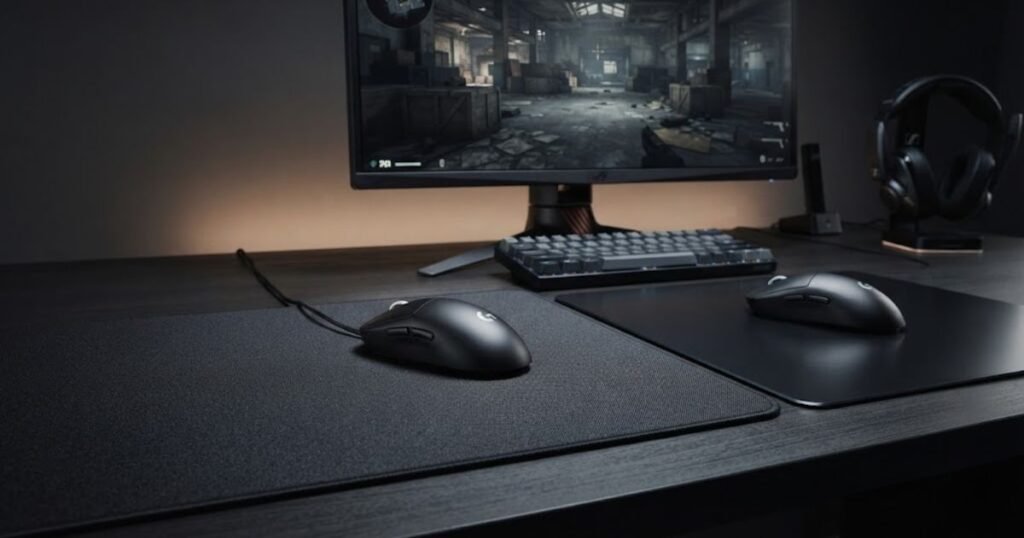
The same sensitivity can also feel very different between players because sensitivity only describes the relationship between mouse movement and in-game crosshair movement. It does not describe how much resistance the mouse encounters on the pad. That physical interaction is why sensitivity should be considered alongside the surface characteristics you already understand from the earlier sections.
Cloth Mouse Pads for Lower-Sensitivity CS2 Players
Lower-sensitivity CS2 players may find cloth pads attractive because larger physical mouse movements can benefit from a surface that feels controlled and predictable. When the mouse travels farther across the pad, the player may value having enough resistance to make the movement feel manageable rather than completely unrestricted.
This does not mean low sensitivity automatically calls for cloth. A player can use low sensitivity with a hard pad if they prefer its faster glide and have enough control over their movements. The important consideration is whether the surface feels natural across the physical distance you regularly move the mouse.
For players who use substantial portions of their mouse pad during a single movement, available pad space also becomes important. A surface preference cannot compensate for a pad that is simply too small for the way you play.
For lower sensitivity, cloth is best viewed as a control-oriented starting point rather than a mandatory choice.
Hard Mouse Pads for Players Who Prefer Faster Mouse Movement
A hard mouse pad can suit CS2 players who prefer faster, lower-resistance mouse movement, regardless of whether their sensitivity is low, medium, or high. The rigid surface can make the mouse feel freer, which may appeal to players who do not want additional resistance during movement.
For a lower-sensitivity player, that freer movement can make large mouse movements feel less restricted. For a player using a higher sensitivity, the same characteristic can make smaller movements feel more immediate. In both cases, the deciding factor is the player’s preferred movement response rather than sensitivity alone.
This distinction is important because sensitivity and surface speed solve different parts of the aiming equation. Sensitivity determines how much in-game movement comes from a given physical mouse movement, while the mouse pad influences the physical feel of making that movement.
A hard surface therefore makes the most sense when faster physical glide is a priority, not simply because a player uses a particular sensitivity.
Why CS2 Sensitivity Should Not Be the Only Selection Rule
CS2 sensitivity should be treated as one selection factor because it does not tell you whether a particular surface will feel comfortable or controllable. Two players can use the same sensitivity and still prefer completely different mouse pads.
The reason is straightforward. Sensitivity describes the in-game response, while the mouse pad changes the physical interaction between the mouse and the surface. Your preferred movement feel can therefore differ even when your CS2 settings are identical to another player’s.
There is also no reliable universal sensitivity threshold at which cloth suddenly becomes better than hard, or vice versa. Treating such a threshold as a rule would oversimplify a decision that also depends on physical movement preference and the rest of the setup.
If your goal is to choose an FPS mouse pad more broadly, rather than only deciding between cloth and hard for CS2, the gaming mouse pad for FPS games guide covers the wider surface-selection context.
In other words, use sensitivity to understand your movement requirements, then use your actual surface preference to make the final choice.
The table below shows how different CS2 sensitivity preferences can influence the direction of your mouse pad choice:
| CS2 sensitivity preference | Surface direction | Reason |
|---|---|---|
| Lower sensitivity | Cloth can be a good starting point | More physical movement can pair well with a controlled surface feel |
| Lower sensitivity with a strong speed preference | Hard can be suitable | Lower resistance can make larger movements feel freer |
| Higher sensitivity | Either surface | Preference for control or glide matters more than sensitivity alone |
| Any sensitivity with a strong control preference | Cloth can be attractive | More resistance may provide a more controlled physical feel |
| Any sensitivity with a strong speed preference | Hard can be attractive | Lower resistance supports a faster movement feel |
The best sensitivity-based approach is to treat your settings as a starting point, not a verdict. Lower sensitivity can make the controlled feel of cloth appealing, while hard surfaces can work well when faster movement is the priority. Ultimately, the surface should match how you physically move and control the mouse rather than forcing your setup into a predetermined category.
Cloth vs Hard Mouse Pad for CS2 Based on Aim Style
Your CS2 aim style can influence which mouse pad surface feels more natural, but arm aiming, wrist aiming, and hybrid aiming do not require a specific material. Cloth can appeal to players who prefer a more controlled physical feel during larger movements, while hard surfaces can suit players who prefer less resistance. The better choice is the surface that fits the way you actually move your mouse.
Different aiming styles can involve different physical movement patterns across the same mouse pad:
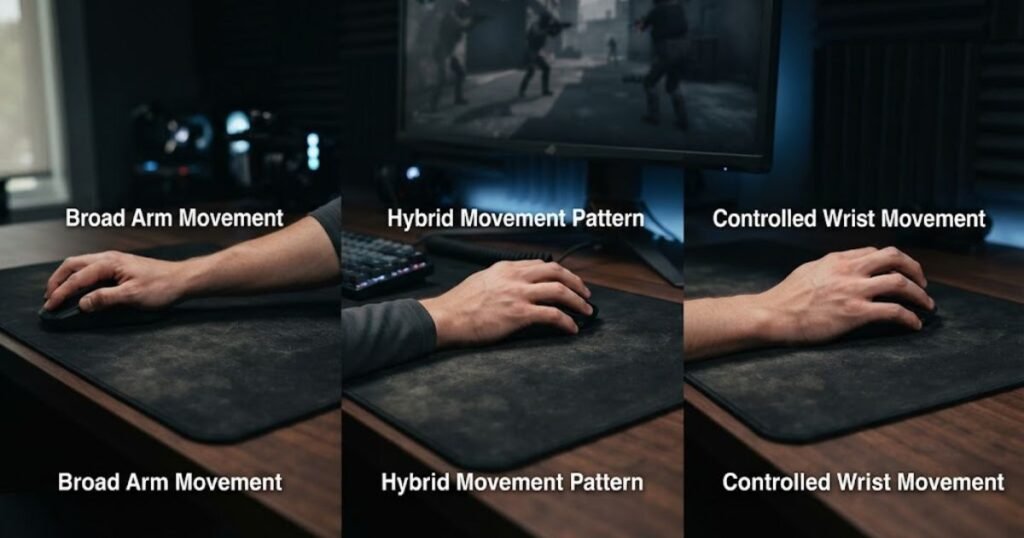
Aim style is useful because it describes how you physically control the mouse. This is different from sensitivity, which describes how that physical movement translates into in-game crosshair movement. Two players can use similar settings while relying on very different combinations of wrist and arm movement.
Cloth Mouse Pads for Arm Aimers
Cloth can be a natural fit for arm aimers who prefer more physical feedback while making larger mouse movements. Because arm aiming often involves moving the mouse across a larger portion of the pad, the surface feel can become noticeable throughout the movement rather than only during small corrections.
A cloth surface can provide a more resistance-focused feel during these movements, which some arm aimers may find easier to manage. The softer surface can also make extended contact between the forearm and pad feel different from a rigid surface.
However, arm aiming does not automatically make cloth the correct choice. Some arm aimers prefer a faster surface precisely because they want less resistance during large movements. The important variable is whether the surface allows those movements to feel natural and repeatable.
For arm aimers, cloth is a reasonable starting direction when controlled physical movement and surface feedback are more important than maximum glide.
Hard Mouse Pads for Wrist Aimers
Hard mouse pads can suit wrist aimers who prefer a freer movement feel during shorter mouse movements. Wrist aiming typically relies more heavily on movements close to the mouse and does not necessarily require the same physical travel across the pad as a predominantly arm-driven style.
The lower resistance of many hard surfaces can make small repositioning movements feel immediate. This can be appealing to players who prefer the mouse to move freely rather than feeling additional resistance beneath it.
That does not mean wrist aimers should automatically choose hard. A wrist aimer who prefers more resistance and a more controlled surface can still find cloth more comfortable and predictable.
For wrist aimers, hard is worth considering when low resistance and freer mouse movement match the way you naturally control the mouse.
Hybrid Aimers Should Prioritize Control Over Aim Style Labels
Hybrid aimers should choose based on the movement characteristics they want rather than trying to match themselves to a cloth or hard category. A hybrid style combines wrist and arm movement, so the player’s preferred surface can depend on which type of movement dominates their actual CS2 sessions.
For example, a player may use the arm for larger repositioning movements but rely on the wrist for smaller adjustments. Another player may reverse that balance. Calling both players simply “hybrid aimers” does not tell you enough to determine which surface will feel better.
This is why aim style should be used as a decision aid rather than a rigid buying rule. If a hybrid player consistently prefers more resistance, cloth may be the better starting point. If the player prefers freer movement, a hard surface may make more sense. If you also play Valorant, the same cloth-versus-hard decision is worth considering from another tactical FPS perspective. The cloth vs hard mouse pad comparison for Valorant looks at how the two surfaces fit that game’s aiming demands.
The useful question for hybrid aimers is not “Which pad is made for hybrid aiming?” but “Which surface characteristics feel most predictable across both types of movement?”
The table below matches common CS2 aiming styles with the surface characteristics they may prefer:
| CS2 aim style | Cloth tendency | Hard tendency | Main consideration |
|---|---|---|---|
| Arm aiming | Controlled physical feel | Faster physical movement | How the surface feels during larger movements |
| Wrist aiming | More resistance | Lower resistance | Preferred movement freedom |
| Hybrid aiming | Useful when control is preferred | Useful when freer movement is preferred | Which movement characteristics remain predictable |
Aim style can help narrow your options, but it should not override your actual experience with the surface. Arm aimers can prefer hard pads, wrist aimers can prefer cloth, and hybrid players can use either. The label describes your movement pattern, not a mandatory mouse pad choice.
Ultimately, the best surface for your CS2 aim style is the one that supports your natural mouse movement without making that movement feel unnecessarily restricted or difficult to control. Use arm, wrist, or hybrid aiming as context for the decision, then judge the surface by how consistently it supports your real movements.
Cloth vs Hard Mouse Pad for CS2: Comfort, Maintenance, and Consistency
For long-term CS2 use, cloth and hard mouse pads differ mainly in surface comfort, cleaning requirements, and how their condition can change over time. Cloth usually provides a softer surface for the arm and wrist, while hard pads are generally easier to wipe clean. Neither surface guarantees better consistency on its own because cleanliness, wear, and surface condition can all affect how the mouse feels.
This matters because a mouse pad does not stay exactly the same throughout its usable life. Dust, moisture, skin oils, repeated contact, and normal wear can gradually change the surface. A player may therefore notice a different movement feel even without changing their CS2 settings or mouse.
Which Surface Is More Comfortable for Long CS2 Sessions?
Cloth mouse pads are generally the more comfortable option for players who prefer a softer surface under the wrist or forearm during long gaming sessions. The fabric construction provides a cushioned contact surface that feels different from the rigid surface of a hard pad.
Comfort is still highly personal. Some players prefer the firm and consistent physical feel of a hard surface, while others dislike having their forearm repeatedly contact a rigid pad. Desk setup, pad thickness, and how much of the arm rests on the surface can also influence the experience.
For CS2, this becomes relevant during longer sessions because comfort can affect whether you naturally maintain the same mouse position and movement habits. A surface that feels uncomfortable may encourage changes in posture or hand position even when the player would otherwise prefer its glide characteristics.
For long sessions, cloth is the more natural starting point if soft arm and wrist contact is a priority, while hard remains viable for players who prefer a firm surface.
Which Mouse Pad Is Easier to Maintain?
Hard mouse pads are generally easier to clean because their rigid surfaces can usually be wiped down directly, while cloth pads require more attention to dirt and moisture trapped in the fabric. The exact cleaning method should still follow the manufacturer’s instructions for the specific mouse pad.
Cloth surfaces can gradually accumulate dust, skin oils, and other debris through normal use. Because the mouse is constantly moving across the same surface, changes in cleanliness can become noticeable as changes in friction or glide.
Hard surfaces also need cleaning. Their advantage is mainly the simplicity of wiping the surface rather than eliminating maintenance altogether. Dust and debris can still affect the interaction between the mouse and pad if they are left on the surface.
The practical difference is that hard pads generally make routine surface cleaning simpler, while cloth pads require more careful attention to their fabric surface.
How Surface Wear Can Change Your CS2 Aim
Surface wear can change the physical feel of a mouse pad, which can make the same CS2 movements feel different from when the pad was new. The change may be gradual, making it easy to adapt without immediately noticing that the surface itself has changed.
A worn cloth pad may develop areas that feel different from the rest of the surface, particularly in regions that receive frequent mouse movement. Changes in texture or friction can make certain parts of the pad feel less consistent than others.
Hard pads can also experience surface changes through prolonged use, although their construction and durability vary by model. Scratches, coating changes, or other surface damage can alter how smoothly the mouse moves.
This is why an inconsistent feeling does not automatically mean that your CS2 sensitivity or aim technique has suddenly become worse. The physical condition of the surface is another variable worth checking.
If a mouse pad has become noticeably worn or no longer provides the same movement feel, when to replace a mouse pad becomes a practical part of the decision rather than simply choosing a different surface material.
Surface wear matters because consistency depends on the condition of the area where you actually move the mouse, not just the material printed on the product packaging.
The table below compares the practical differences between cloth and hard pads for long-term CS2 use:
| Factor | Cloth Mouse Pad | Hard Mouse Pad |
|---|---|---|
| Surface comfort | Generally softer | Generally firmer |
| Routine cleaning | More involved | Usually simpler |
| Dust and debris | Can interact with the fabric surface | Can remain on the surface until wiped away |
| Wear over time | Fabric condition can change with use | Surface condition can change with use |
| Consistency concern | Watch for changes across frequently used areas | Watch for scratches, coating changes, and debris |
The long-term choice is therefore not simply about which material lasts longer. It is about whether the surface remains comfortable, clean, and predictable enough for your regular CS2 sessions. A well-maintained pad can remain useful for a long time, while a neglected or worn surface can eventually change the movement experience.
For long-term CS2 use, cloth favors softer physical comfort while hard favors simpler routine cleaning, but consistency ultimately depends on how well the surface is maintained and how its condition changes over time.
How to Choose Between a Cloth and Hard Mouse Pad for CS2
The best way to choose between a cloth and hard mouse pad for CS2 is to start with the movement feel you want, then evaluate your current setup, physical mouse movement, comfort, and consistency. This approach is more reliable than choosing a material based on a single specification or assuming that one surface is universally better for competitive play.
By this point, the important differences between the two surfaces are clear. The next step is to turn those differences into a practical decision without treating sensitivity, aim style, or surface speed as automatic rules.
Start With the Movement Feel You Want
Your preferred movement feel should be the first filter because it determines whether you are naturally drawn toward more resistance or freer glide. If you consistently prefer a controlled physical feel, cloth is a logical starting point. If you prefer the mouse to move with less resistance, a hard surface may be more suitable.
This first step is deliberately simple. You do not need to know your exact sensitivity category or copy another player’s setup before deciding which direction to investigate.
Choose the surface characteristic you actually want before comparing specific mouse pads.
Consider How Much of the Pad You Use
The amount of physical space you use during normal CS2 play should influence your choice because your preferred surface is only useful if the pad provides enough usable area. Players who make large mouse movements may need more space, while players whose movement stays closer to the center of the pad may have different size requirements.
This is a separate decision from choosing cloth or hard. A surface can feel perfect but still be impractical if the mouse repeatedly reaches the edge during normal movement.
For that reason, think about your actual mouse travel rather than choosing a pad size based only on how large it looks on a desk.
The right surface still needs enough usable space to support your normal CS2 movements.
Check Whether Your Current Pad Is Actually the Problem
Before replacing your mouse pad, make sure the problem is actually the surface. A change in aim consistency can come from surface wear, dirt, moisture, or other changes in the physical setup rather than from choosing the wrong material category.
This distinction prevents an unnecessary upgrade. If your current pad previously felt consistent and has only recently started feeling different, changing from cloth to hard may solve the wrong problem.
Likewise, if the surface still feels predictable but you simply want a different movement characteristic, switching materials can make sense. The decision should come from a clear difference between your current experience and the experience you want.
Diagnose the current problem first, then decide whether changing surface type is actually necessary.
Compare Comfort and Maintenance Before Buying
Comfort and maintenance should be part of the buying decision because a mouse pad is used continuously rather than only during competitive matches. A surface that feels good for a short test but becomes uncomfortable during longer sessions may not be the best long-term choice.
The same applies to maintenance. If you prefer a surface that is straightforward to wipe down, that preference can reasonably influence the decision. If softer arm contact matters more, the physical feel of cloth may carry greater weight.
These factors do not determine aim performance by themselves, but they can determine whether you are comfortable using the same setup consistently.
A good CS2 mouse pad should fit your daily use, not just your idealized aim setup.
Make the Final Choice Based on Consistency
The final decision should favor the surface that gives you the most predictable experience across repeated CS2 sessions. If you repeatedly feel more comfortable controlling the mouse on cloth, that is useful evidence. If a hard surface consistently gives you the movement freedom you prefer without making control feel unstable, that is equally valid.
You do not need to choose the surface that is considered fastest, most popular, or most competitive. The purpose of the decision process is to identify which surface characteristics work with your own setup.
Consistency is the final filter because a mouse pad should support repeatable movement rather than constantly make you adapt to the surface.
Use these steps to narrow your CS2 mouse pad choice:
- Identify your preferred movement feel: Decide whether you naturally prefer more resistance or freer mouse movement.
- Consider your usable pad space: Make sure the surface provides enough room for the movements you actually make.
- Check your current pad: Determine whether wear, dirt, or another physical change is causing the problem.
- Consider your sensitivity and movement pattern: Use your existing setup as context rather than treating it as a strict material rule.
- Evaluate comfort: Consider how the surface feels during the length of your normal gaming sessions.
- Evaluate maintenance: Choose a surface whose cleaning and upkeep requirements fit your routine.
- Prioritize consistency: Select the surface that gives you the most predictable movement feel over repeated CS2 sessions.
The process moves from the broadest preference to the final practical test. You first identify the movement characteristic you want, then make sure the pad fits your physical setup and daily use before making the final decision.
The table below summarizes the main decision factors and the direction they can point toward:
| Decision factor | Cloth may be the better starting point | Hard may be the better starting point |
|---|---|---|
| Preferred movement feel | More resistance and feedback | Freer, lower-resistance movement |
| Surface preference | Softer physical feel | Firm physical feel |
| Movement freedom | More controlled feel | Faster glide |
| Comfort priority | Soft arm or wrist contact | Firm surface contact |
| Maintenance preference | Willing to care for a fabric surface | Prefers simpler routine wipe-downs |
| Current problem | Useful if the desired change is more controlled movement | Useful if the desired change is freer movement |
The table should be used as a decision aid rather than a scoring system. A player does not need every factor to point toward the same surface. The strongest signals should come from the movement feel and consistency the player actually wants.
The simplest decision is to choose cloth when its controlled physical feel fits your preferences, or hard when its freer movement fits them better. Sensitivity, pad size, comfort, maintenance, and the condition of your current setup then help confirm whether that choice makes sense for your specific CS2 setup.
Cloth vs Hard Mouse Pad for CS2: Which One Should You Buy?
Choose a cloth mouse pad for CS2 if you want a more controlled physical feel and prefer greater surface feedback, while a hard mouse pad makes more sense if you want faster, lower-resistance movement. Neither option is universally better, and you should not choose a surface simply because it is marketed as faster or more competitive.
The decision becomes much easier once you separate the surface characteristics from the marketing around them. Your sensitivity, aim style, comfort preferences, available desk space, and current setup can all influence which option feels right, but none of them creates a universal rule that applies to every CS2 player.
Choose a Cloth Mouse Pad If You Prioritize Control
A cloth mouse pad is the better choice when you prefer more resistance, a softer physical surface, and a movement feel that does not feel excessively free. This can be especially appealing if your priority is having noticeable surface feedback while controlling the mouse.
Cloth is also a practical choice when softer contact with the wrist or forearm matters during longer sessions. However, choosing cloth does not mean choosing the slowest surface available. Different cloth pads can have substantially different surface characteristics.
If you already know that you prefer a controlled surface and your current pad feels too fast or lacks the physical feedback you want, moving toward a cloth surface is a logical decision.
Choose cloth when controlled movement, surface feedback, and softer contact match what you want from your CS2 setup.
Choose a Hard Mouse Pad If You Prioritize Speed
A hard mouse pad is the better choice when you prefer lower resistance and freer mouse movement. Its rigid surface can make the mouse feel faster and more immediate, which can appeal to players who dislike the resistance associated with many cloth surfaces.
Hard does not automatically mean better for fast aim, however. A low-resistance surface can feel excellent when it matches your control, but it can also feel too fast if the movement does not feel predictable to you.
If your current cloth pad feels unnecessarily restrictive and you consistently prefer freer movement, switching to a hard surface can be a reasonable next step.
Choose hard when lower resistance and faster physical glide are more important to you than the softer, more resistance-focused feel of cloth.
Choose Neither Yet If Your Current Problem Is Not the Surface
Do not replace your mouse pad yet if the real problem may be surface wear, cleanliness, comfort, available space, or another part of your setup. Changing from cloth to hard will not automatically fix an inconsistent experience caused by an unrelated issue.
A useful example is a pad that used to feel consistent but has gradually developed a different movement feel. That situation calls for checking the condition of the existing surface before assuming that the material category is wrong.
The same principle applies if the pad simply does not provide enough usable space. Switching materials without addressing the physical limitation may leave the underlying problem unchanged.
If you cannot identify a clear reason to change surface type, keeping your current pad and diagnosing the actual problem first is often the more rational decision.
The final decision can be simplified into three directions:
- Choose cloth: Prioritize a more controlled physical feel, noticeable resistance, and softer surface contact.
- Choose hard: Prioritize freer movement, lower resistance, and a faster physical glide.
- Keep your current pad: Choose neither if the real issue is wear, cleanliness, size, comfort, or another setup problem.
This gives you a practical final filter without turning cloth and hard into rigid player categories. Your actual experience with the surface remains more useful than a general claim that one material is always superior.
For most CS2 players, the right purchase is not the mouse pad with the fastest reputation, but the surface that makes their own mouse movements feel predictable and repeatable.
Cloth is the stronger starting point when control and surface feedback are the priority. Hard is the stronger starting point when freer movement and lower resistance are the priority. If neither addresses the problem you are experiencing, there is no reason to replace the pad simply for the sake of changing materials.
Ultimately, the best cloth vs hard mouse pad for CS2 is the one that fits your preferred movement feel and remains comfortable and predictable throughout your regular sessions.
FAQ About Cloth vs Hard Mouse Pads for CS2
These answers cover the most common questions CS2 players may still have after comparing cloth and hard mouse pads. The key is to use the surface characteristics as a guide rather than treating one material as universally better.
Is a cloth mouse pad better than a hard mouse pad for CS2?
Not universally. Cloth can be a better fit for players who prefer more resistance and a softer surface, while hard can suit players who prefer lower resistance and faster glide.
Is a hard mouse pad too fast for CS2?
A hard mouse pad is not inherently too fast for CS2. It can feel fast because of its lower resistance, but whether that becomes difficult to control depends on how naturally you handle the surface.
Which mouse pad is better for low sensitivity in CS2?
Cloth can be a good starting point for low-sensitivity players, but low sensitivity does not require a cloth pad. Players who prefer faster movement can still use a hard surface successfully.
Which mouse pad is better for high sensitivity in CS2?
High sensitivity does not automatically favor either surface. At higher sensitivity, the more important question is whether you prefer the additional resistance of cloth or the freer movement of a hard surface.
Do professional CS2 players use cloth or hard mouse pads?
Professional CS2 players use different mouse pad surfaces, so professional usage does not establish one universally superior material. A professional setup can be useful for understanding available options, but copying the surface alone does not guarantee the same experience.
Does a mouse pad affect CS2 aim consistency?
Yes, the mouse pad can affect the physical consistency of mouse movement. Changes in friction, surface condition, and movement feel can alter how predictable the mouse feels during repeated aim movements.
Does mouse pad material affect mouse sensor performance in CS2?
Material should not be treated as a simple guarantee of better sensor performance. The actual interaction depends on the mouse sensor, surface characteristics, and specific mouse pad, so choosing cloth or hard solely for sensor performance oversimplifies the decision.
Are hard mouse pads louder than cloth mouse pads?
Hard mouse pads can produce more audible mouse movement than cloth surfaces. The rigid surface can create a different sound when the mouse moves across it, while cloth generally provides a softer physical interaction.
Can a cloth mouse pad make CS2 aim feel more controlled?
Yes, a cloth pad can feel more controlled because its surface generally provides more resistance. That feeling does not mean the player will automatically aim more accurately, but the additional physical feedback can be preferable for some players.
Should you switch from cloth to hard if your aim feels slow?
Not necessarily. If the mouse feels slow, first determine whether the issue comes from the surface itself or from factors such as surface condition, cleanliness, or your preferred movement feel.
How do you know whether your CS2 mouse pad is the problem?
A mouse pad is more likely to be the problem when its movement feel has changed, feels inconsistent across the surface, or no longer matches the movement characteristics you want. Checking its condition before replacing it can prevent an unnecessary material change.
Is cloth or hard better for long CS2 gaming sessions?
Cloth is generally more appealing if you prefer softer contact during long sessions, while hard can suit players who prefer a firm surface. Long-session comfort is personal, so the surface that feels sustainable for your normal gaming routine is the better choice.
Overall, the FAQ reinforces the same decision principle without making cloth or hard an absolute winner: choose the surface whose physical characteristics fit the way you use your mouse and the experience you want from CS2.
Thank you for taking the time to read this guide. I hope it helps you understand the differences between cloth and hard mouse pads and choose the surface that feels right for your CS2 playstyle.