
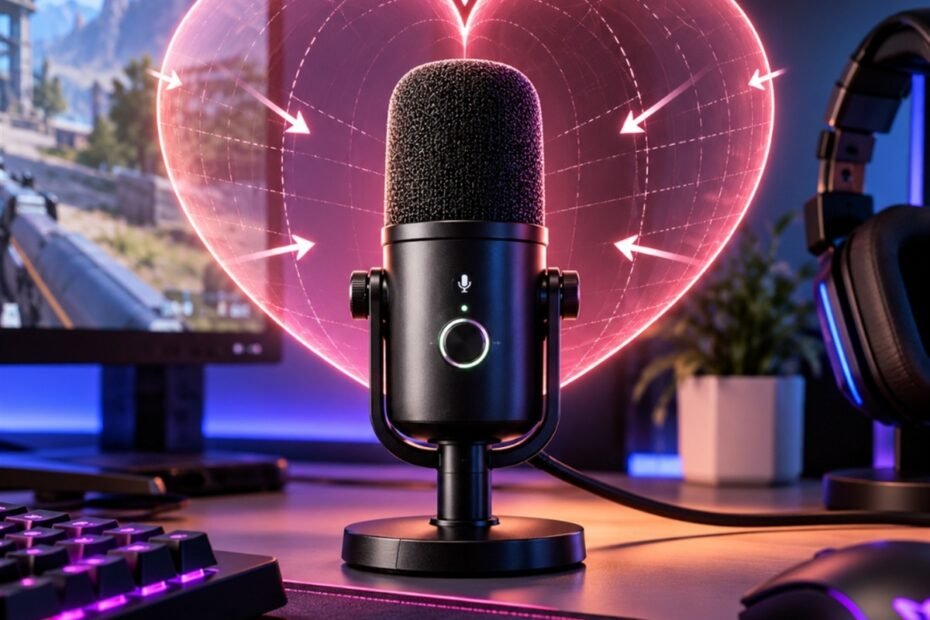
Understanding what is a cardioid microphone is essential for competitive gamers, streamers, and podcasters aiming to achieve clean, studio-grade vocal callouts without ambient room clutter. In dynamic tactical titles like Counter-Strike 2, Valorant, and Apex Legends, crystal-clear voice comms often struggle against aggressive mechanical keyboard clatter, heavy mouse clicking, and loud computer chassis fans that compromise tactical coordination.
A cardioid polar pattern provides the definitive acoustic solution by strategically shaping microphone sensitivity to favor your mouth while eliminating unwanted desktop noise. Expanding upon our foundational guide to types of gaming microphones, this comprehensive engineering breakdown examines polar pattern geometry, phase cancellation physics, optimal desk placement angles, and proximity effect dynamics to help you master your voice setup.
The Acoustic Definition of a Cardioid Polar Pattern
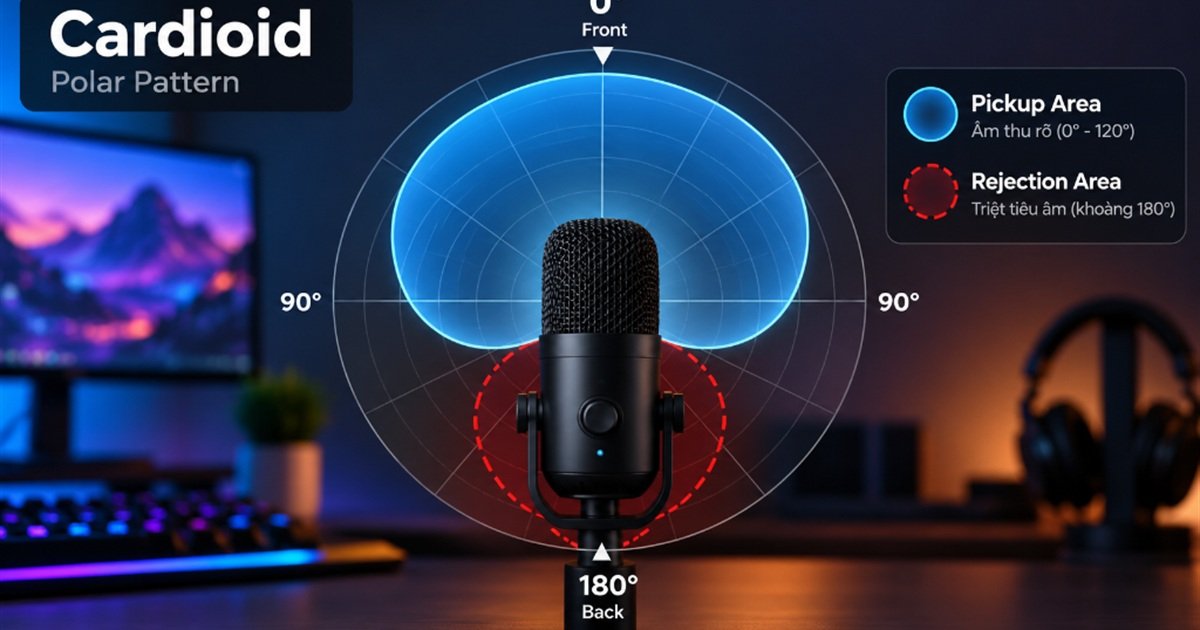
A cardioid microphone is a directional audio transducer featuring a heart-shaped pickup pattern that maximizes sensitivity directly in front of the capsule (0 degrees) while completely rejecting sound originating from the rear (180 degrees).
Heart-Shaped Sensitivity Geometry and Sound Angle Reception
The term cardioid originates from the Greek word kardia, meaning heart, referencing the distinctive heart-shaped acoustic sensitivity contour plotted on a two-dimensional polar graph. Unlike omnidirectional capsules that capture acoustic pressure equally from all 360 degrees, a cardioid microphone prioritizes a focused forward acceptance zone spanning approximately 120 to 130 degrees.
Sound waves arriving directly on-axis (zero degrees) encounter peak sensitivity with zero decibels of attenuation. As acoustic sources move around the capsule toward the sides (90 and 270 degrees), sensitivity drops by approximately 6 decibels, halving the perceived acoustic volume. When sound reaches the direct rear of the microphone (180 degrees), attenuation plummets by 20 to 30 decibels, creating an acoustic blind spot known as the rear null point.
Phase Cancellation: How Acoustic Ports Create the 180-Degree Null Zone
Creating a directional cardioid pickup pattern requires an acoustic pressure-gradient design rather than a simple sealed pressure chamber. A cardioid microphone capsule incorporates precision engineered acoustic ports or rear delay networks cut directly into the side and rear walls of the microphone housing.
When sound originates from behind the microphone at 180 degrees, acoustic waves travel simultaneously to the front of the diaphragm and through the rear acoustic ports. The rear labyrinth delays the internal sound wave by the exact fraction of a millisecond required for the external sound wave to reach the front diaphragm surface. Because both waves arrive at opposite sides of the flexible membrane at identical pressure levels and reverse phase polarity, they cancel each other out completely, producing virtually zero diaphragm displacement.
Why Gaming Microphones Rely on Cardioid Capsules
Cardioid capsules are the industry standard for gaming microphones because their 180-degree rear null point physically silences mechanical keyboard clicks and desktop vibrations before sound reaches the voice chat server.
Isolating Vocal Callouts from Mechanical Keyboard Switches
In high-intensity esports competitions, aggressive key actuation on tactile and clicky mechanical switches generates sharp, high-frequency sound impulses exceeding 75 decibels sound pressure level. When positioned properly on a desktop boom arm, a cardioid microphone aligns its rear null point directly toward the keyboard deck.
Because the mechanical switch strikes occur precisely within the 180-degree acoustic cancellation zone, high-frequency switch clatter is attenuated by up to 25 decibels before entering the microphone preamplifier. This acoustic noise rejection prevents team comms from being overwhelmed by keystroke noise, eliminating the necessity for aggressive digital noise gates that frequently clip vital tactical callouts during quiet moments.
Eliminating PC Chassis Fan Hum and Desk Surface Vibrations
High-performance gaming computers utilize multiple cooling fans and high-RPM graphics card blowers that radiate steady low-frequency hum throughout the room. Furthermore, intense mouse swipes and desk bumping transmit mechanical shock waves through desk frames directly into desktop stands.
A cardioid microphone mitigates room reflections and direct computer hum by maintaining narrow side pickup rejection. When paired with an elastic suspension shockmount and directed away from computer exhaust vents, the capsule rejects low-frequency fan resonance and floor vibrations, delivering focused vocal fundamentals directly into voice communication channels.
The 180-Degree Null Alignment Principle: Noise rejection in a cardioid microphone is an acoustic physics phenomenon, not software AI filtering. Positioning the absolute rear of your microphone chassis directly toward your mechanical keyboard switches provides up to 25 dB of natural, uncolored physical attenuation without adding audio latency.
Cardioid vs Other Polar Patterns: Acoustic Comparison
Compared to omnidirectional, bidirectional, and supercardioid patterns, standard cardioid provides the widest practical forward pickup angle combined with the deepest single-direction rear rejection zone.
The following technical matrix compares the electroacoustic characteristics of common microphone polar patterns in desktop gaming environments:
| Polar Pattern | Pickup Angle (Front) | Null Zone (Maximum Rejection) | Ambient Noise Sensitivity | Optimal Gaming and Streaming Application |
|---|---|---|---|---|
| Cardioid | 120 to 130 degrees | 180 degrees (Direct rear) | Low (Excellent desktop isolation) | Solo gaming, Discord voice chat, streaming, esports. |
| Supercardioid | 100 to 115 degrees | 125 and 235 degrees (Rear lobe present) | Moderate (Narrower front, small rear pickup) | Noisy environments where sound arrives from the sides. |
| Hypercardioid | 90 to 105 degrees | 110 and 250 degrees (Prominent rear lobe) | Moderate (High side rejection, larger rear lobe) | Shotgun microphones, tight broadcast vocal isolation. |
| Omnidirectional | 360 degrees (All directions) | None (Equal sensitivity everywhere) | High (Captures keyboard, fans, and room echo) | Conference calls, room acoustic testing, multi-person chats. |
| Bidirectional (Figure-8) | 90 degrees front / 90 degrees back | 90 and 270 degrees (Direct sides) | Moderate (Rejects sides, captures front and back) | Two-person face-to-face podcasts, acoustic instruments. |
This comparative overview highlights why multi-pattern USB microphones should almost universally remain locked in cardioid mode for gaming. Selecting omnidirectional or figure-8 patterns inadvertently invites ambient room reflections and mechanical keyboard chatter into your team comms.
Optimal Positioning and Angle Alignment for Gaming Desks
For optimal vocal clarity and keyboard rejection, position a cardioid microphone 10 to 15 centimeters from your mouth at a 45-degree angle, with the rear of the chassis pointed directly at your keyboard switches.
The 45-Degree Off-Axis Rule: Avoiding Plosive Puffs and Keyboard Bleed
Speaking directly into the front on-axis center of a microphone diaphragm exposes the capsule to high-velocity bursts of expelled breath caused by plosive consonants such as P, T, and B sounds. These fast air blasts slam into the diaphragm, producing jarring low-frequency thumps and clipping distortion.
By angling the cardioid microphone 45 degrees relative to your mouth (either slightly to the side or angled upward from below the chin), breath blasts pass harmlessly across the face of the capsule rather than directly into it. Because the cardioid acceptance cone spans 120 degrees, your voice remains within the flat on-axis frequency response zone while plosive wind turbulence is eliminated.
Boom Arm vs Desktop Stand: Maintaining the 180-Degree Rear Null Angle
Standard desktop tripod stands bundled with consumer microphones position the capsule directly on the desk surface, placing the microphone closer to your mechanical keyboard than your mouth. This inverted proximity ratio forces gamers to crank up preamplifier gain, amplifying desk vibration rumble and keyboard clicking.
Mounting your cardioid microphone on an articulated suspension boom arm elevates the capsule above the desk. This allows you to tilt the microphone downward toward your mouth while aiming the rear 180-degree null zone squarely down at your mechanical switches. This configuration maximizes vocal signal-to-noise ratio and ensures your primary gaming monitor remains completely unobstructed.
The Proximity Effect in Cardioid Gaming Microphones
The proximity effect creates a natural low-frequency bass boost when speaking within 5 to 10 centimeters of a cardioid capsule, imparting broadcast vocal warmth but requiring pop filtration.
Low-Frequency Bass Buildup at Close Working Distances
Because cardioid microphones rely on pressure-gradient acoustic phase cancellation ports, they are naturally susceptible to the proximity effect. As your mouth moves closer to the front diaphragm, low-frequency sound waves encounter a sharp phase discrepancy between the front and rear ports, causing acoustic bass frequencies below 200 Hz to amplify by up to 6 to 10 decibels.
Broadcasters and esports commentators frequently utilize this acoustic characteristic to give voice comms an authoritative, full-bodied resonance. When selecting between different transducer types, as detailed in our guide comparing dynamic vs condenser microphones, understanding how proximity bass interacts with capsule sensitivity ensures your voice maintains natural intelligibility without becoming boomy or muffled.
Managing Plosives with Pop Filters and Integrated Windscreens
Leveraging the proximity effect requires speaking in close proximity to the capsule, which significantly increases the risk of plosive pops. To counteract plosive air blasts without degrading high-frequency clarity, deploy a dual-layer nylon pop filter or high-density acoustic foam windscreen.
A quality pop shield disperses directional breath bursts laterally across its porous mesh surface, allowing clean acoustic sound pressure waves to pass through unhindered while neutralizing aerodynamic turbulence before it impacts the delicate microphone diaphragm.
Step-by-Step Guide: Calibrating a Cardioid Microphone for Discord and FPS Comms
Follow this sequential 4-step acoustic calibration process to configure your cardioid microphone for pristine voice intelligibility in Discord, Valorant, and Counter-Strike 2.
Execute these calibration steps sequentially to establish optimal hardware positioning and clean digital gain staging:
- Align the Physical 180-Degree Rear Null Zone: Secure your microphone to an articulated boom arm. Rotate the microphone body so the front capsule face points directly at your lips while the direct back of the microphone chassis angles downward toward your keyboard switches.
- Calibrate Working Distance: Position the front grille exactly 10 to 15 centimeters (approximately one hand span) away from your mouth. Angle the capsule 45 degrees off-axis to avoid direct breath impact.
- Set Clean Analog Hardware Preamp Gain: Speak at your standard tactical callout volume while observing your audio interface or USB recording meter. Adjust the hardware gain knob until your loudest tactical shouts peak between -18 dBFS and -12 dBFS in your software meter, ensuring clean headroom without digital clipping.
- Tune Discord Noise Suppression and Voice Gate Threshold: In Discord Voice & Video settings, set your Input Sensitivity threshold approximately 3 to 5 decibels above your room resting noise floor. Because the cardioid capsule passively rejects keyboard clatter, you can disable aggressive software noise filters for natural voice dynamics.
Eliminate Software Filter Artifacts: Aggressive digital noise suppression algorithms like Krisp or RTX Voice often strip natural high frequencies and cause vocal clipping during intense battle shouts. Perfecting your cardioid microphone physical angle and distance allows you to disable heavy software filters and maintain crisp, uncompressed team comms.
Frequently Asked Questions: Cardioid Gaming Microphones
Explore detailed technical answers to the most common questions regarding cardioid polar pattern mechanics, ambient sound rejection, and gaming voice chat configuration:
What does cardioid mean in microphones?
Cardioid refers to a directional microphone pickup pattern that captures sound primarily from the front while attenuating sound from the sides and completely rejecting acoustic energy arriving directly from the rear.
Why is it called a cardioid pattern?
The pattern is named cardioid because its two-dimensional directional sensitivity graph resembles a heart contour, derived from the Greek word kardia, showing maximum sensitivity at zero degrees and an indented null at 180 degrees.
What is an acoustic null point?
An acoustic null point is a specific angle of a microphone capsule where internal acoustic phase cancellation creates a zone of minimal sensitivity, rejecting incoming sound waves by 20 to 30 decibels.
What is the pickup angle of a standard cardioid microphone?
A standard cardioid microphone features an effective forward pickup acceptance angle of approximately 120 to 130 degrees, allowing comfortable speaker head movement without significant loss of vocal volume.
How does a cardioid microphone cancel sound from the rear?
Cardioid capsules use rear acoustic ports to route rear sound waves to both sides of the diaphragm simultaneously with reverse phase polarity, causing identical acoustic pressures to cancel each other out completely.
What is the difference between cardioid and supercardioid microphones?
Supercardioid microphones feature a narrower front pickup angle of 115 degrees and greater side rejection, but they possess a small rear sensitivity lobe, whereas cardioid microphones feature zero rear sensitivity at 180 degrees.
Does a cardioid microphone pick up keyboard typing sounds?
A cardioid microphone significantly attenuates keyboard sounds if the keyboard is positioned within its 180-degree rear null zone; however, room wall reverberations and desk vibrations can still bleed into the capsule if untreated.
Can a cardioid microphone capture more than one person?
Yes, but multiple speakers must position themselves closely together within the forward 120-degree acceptance cone; individuals sitting outside this front angle will sound distant, muffled, and substantially quieter.
Why do competitive FPS players use cardioid microphones?
Competitive FPS players use cardioid microphones because their rear null zone isolates tactical voice callouts from loud mechanical key tapping and mouse clicks, ensuring teammates receive clear, distraction-free voice communication.
What is the best angle to position a cardioid microphone for gaming?
The best position is angled 45 degrees off-axis relative to your mouth at a distance of 10 to 15 centimeters on a boom arm, with the rear of the microphone chassis pointed directly down at your keyboard switches.
Does a cardioid pattern eliminate the need for Discord noise suppression?
In most moderately quiet home environments, a properly positioned cardioid microphone eliminates the need for aggressive software noise suppression, preventing digital compression artifacts and robotic vocal distortion during fast-paced callouts.
Is a condenser cardioid or dynamic cardioid better for an untreated room?
A dynamic cardioid microphone is substantially better for an untreated gaming room because its heavier diaphragm mass and lower electrical sensitivity provide superior passive rejection of distant wall echoes and PC fan noise.
Final Verdict: Maximizing Voice Clarity with Cardioid Polar Patterns
A cardioid microphone is the most reliable, effective, and versatile audio investment for gamers, streamers, and broadcasters seeking pristine voice isolation without complex acoustic room treatments.
Mastering voice communication in competitive esports requires understanding how your hardware interacts with physical desktop acoustics. By harnessing the physical phase cancellation of a cardioid polar pattern and aligning its 180-degree rear null directly toward your mechanical keyboard, you achieve crystal-clear tactical callouts and effortless audio authority in every competitive match.
Thank you for reading GearTP. We hope this comprehensive polar pattern engineering guide empowers you to position, calibrate, and master your cardioid gaming microphone for flawless voice communication.