
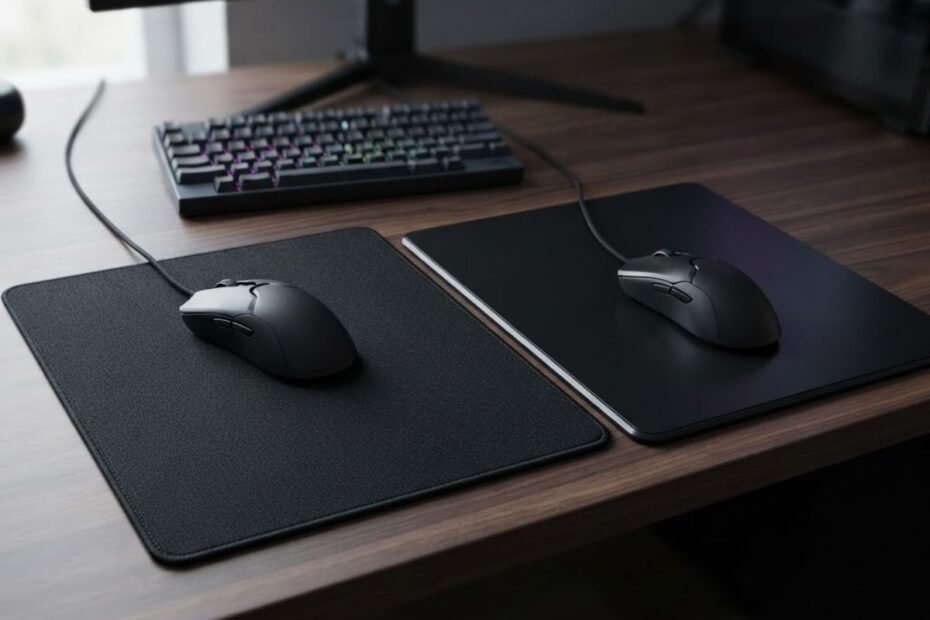
Choosing between a cloth and hard gaming mouse pad comes down to how each surface changes the feel of mouse movement. Cloth pads generally provide a softer and more controlled surface, while hard pads offer a firmer surface with less resistance. Neither material is automatically better for every FPS player, so the right choice depends on the type of movement and surface feel you prefer.
For FPS players, the difference matters because the mouse pad is the surface your mouse physically interacts with throughout every match. Even when the same mouse and sensitivity are used, changing the surface can make movement feel noticeably different. Understanding the basic construction of each type is the first step toward choosing the right one.
What Is the Difference Between Cloth and Hard Gaming Mouse Pads?
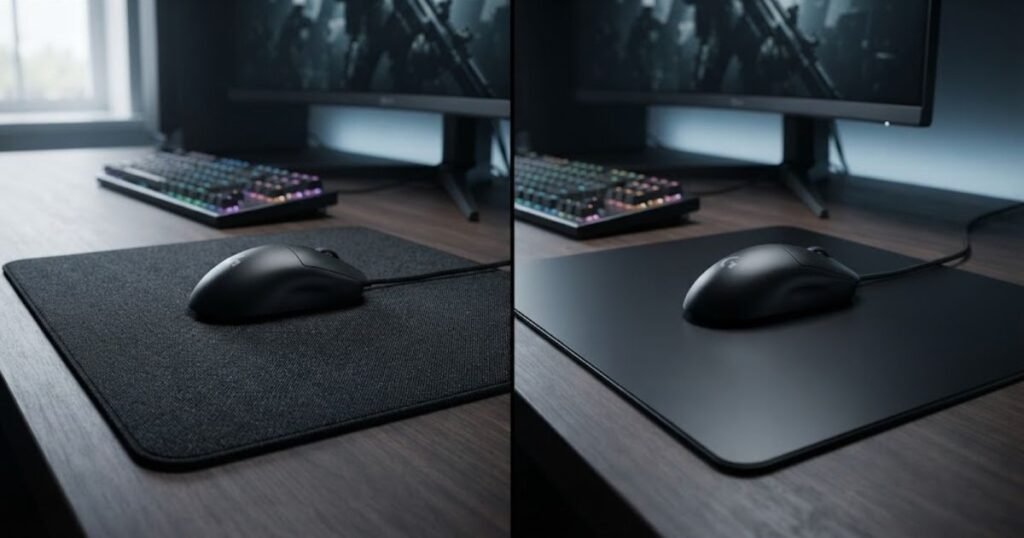
Cloth and hard gaming mouse pads differ primarily in how their surfaces are constructed. A cloth pad uses a flexible fabric surface, while a hard pad uses a rigid surface designed to provide a firmer contact point for the mouse feet. That physical difference changes the overall feel of the pad before factors such as personal aim style, mouse feet, or game preference are even considered.
For FPS players, cloth is generally associated with a softer and more forgiving surface feel, while hard pads tend to feel firmer and more direct. The important distinction is that material describes the physical type of surface, not a guaranteed performance level. Different cloth and hard pads can still feel noticeably different from one another because texture, coating, and construction also affect the final experience.
The physical difference between the two surfaces is easiest to see when they are placed side by side:
GearTP’s broader guide to gaming mouse pads for FPS games treats surface material as one of the first filters for understanding how a pad may behave. For this comparison, however, the focus is narrower: choosing between cloth and hard surfaces rather than comparing every available mouse pad material.
How Does a Cloth Mouse Pad Feel During Mouse Movement?
A cloth mouse pad feels softer and more flexible under the mouse, creating a surface that generally feels more controlled and forgiving during movement. The fabric construction also gives the pad a different tactile character from rigid surfaces, which can make it more comfortable for players who keep their wrist or forearm in contact with the pad.
Because cloth surfaces are not rigid, the overall feel can vary considerably between models. Fabric texture, weave, surface treatment, and thickness can all change how the mouse moves. Therefore, calling every cloth pad “slow” would be misleading. Cloth describes the construction, while the actual glide characteristics depend on the specific surface.
This distinction is important when comparing materials. A cloth pad can be designed around faster movement, balanced movement, or stronger control, so material alone should not be treated as a complete performance specification.
In practical terms, cloth gives players a softer surface with a more forgiving physical feel. The exact amount of resistance and glide still depends on the individual pad.
How Does a Hard Mouse Pad Feel During Mouse Movement?
A hard mouse pad provides a rigid surface that feels firmer and more direct beneath the mouse. Compared with a flexible cloth surface, hard pads generally allow the mouse to move across a more consistent physical plane without the fabric compression associated with soft pads.
Hard surfaces are commonly designed to provide low resistance and faster-feeling movement, although the exact experience depends on the surface material, texture, and coating. A hard pad therefore should not be judged solely by the assumption that every model will feel identical.
The rigid construction also creates a distinctly different tactile experience. Instead of the softer contact associated with fabric, the mouse moves across a firm surface that can feel more immediate and responsive.
For players comparing the two materials for the first time, this is the fundamental difference to remember: cloth emphasizes a softer physical surface, while hard emphasizes a rigid one. The performance trade-offs created by those surfaces will be examined separately later in the guide.
The table below summarizes the core physical differences between cloth and hard gaming mouse pads:
| Factor | Cloth Gaming Mouse Pad | Hard Gaming Mouse Pad |
|---|---|---|
| Surface construction | Flexible fabric surface | Rigid surface |
| Physical feel | Softer and more forgiving | Firmer and more direct |
| Surface flexibility | Flexible | Rigid |
| Typical movement feel | More controlled | Faster and lower-resistance |
| Surface variation | Can vary significantly by fabric, weave, and coating | Can vary by material, texture, and coating |
| Overall tactile character | Soft and fabric-like | Firm and smooth or textured |
The key takeaway is that cloth and hard describe two different physical approaches to the mouse pad surface. Cloth generally provides a softer, more forgiving foundation, while hard pads provide a rigid and more direct surface. The material itself does not determine whether a pad will be ideal for your aim, because the specific surface characteristics still matter.
How Do Cloth and Hard Mouse Pads Affect Speed, Control, and Stopping?
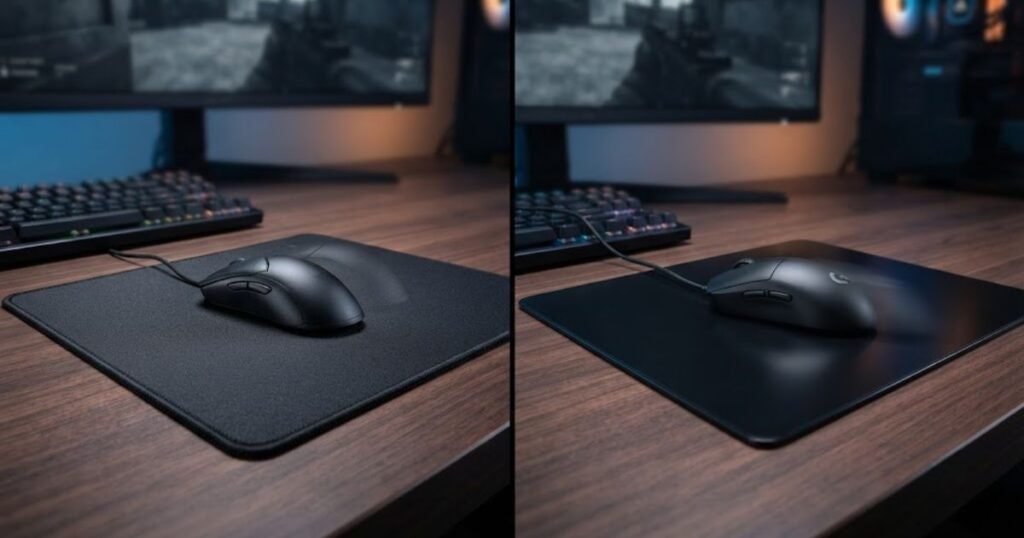
Cloth and hard mouse pads can change how easily the mouse starts moving, how freely it glides, and how the hand settles the crosshair after a movement. A lower-friction surface generally feels faster, while greater surface resistance can make controlled stopping feel more deliberate. The important point is that speed and control are not separate advantages that one material always wins. They are trade-offs that affect different parts of the same aiming movement.
The difference becomes more practical when the same type of mouse movement is considered across both surfaces:
For FPS players, this distinction matters because aiming is not just about moving the crosshair quickly. A useful surface needs to let you initiate movement when needed and regain control when the crosshair reaches the intended position. That is why a faster-feeling pad is not automatically an upgrade over a more controlled one.
Why Does a Lower-Friction Surface Feel Faster?
A lower-friction surface feels faster because the mouse can move with less resistance from the pad. When the hand starts a swipe, less resistance can make the initial movement feel easier and allow the mouse to continue gliding more freely. This can be especially noticeable during larger or repeated movements where the player wants the mouse to change direction quickly.
Hard mouse pads commonly produce this type of low-resistance movement, although the exact glide depends on the specific surface and mouse feet. Not every hard pad will feel identical, and a cloth pad with a faster surface treatment can also provide relatively quick movement.
The useful distinction is therefore not simply “hard is fast.” The more accurate way to think about it is that a surface with lower resistance can make movement feel faster, regardless of whether the pad is cloth or hard.
For an FPS player, that faster movement can make large swipes and rapid repositioning feel more fluid. However, the same freedom of movement can also change how much physical control is needed when the mouse reaches the desired position.
Why Can More Friction Help With Stopping?
More surface resistance can make it easier to feel when the mouse is settling into position because the pad provides greater resistance against continued movement. This can give the hand a more controlled stopping sensation, particularly when the player needs to slow down a movement rather than simply move the mouse as quickly as possible.
That does not mean higher friction automatically produces better accuracy. Stopping still depends on the player’s hand control, sensitivity, mouse weight, and muscle memory. The surface simply changes how much resistance the player feels while performing the movement.
This is where cloth pads can appeal to FPS players who prefer a more controlled movement experience. The fabric surface can provide a different balance between movement and resistance than a low-friction hard surface, but the exact result varies between individual pads.
The practical takeaway is that stopping should be considered as part of the entire aiming movement. A surface that feels easy to move across may require a different braking motion from one that provides more resistance.
Why Is Faster Glide Not Automatically Better?
Faster glide is not automatically better because FPS aiming requires both movement and control. A surface that lets the mouse move very freely can reduce resistance during a swipe, but the player still needs to control the mouse precisely when changing direction or settling the crosshair.
This creates an important trade-off. Players who already have precise hand control may enjoy the freedom of a fast surface, while others may prefer additional resistance because it gives them a more predictable stopping sensation. Neither preference indicates better or worse aim by itself.
The right question is therefore not “Which mouse pad is faster?” but “How much resistance helps me perform the movements I actually make?” That distinction becomes especially important when choosing a surface for a specific FPS aiming style.
The table below shows how surface resistance can change different stages of mouse movement:
| Aiming characteristic | Higher-resistance surface | Lower-resistance surface |
|---|---|---|
| Starting movement | Feels more deliberate | Feels easier to initiate |
| Continuous glide | More resistance during movement | More freely flowing |
| Large swipes | More controlled | More fluid |
| Stopping | Can feel more supported by resistance | Requires more active braking |
| Direction changes | Can feel more deliberate | Can feel quicker and more responsive |
| Overall movement character | Control-oriented | Speed-oriented |
The main takeaway is that speed and control describe different parts of the same aiming process. Lower resistance can make movement feel faster and more fluid, while greater resistance can provide a more deliberate stopping sensation. Cloth and hard pads can both exist at different points on this spectrum, so the specific surface matters more than the material label alone.
Razer’s official gaming mouse mat guide similarly distinguishes soft and hard surfaces by the balance between control and speed, reinforcing why surface choice should be connected to the player’s preferred movement characteristics rather than treated as a universal ranking.
Razer’s gaming mouse mat guide describes hard surfaces as a speed-focused option and soft surfaces as more control-oriented, which supports this speed-versus-control framework.
Which Surface Fits Different FPS Aiming Styles?
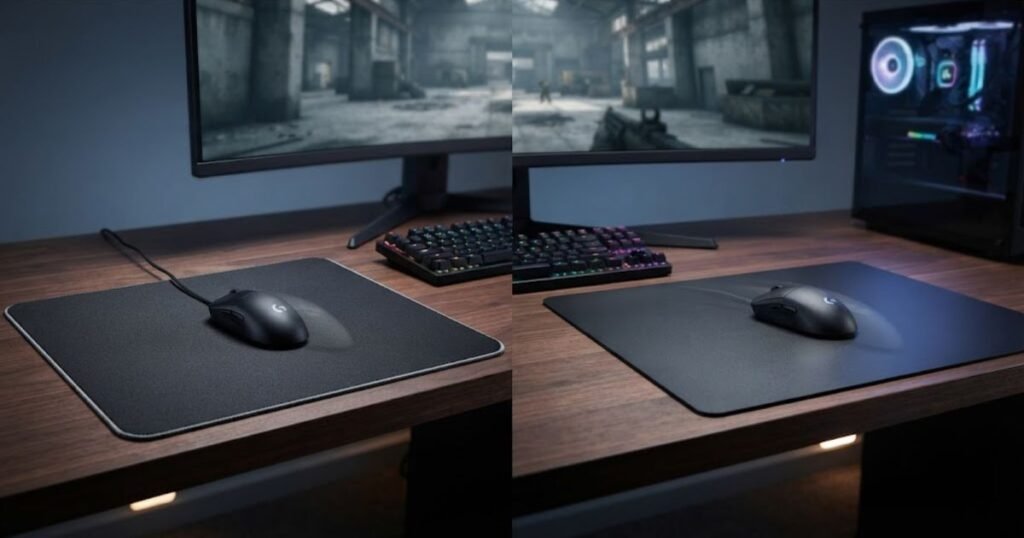
There is no single best surface for every FPS player because different aiming styles place different demands on mouse movement. Players who rely heavily on precise stops may prefer the more controlled feel commonly associated with cloth, while players who prioritize fluid movement and rapid repositioning may prefer a faster hard surface. The better choice depends on how you actually move the mouse during gameplay, not simply on which material is considered better.
Different aiming demands become easier to compare when the mouse movement itself is the focus:
The most useful way to make this decision is to match the surface to your dominant aiming behavior. Consider whether your aim depends more on precise stops, repeated micro-adjustments, fast repositioning, or continuous tracking. This approach is more reliable than choosing a pad based only on the game title or a general reputation for speed or control.
Is Cloth Better for Players Who Prioritize Precision and Stopping?
Cloth can be a strong fit for players who prioritize controlled aiming and a predictable stopping feel. Its softer surface can provide more resistance during mouse movement, which may feel easier to manage when the player needs to slow the mouse and settle the crosshair precisely.
This can be useful for players whose aim involves frequent small corrections or deliberate flicks rather than constantly moving the mouse at maximum speed. The goal is not to make the mouse slower for its own sake, but to give the player a surface feel that supports controlled movement.
Tactical FPS players can especially notice this preference because a large part of their aim may involve holding an angle, making a short adjustment, and stopping the crosshair at a specific point. That does not make cloth universally better for tactical games, but it explains why a controlled surface can make sense for this type of player.
For Valorant players, the choice can become particularly relevant when balancing precise stopping with the amount of movement used during a round. The comparison between cloth vs hard mouse pads for Valorant can therefore be evaluated through the demands of the player’s actual aiming style rather than a simple material preference.
Cloth is therefore a reasonable starting point when controlled movement and stopping are more important to you than maximizing glide speed. The specific cloth surface still matters, so the material should be treated as a starting category rather than a guarantee of performance.
Is Hard Better for Players Who Prioritize Fast Movement?
Hard mouse pads can suit players who prioritize fast, fluid mouse movement and low resistance. The rigid surface can make the mouse feel easier to move across, which may benefit players who frequently reposition their aim or use larger, faster movements.
This can be attractive for players who want the mouse to transition quickly from one position to another without feeling heavily resisted by the surface. The benefit is most noticeable when the player’s natural aiming technique already provides enough hand control to manage a faster glide.
However, fast movement should not be confused with better aim. A player who is comfortable on a controlled surface may lose consistency after moving to a much faster one if the new surface requires a different braking motion. The advantage of a hard pad therefore depends on whether its movement characteristics complement the player’s existing technique.
Hard is a stronger starting point when low resistance and fluid movement are central to your preferred aiming experience. It becomes less compelling when the player consistently feels that additional surface resistance helps them settle the crosshair.
What Changes for Tracking-Heavy FPS Games?
Tracking-heavy FPS games place greater emphasis on maintaining crosshair movement while following a moving target, so some players may prefer a surface that allows the mouse to glide continuously with less resistance. A faster surface can make repeated directional movement feel more fluid, although a controlled surface can still work well for players who value stability over maximum glide.
The important distinction is that tracking does not automatically require a hard mouse pad. Tracking performance depends on the player’s hand control, sensitivity, mouse, skates, and preferred surface feel. The surface only changes the physical interaction that the player has to manage.
In Apex Legends, for example, players can encounter situations that require continuous tracking as well as rapid directional changes. That makes surface preference particularly personal because the player may value both fluid movement and the ability to regain control quickly. The comparison of cloth vs hard mouse pads for Apex Legends is therefore best understood through those movement demands rather than assuming that one material is automatically superior.
A faster surface can make sense for a tracking-focused player who already feels comfortable controlling low resistance. A more controlled surface may remain preferable for someone who wants additional resistance during directional changes and stopping.
What About Tactical FPS Games That Reward Precise Stops?
Tactical FPS games often make precise stopping especially important because players may need to hold narrow angles, make small crosshair corrections, and stop the mouse accurately before taking a shot. A controlled surface can complement this style, but the player’s own aiming technique remains more important than the game category itself.
CS2 provides a useful example because its aiming demands can involve deliberate crosshair placement, short adjustments, and precise stopping. Players who prefer a more controlled surface may find cloth a natural fit, while players who already have strong control over a faster glide may still prefer hard.
That is why the decision should not be reduced to “tactical FPS equals cloth.” The better question is whether the surface gives you the movement characteristics you can consistently control during your actual matches. The cloth vs hard mouse pads for CS2 comparison can help frame that decision around the game’s aiming demands without assuming that every CS2 player should use the same surface.
For tactical FPS players, a controlled surface is often the more intuitive starting point when precise stops are a dominant part of their aim. A faster hard surface can still work when the player prefers freer movement and can reliably manage the additional glide.
The table below matches common FPS aiming priorities with the surface characteristics that may fit them:
| Player priority | Cloth tendency | Hard tendency |
|---|---|---|
| Precise stopping | Strong fit | More demanding |
| Fast repositioning | More controlled | Strong fit |
| Continuous tracking | Controlled and stable | Fluid and low-resistance |
| Micro-adjustments | More deliberate | More responsive |
| Tactical FPS aiming | Strong fit for control-focused players | Preference-dependent |
| Movement-heavy FPS aiming | Preference-dependent | Strong fit for speed-focused players |
The best surface is ultimately the one whose movement characteristics match the way you aim consistently. Cloth is a sensible starting point for players who value controlled stopping and a softer movement experience, while hard can suit players who want lower resistance and faster repositioning. Game genre can provide useful context, but your actual aiming behavior should make the final call.
Which Mouse Pad Is More Comfortable for Long Gaming Sessions?
Cloth gaming mouse pads are generally more comfortable for long gaming sessions because their softer surface creates a less rigid contact area for the wrist and forearm. Hard mouse pads provide a firmer feel, which some players may prefer, but that firmness can feel less forgiving when the arm remains in contact with the pad for extended periods.
Comfort is a separate consideration from aiming performance. A surface that feels excellent for movement may not be the surface you enjoy resting your arm on for several hours. For players who spend long sessions gaming, the way the pad feels against the skin, how its edges interact with the wrist, and how much movement noise it produces can all influence the overall experience.
How Does Surface Firmness Affect Comfort?
Surface firmness changes how the wrist and forearm interact with the mouse pad during extended use. Cloth provides a softer contact point because the fabric surface has some flexibility, while a hard pad maintains a rigid surface beneath the arm.
This difference can become more noticeable during long sessions when the same areas of the wrist or forearm remain in contact with the pad. A softer surface may feel more forgiving for players who frequently rest part of their arm on the mouse pad, while a firm surface can appeal to players who prefer a stable, rigid contact point.
Comfort also depends on the rest of the setup. Desk height, chair position, wrist posture, and how much of the forearm rests on the pad can influence comfort just as much as the material itself. Therefore, cloth should not be treated as automatically comfortable for every player.
The practical distinction is simple: cloth tends to provide a softer physical interface, while hard pads provide a firmer one. Your preferred contact feel should determine which direction makes more sense for long sessions.
Does a Hard Surface Feel Different Against the Wrist?
Yes. A hard mouse pad feels noticeably firmer because the surface does not compress under the wrist or forearm in the same way a cloth pad can. This creates a more rigid contact experience that some players enjoy because it feels stable and consistent.
For players who rarely rest their wrist on the pad, this difference may have little practical importance. For players who keep their wrist or forearm in contact with the surface throughout a gaming session, however, the firmer feel can become much more noticeable.
Edge construction also matters. A rigid surface with an uncomfortable edge can create a different experience from a hard pad with a carefully designed perimeter. The same principle applies to cloth pads, where the edge treatment can affect how naturally the wrist moves between the pad and desk.
Hard surfaces can therefore work well for long sessions when the player prefers a firm contact point and does not find the rigidity uncomfortable. If softer contact is a priority, cloth is usually the more natural starting point.
Does Noise Matter When Choosing Between Cloth and Hard?
Noise can matter because the surface changes how the mouse and mouse feet interact with the pad during movement. Cloth generally produces a softer and less noticeable movement sound, while hard surfaces can create a more distinct sound depending on the mouse feet and surface construction.
The difference is not identical across every model. Mouse feet, surface texture, and the way the player moves the mouse can all affect the final sound. A hard pad is therefore not necessarily loud, just as a cloth pad is not completely silent.
Noise becomes more relevant for players who game in shared spaces, record gameplay, stream, or simply prefer a quieter desk setup. In those situations, the acoustic character of the surface can be part of the comfort decision rather than an afterthought.
For most players, noise is a secondary factor compared with physical comfort. It becomes useful as a tie-breaker when two surfaces otherwise fit the same aiming preferences.
These comfort factors matter more than material alone:
- Surface firmness: How the pad feels under the wrist and forearm during extended use.
- Edge feel: Whether the transition at the pad’s edge feels comfortable against the wrist or arm.
- Contact area: How much of the wrist or forearm remains in contact with the surface while playing.
- Movement noise: How noticeable mouse movement sounds in the player’s gaming environment.
- Desk setup: How the pad works with the desk, keyboard, chair position, and overall posture.
For long gaming sessions, cloth generally has the advantage when softness and a forgiving contact feel are priorities. Hard pads remain a valid choice for players who prefer a firm surface or keep little of their arm on the pad. Comfort ultimately depends on the interaction between the surface and the player’s physical setup, not material alone.
Which Surface Is Easier to Clean and Maintain?
Hard gaming mouse pads are generally easier to clean and maintain because their rigid surfaces can usually be wiped without dealing with fabric fibers. Cloth pads require more attention because their fabric surface can hold dust, moisture, and skin oils within the material. For players who want the simplest day-to-day maintenance, hard has the clearer advantage.
This difference is separate from aiming performance. A player may prefer the feel of cloth but accept the additional maintenance, while another player may value the convenience of quickly wiping down a hard surface. Maintenance should therefore be treated as part of ownership rather than as evidence that one material is better for gaming.
How Do You Maintain a Cloth Mouse Pad?
Cloth mouse pads require more careful cleaning because the surface is made from fabric. Dust, debris, moisture, and skin oils can accumulate in the material over time, particularly in areas that receive frequent contact from the hand and forearm.
Routine care is mainly about keeping the surface clean without unnecessarily stressing the fabric or changing its surface characteristics. The exact cleaning method should follow the manufacturer’s instructions because different fabrics, coatings, and constructions can have different care requirements.
Regular maintenance can help preserve the surface condition, but cleaning frequency should reflect actual use. A heavily used pad in a dusty environment will naturally require more attention than one used occasionally in a clean setup.
The main trade-off is convenience: cloth can provide the softer experience many players prefer, but maintaining that fabric surface generally takes more effort than wiping a rigid pad.
Why Are Hard Mouse Pads Easier to Wipe Clean?
Hard mouse pads are easier to wipe clean because the rigid surface does not absorb or retain debris in the same way a fabric surface can. Dust and surface residue can generally be removed directly from the top layer, making routine cleaning more straightforward.
This makes hard pads particularly convenient for players who want low-maintenance equipment. The surface can be checked quickly, cleaned when necessary, and returned to use without dealing with fabric drying or deeper cleaning concerns associated with some cloth constructions.
Hard surfaces still need appropriate care. Dirt or debris can affect the interaction between the mouse feet and pad, while scratches or surface damage may change how the pad feels. Easy cleaning does not mean the surface is maintenance-free.
For players who prioritize simple day-to-day upkeep, however, the rigid construction gives hard mouse pads a practical advantage.
The table below compares the everyday maintenance demands of cloth and hard mouse pads:
| Maintenance Factor | Cloth Gaming Mouse Pad | Hard Gaming Mouse Pad |
|---|---|---|
| Routine cleaning | Requires more care | Generally simpler |
| Dust removal | Can require more attention | Usually easy to wipe away |
| Moisture | More important to manage | Generally easier to remove from the surface |
| Deep cleaning | More involved | Usually less involved |
| Day-to-day effort | Higher | Lower |
The maintenance decision is straightforward: hard pads are generally easier to keep clean, while cloth pads require more care because of their fabric construction. If comfort and surface feel are your priorities, the extra maintenance of cloth may be worth accepting. If convenience is more important, a hard surface offers a simpler ownership experience.
How Does Durability Differ Between Cloth and Hard Mouse Pads?
Cloth and hard mouse pads wear in different ways, so durability should be judged by how well each surface maintains a consistent gaming experience over time. Cloth pads can develop fabric wear, fraying, or changes in surface feel, while hard pads are more exposed to scratches and surface damage. A physically durable pad is not necessarily the one that keeps the same glide and feel for the longest time.
For FPS players, the more useful question is not simply which material lasts longer. What matters is whether the surface remains consistent enough for the player to keep using the same aiming technique without noticeable changes in how the mouse interacts with the pad.
What Happens to a Cloth Mouse Pad as It Wears?
A cloth mouse pad can gradually change as its fabric surface receives repeated mouse and arm contact. High-use areas may become more worn than the rest of the pad, while the edges can eventually show fraying depending on the construction and how the pad is handled.
Surface wear can also change the way the pad feels during use. A section that has received significantly more movement may no longer feel exactly like a less-used section. For an FPS player, that matters because consistency across the area used for aiming is more useful than simply having a pad that remains physically intact.
Not every cloth pad will wear at the same rate. Fabric quality, construction, edge treatment, usage frequency, cleaning habits, and the amount of mouse movement all influence how the surface ages.
The practical concern with cloth is therefore surface consistency. When the fabric condition changes enough to affect the player’s normal movement, the pad may no longer provide the same experience it had when new.
What Happens to a Hard Mouse Pad as It Wears?
A hard mouse pad does not have a fabric surface that can fray, but its rigid surface can still develop wear through repeated use. Scratches, surface damage, or changes to the top layer can eventually affect how the mouse feet interact with the pad.
Because the surface is rigid, visible physical damage can be easier to identify than gradual fabric wear. However, appearance alone does not determine whether the pad is still performing consistently. A hard pad may remain usable despite minor cosmetic marks, while more significant surface damage can change its movement characteristics.
The lifespan of a hard pad therefore depends on the condition of the actual contact surface. Keeping the surface free from abrasive debris and avoiding unnecessary damage can help preserve its intended feel.
Hard construction removes some of the wear patterns associated with fabric, but it does not make the surface immune to degradation. The important consideration remains whether the mouse can still move across the pad consistently.
Does Durability Mean the Pad Will Perform Better for Longer?
No. Physical durability and performance longevity are not the same thing. A mouse pad can remain structurally intact while its surface characteristics have changed enough to affect how the mouse feels during gameplay.
For example, a cloth pad may still have an intact base and usable edges even after the most frequently used area has developed a different surface feel. Likewise, a hard pad can remain rigid while scratches or surface damage affect the interaction between the mouse feet and the pad.
For an FPS player, useful lifespan is therefore better measured by surface consistency than by structural survival alone. If the pad still provides a predictable experience across the area where you aim, its physical age may be less important than its actual condition.
The table below separates common wear patterns from the factors that affect long-term usability:
| Wear Factor | Cloth Gaming Mouse Pad | Hard Gaming Mouse Pad |
|---|---|---|
| Fabric wear | Relevant to long-term surface condition | Not applicable |
| Edge fraying | Possible depending on construction | Not applicable to fabric edges |
| Surface scratches | Less characteristic of the material | More relevant to the rigid surface |
| Changes in surface feel | Can occur as fabric wears | Can occur after significant surface damage |
| High-use area wear | Can become more noticeable over time | Depends on surface condition and usage |
| Long-term consistency | Depends heavily on fabric condition | Depends heavily on the condition of the contact surface |
Cloth and hard pads simply have different failure points. Cloth is more vulnerable to fabric-related wear and changes across heavily used areas, while hard pads are more concerned with scratches and damage to the rigid contact surface. For FPS gaming, the better measure of durability is whether the pad continues to provide a consistent surface, not whether the material merely remains intact.
Do Mouse Skates Change the Cloth vs Hard Decision?
Yes. Mouse skates can noticeably change how a mouse feels on cloth and hard surfaces, so the pad should not be evaluated independently from the feet underneath the mouse. The same mouse can feel more controlled on one surface and substantially faster on another because the skates determine how the mouse physically interacts with the pad.
The mouse feet are the physical connection between the mouse and the surface, making this interaction important when comparing pads:
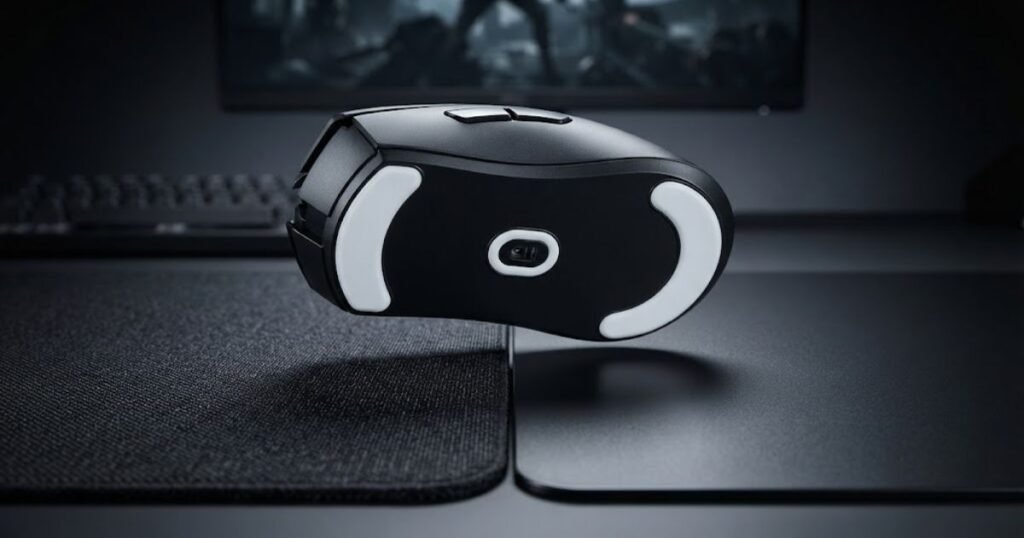
This matters when switching surfaces because a player is not simply changing the pad. They are changing the overall friction and glide characteristics of the mouse setup. A surface that feels manageable with one set of mouse feet may feel much faster or less controlled with another.
Why Can the Same Mouse Feel Faster on a Hard Pad?
The same mouse can feel faster on a hard pad because the interaction between the mouse feet and the rigid surface can produce less resistance during movement. When resistance decreases, the hand may need less force to initiate or maintain movement, making the mouse feel more responsive and free-moving.
The mouse itself has not become faster. The change comes from the interaction between the feet and the surface. This is why judging a hard mouse pad by testing it with a different mouse can produce a different impression from using it with your own setup.
Mouse feet also differ in material, shape, thickness, and surface condition. These differences can influence how much friction the player experiences. As a result, there is no universal glide experience that applies to every mouse and hard pad combination.
The useful takeaway is that surface speed is a property of the complete setup rather than the mouse pad alone. Changing either the pad or the mouse feet can change how the movement feels.
Should You Consider Mouse Feet Before Switching to a Hard Pad?
Yes. If you are considering a hard pad primarily because you want faster movement, your current mouse feet should be part of the decision. A very low-resistance combination may feel significantly different from the setup you are accustomed to, which can affect how easily you control the mouse.
You should also consider the condition of the existing feet. Worn or damaged skates can change the contact between the mouse and pad, making it difficult to judge the surface fairly. Replacing the pad without considering the condition of the feet can therefore make the source of a change in glide difficult to identify.
This does not mean you need to replace your mouse feet whenever you buy a new mouse pad. The important point is simply to recognize that the two components work together and that changing one can alter the feel of the entire setup.
If your current mouse already feels predictable and controlled, a major change in surface friction may require an adjustment period. That is a setup consideration, not evidence that the new surface is inherently better or worse.
Why Should the Mouse and Mouse Pad Be Treated as One Setup?
The mouse and mouse pad should be treated as one setup because their physical interaction determines much of the movement experience. Surface material, surface texture, mouse feet, mouse weight, and the player’s hand control all contribute to how easily the mouse starts, glides, changes direction, and stops.
This is especially important when comparing cloth and hard surfaces. Looking only at the pad can make the decision seem simpler than it actually is. A player who likes the feel of a particular cloth pad may not get the same experience from a different mouse and skate combination, just as a hard pad can feel substantially different depending on the feet being used.
For that reason, the best comparison is based on your existing setup. If you already know how your mouse behaves on your current pad, changing to a different surface gives you a clearer reference point than judging the new pad in isolation.
The goal is not to find the theoretically fastest combination. It is to find a mouse and surface combination that gives you a movement feel you can control consistently during actual gameplay.
Mouse skates therefore act as an important bridge between the pad and the player’s aiming experience. Once you account for that interaction, the cloth vs hard decision becomes less about choosing a universally superior material and more about finding the surface characteristics that work with your existing setup.
Cloth vs Hard Gaming Mouse Pad: Which One Should You Choose?
Choose a cloth gaming mouse pad if you want a softer surface, controlled movement, and a more forgiving stopping feel. Choose a hard gaming mouse pad if you prefer a firm surface, lower resistance, and faster-feeling movement. If you are still unsure, base the decision on the surface characteristics you can control consistently rather than choosing a material simply because it is considered faster or more popular.
Choose Cloth If You Prioritize Control and Comfort
Cloth is the better starting point when your priorities are controlled movement, comfortable long-session use, and a forgiving surface feel. It can be particularly suitable when you want the mouse to feel predictable during precise adjustments and deliberate stops.
Cloth is also a practical choice if you play several FPS games with different aiming demands and do not want an extremely fast surface. A balanced cloth pad can provide a familiar starting point without requiring you to adapt immediately to a very low-resistance surface.
The trade-off is that cloth requires more maintenance and can develop fabric-related wear over time. If those factors are acceptable, its combination of comfort and controlled movement makes it a strong choice for many FPS players.
Choose Hard If You Prioritize Speed and Low Friction
Hard is the better starting point when you want a firm surface with low resistance and a faster-feeling glide. It can suit players who prefer fluid mouse movement and already have enough hand control to manage a surface that offers less physical resistance.
A hard pad can also make sense when you dislike the softer feel of fabric or prefer a rigid contact surface. Its easier day-to-day cleaning can be another practical advantage for players who want lower maintenance.
The trade-off is that a faster surface can demand more active control during stopping and direction changes. If your current aim already feels inconsistent on low-friction surfaces, moving directly to a very fast hard pad may not solve the underlying problem.
What If You Want a Middle Ground?
If neither extreme sounds ideal, the best approach is to look for a surface that sits between strong control and very low friction. You do not need to choose the slowest cloth pad or the fastest hard pad simply because those are the defining characteristics of their categories.
A balanced surface can be useful for players who switch between tactical and tracking-heavy FPS games or who have not yet developed a strong preference for one movement style. The goal is to find enough resistance for reliable stopping without making larger movements feel unnecessarily difficult.
This also means that material should remain a starting filter rather than the final decision. Two pads made from the same broad material category can produce noticeably different experiences because their surface construction and treatment are not identical.
Use this three-step process to make the final choice:
- Identify your priority: Decide whether controlled stopping or low-resistance movement matters more to your aiming.
- Match your movement style: Consider whether your aim relies more on precise adjustments, deliberate stops, continuous tracking, or fast repositioning.
- Check your setup: Factor in your mouse feet, comfort preference, maintenance expectations, and the surface feel you already know how to control.
The table below gives a final decision framework based on the priorities discussed in this guide:
| If You Prioritize… | Better Starting Point |
|---|---|
| Stopping control | Cloth |
| Long-session comfort | Cloth |
| Low-friction movement | Hard |
| Fast-feeling glide | Hard |
| Firm surface feel | Hard |
| Forgiving movement | Cloth |
| Mixed FPS use | Depends on your preferred balance |
| Uncertain surface preference | Start with a balanced control surface |
If you have already decided which surface characteristics fit your aim, the next decision is finding a specific model that provides those characteristics consistently. GearTP’s best gaming mouse pads for FPS games comparison is the natural next step when moving from surface selection to individual pad selection.
Ultimately, the best choice is the surface you can use consistently without fighting its movement characteristics. Cloth is the safer starting point for control and comfort, while hard is the stronger starting point for low resistance and fast movement. Neither should be treated as universally superior.
FAQ: Cloth vs Hard Gaming Mouse Pad
These questions cover the most important differences, technical considerations, and practical decisions when choosing between cloth and hard gaming mouse pads. Each answer focuses on one specific question so you can quickly determine which surface better fits your FPS setup.
What Is a Cloth Gaming Mouse Pad?
A cloth gaming mouse pad is a mouse pad that uses a flexible fabric surface to provide a softer contact area for the mouse. Its exact glide and control characteristics depend on the fabric, weave, coating, and construction.
What Is a Hard Gaming Mouse Pad?
A hard gaming mouse pad is a mouse pad with a rigid surface designed to provide a firm contact area for the mouse. Hard surfaces commonly emphasize low resistance and faster-feeling movement, although the exact performance depends on the surface material and construction.
What Is the Main Difference Between Cloth and Hard Mouse Pads?
The main difference is surface construction: cloth uses a flexible fabric surface, while hard uses a rigid surface. This physical difference can change how movement, friction, and surface feel are experienced during gaming.
Is Cloth or Hard Better for FPS Gaming?
Neither surface is universally better for FPS gaming. Cloth is generally a stronger fit for players who prefer controlled movement and a softer feel, while hard can suit players who prefer lower resistance and faster-feeling movement.
How Does Mouse Sensitivity Affect the Cloth vs Hard Choice?
Mouse sensitivity affects how much physical movement you make, so it can change which surface characteristics feel comfortable and controllable. Lower sensitivity usually involves larger mouse movements, making the preferred balance between glide and resistance especially important.
Do Mouse Skates Affect How Cloth and Hard Pads Feel?
Yes. Mouse skates directly interact with the pad surface, so their material, condition, and design can change the amount of friction and glide you experience on both cloth and hard pads.
Why Can a Hard Mouse Pad Feel Faster With the Same Mouse?
A hard mouse pad can feel faster because its surface may create less resistance between the mouse feet and pad, allowing the mouse to move more freely. The mouse itself has not become faster; the surface interaction has changed.
Does a Cloth Mouse Pad Always Provide More Control?
No. Cloth generally offers a more controlled surface feel, but different cloth pads can vary substantially in friction and glide. The specific surface construction matters more than the material category alone.
Which Should You Choose If You Prioritize Precise Stopping?
Choose cloth as a starting point if precise stopping and controlled movement are your highest priorities. Its generally more resistant surface can provide a more deliberate stopping feel, although individual preference still matters.
Which Should You Choose If You Prioritize Fast Mouse Movement?
Choose hard as a starting point if you prioritize low resistance and fast-feeling mouse movement. A hard surface can make large swipes and rapid repositioning feel more fluid when you are comfortable controlling the additional glide.
Which Is Better for Players Who Switch Between Different FPS Games?
A balanced cloth surface can be a versatile starting point for players who switch between different FPS games because it offers a controlled movement experience without committing to extremely low resistance. Players who strongly prefer fast movement may instead favor a hard surface.
How Do You Decide Between a Cloth and Hard Gaming Mouse Pad?
Choose cloth if you prioritize control, stopping, and softer long-session comfort, and choose hard if you prioritize low resistance, fast movement, and a firm surface feel. If you are unsure, start with the surface you can control consistently rather than choosing based on material popularity alone.
Conclusion
The choice between a cloth and hard gaming mouse pad is ultimately a choice about how you want your mouse movement to feel. Cloth generally favors a softer and more controlled experience, while hard surfaces favor a firmer and lower-resistance experience.
Your FPS game can provide useful context, but it should not make the decision for you. Your aiming style, stopping habits, comfort preference, mouse feet, and ability to control the surface are more useful indicators of whether cloth or hard is the better fit.
“Mouse pads do affect aim consistency because the surface underneath your mouse influences friction, tracking behavior, stopping power, and muscle memory.”
That principle is why the most useful mouse pad is not necessarily the fastest or most durable option. It is the one that gives you a consistent physical surface you can control throughout your normal gaming sessions.
“A mousepad is a surface for placing and moving a computer mouse.”
For modern FPS gaming, that simple function becomes part of the aiming system. The surface determines how the mouse interacts with the desk, while the player determines how effectively that movement is translated into aim.
If you prioritize control, comfort, and a forgiving surface, start with cloth. If you prioritize low resistance, a firm feel, and faster movement, start with hard. Once you know which direction fits your aiming style, comparing individual mouse pads becomes a much more meaningful decision.
Thank you for reading GearTP. I hope this guide helps you choose the mouse pad surface that feels right for your aim and gaming style.