
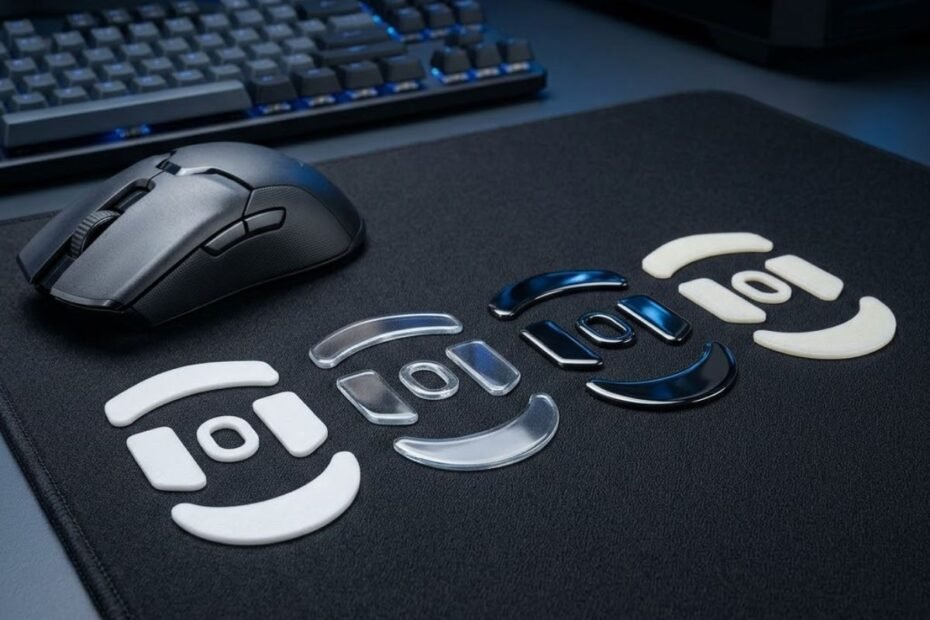
The best mouse feet material for most FPS players is virgin PTFE because it offers the best balance of glide speed, stopping power, consistency, durability, and compatibility with cloth mouse pads. While materials like glass, ceramic, and UHMWPE each have unique strengths, they are better suited to specific preferences rather than replacing PTFE as the overall recommendation.
Many gamers spend time researching sensors, switches, and mouse weight but rarely consider the material underneath the mouse. Since mouse feet are the only part of the mouse that stays in constant contact with the mouse pad, their material directly affects how your mouse feels during every movement, from fast flicks to small tracking adjustments.
The goal is not simply to choose the fastest material. Instead, the best mouse feet material is the one that provides the right balance between speed and control for your aiming style. A material with lower friction may feel effortless to move, while one with slightly higher friction can make stopping and micro-adjustments more predictable.
In this guide, you’ll learn how the most common mouse feet materials compare, why virgin PTFE remains the industry standard for competitive FPS games, and when alternative materials may be a better choice for your setup.
Which Mouse Feet Material Is Best Overall?
Virgin PTFE is the best overall mouse feet material because it delivers the most consistent combination of speed, control, durability, and compatibility across different mouse pads and FPS playstyles. Although glass, ceramic, UHMWPE, and composite materials each provide unique advantages, they are generally designed to satisfy specific preferences rather than outperform virgin PTFE in every category.
The comparison below highlights the most popular mouse feet materials used by competitive FPS players:
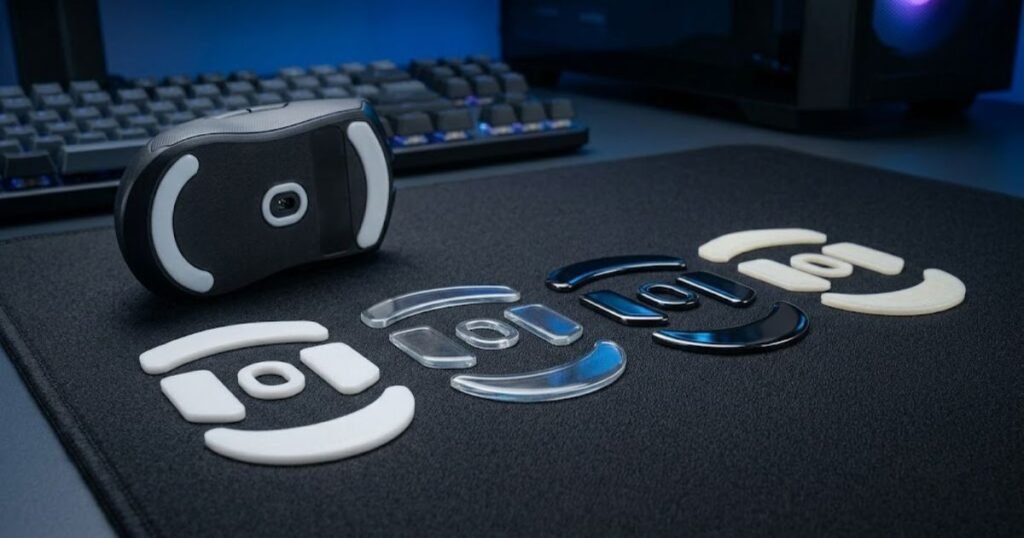
When evaluating mouse feet materials, experienced players rarely focus on maximum glide speed alone. A faster material is not automatically better if it sacrifices stability or makes precise stopping more difficult. The best material is the one that produces predictable movement, maintains consistent friction over time, and complements both your mouse pad and aiming technique.
Why Virgin PTFE Is Still the Industry Standard
Virgin PTFE continues to be the industry standard because it provides exceptionally low friction without sacrificing control, making it suitable for nearly every competitive FPS title.
Unlike standard PTFE blends that may include recycled materials or fillers, virgin PTFE is manufactured from pure polytetrafluoroethylene. The result is a smoother surface that produces more consistent glide characteristics throughout its lifespan. This consistency is one of the primary reasons why many premium aftermarket skates continue to use virgin PTFE as their core material.
Another major advantage is compatibility. Virgin PTFE performs exceptionally well on most cloth mouse pads, which remain the preferred choice for competitive players. Whether you’re making large flicks in fast-paced shooters or carefully tracking targets at low sensitivity, the material provides a predictable balance between movement and stopping power.
It’s also important to understand that high-quality mouse feet cannot compensate for poor sensor performance. Instead, they allow a capable sensor to perform more consistently by reducing unwanted friction and creating smoother movement across the mouse pad. If you’d like to understand how modern sensors translate physical movement into accurate cursor tracking, read our guide on gaming mouse sensors.
For the majority of FPS players, virgin PTFE remains the safest recommendation because it performs reliably across a wide variety of gaming environments without requiring specialized equipment or unusual maintenance.
When Other Materials Can Be Better
Alternative mouse feet materials can outperform virgin PTFE in certain situations, but only when their specific characteristics match a player’s preferences and setup.
Glass mouse feet, for example, significantly reduce friction and create an extremely fast glide that some players enjoy for rapid target transitions. However, the reduced resistance can also make stopping more difficult, especially for players who rely on precise crosshair placement in tactical shooters.
Ceramic mouse feet emphasize durability and maintain their glide characteristics for a long time. Their harder surface creates a unique feeling that appeals to a niche group of players, although they are less common than PTFE-based products and may not suit every mouse pad.
UHMWPE is another low-friction polymer that offers excellent wear resistance while maintaining a smooth glide. Although it has gained popularity in some aftermarket products, its availability remains relatively limited compared to PTFE.
Ultimately, these materials are not objectively better than virgin PTFE. Instead, they provide alternative glide characteristics that may better match individual preferences, specific mouse pads, or unique aiming styles.
The table below compares the overall strengths of the most common mouse feet materials:
| Material | Glide Speed | Control | Durability | Best For |
|---|---|---|---|---|
| Virgin PTFE | Excellent | Excellent | Very Good | Most competitive FPS players |
| Regular PTFE | Very Good | Good | Good | Stock gaming mice |
| Glass | Excellent | Moderate | Excellent | Players who prefer maximum glide |
| Ceramic | Fast | Moderate | Excellent | Long-term durability |
| UHMWPE | Very Good | Good | Excellent | Low-friction enthusiasts |
For most gamers, the decision is simpler than it first appears. Unless you have a specific reason to pursue an ultra-fast or highly specialized glide, virgin PTFE continues to offer the most balanced performance for competitive FPS gaming, making it the benchmark against which other mouse feet materials are measured.
How Different Mouse Feet Materials Affect Performance
Different mouse feet materials influence performance by changing how your mouse glides, stops, and maintains consistency during movement. While gaming sensors determine tracking accuracy, the material beneath your mouse controls how that tracking feels in real gameplay. The right material can make aiming feel smoother and more predictable, while the wrong one may create unnecessary resistance or reduce stopping confidence.
The illustration below demonstrates how different materials influence mouse movement during gameplay:
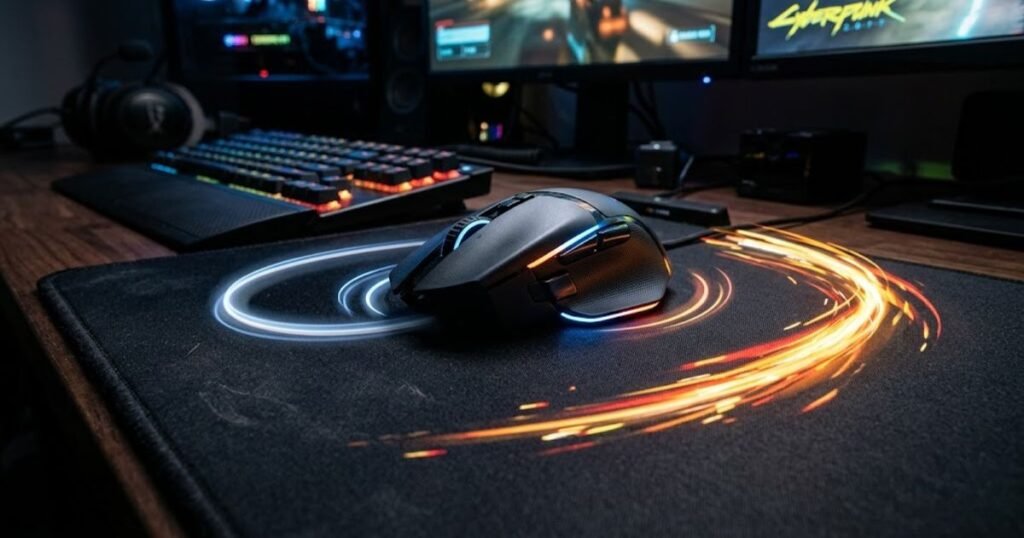
Instead of focusing on speed alone, competitive players should evaluate how each material affects three key performance factors: glide speed, stopping power, and tracking consistency. Together, these characteristics determine how natural and controllable your mouse feels during every movement.
Glide Speed
Glide speed describes how easily a mouse moves across the surface of a mouse pad, and it is primarily determined by the friction between the mouse feet and the pad.
Materials with lower friction require less force to begin moving and continue moving. Glass mouse feet generally provide the fastest glide because they minimize surface resistance, allowing rapid movements with very little effort. Virgin PTFE also delivers an exceptionally smooth glide but introduces slightly more friction, giving players additional control without feeling slow.
By comparison, regular PTFE often feels slightly less refined because manufacturing quality varies between products. Ceramic and UHMWPE usually sit between these extremes, offering different balances of smoothness depending on their design and the mouse pad being used.
Fast glide can benefit players who frequently perform large flicks or rapid target transitions. However, excessive speed may also reduce confidence during precise crosshair placement, especially in tactical shooters where accurate stopping is just as important as fast movement.
Glide speed should therefore be viewed as one part of the overall aiming experience rather than the only measurement of performance.
Stopping Power
Stopping power refers to how easily you can control and stop the mouse exactly where you intend after a movement.
This characteristic becomes particularly important during micro-adjustments, counter-strafing, and precision flick shots. Materials with extremely low friction may feel incredibly smooth, but they also require more muscle control to stop accurately. As a result, a material that feels faster does not always produce better aiming performance.
Virgin PTFE has become the preferred material for competitive FPS players because it balances low friction with predictable stopping resistance. This combination allows quick movements while still maintaining excellent control during precise adjustments.
Glass mouse feet often feel almost effortless to move, but some players find that the reduced resistance makes their aim feel overly sensitive. Ceramic materials can produce a similar sensation depending on the mouse pad, although their harder surface creates a different tactile experience.
The ideal amount of stopping power depends on personal preference, but most competitive players benefit from a balanced level of resistance rather than the lowest friction possible.
Tracking Consistency
Tracking consistency describes how predictable the mouse feels throughout long gaming sessions as it moves across different parts of the mouse pad.
Consistency depends on more than just the mouse feet themselves. Surface texture, wear, dust accumulation, humidity, and manufacturing quality all influence how stable the glide remains over time. High-quality materials maintain similar friction characteristics throughout their lifespan, reducing unexpected changes in movement.
Virgin PTFE is widely regarded as the benchmark because its friction remains relatively stable as the feet wear naturally. Lower-quality materials or poorly manufactured skates may develop uneven wear patterns that create inconsistent glide across different directions.
Although technologies such as Motion Sync help synchronize sensor reporting with internal processing, they do not change the physical friction between the mouse and the mouse pad. Instead, high-quality mouse feet complement modern sensor technologies by providing smoother and more predictable physical movement.
The table below compares how the most common mouse feet materials influence overall gaming performance:
| Material | Glide Speed | Stopping Power | Tracking Consistency |
|---|---|---|---|
| Virgin PTFE | Excellent | Excellent | Excellent |
| Regular PTFE | Very Good | Good | Good |
| Glass | Outstanding | Moderate | Very Good |
| Ceramic | Fast | Moderate | Very Good |
| UHMWPE | Very Good | Good | Very Good |
No single material delivers the highest score in every category. For most FPS players, the ideal choice is the material that balances glide speed, stopping power, and long-term consistency rather than maximizing one characteristic at the expense of another.
Which Mouse Feet Material Fits Your Mouse Pad?
The best mouse feet material depends not only on the skates themselves but also on the mouse pad you use. A material that feels perfectly balanced on one surface can become either too fast or too slow on another. This is why experienced FPS players evaluate their mouse feet and mouse pad as a complete system rather than upgrading either component independently.
The image below compares how mouse feet interact with different mouse pad surfaces:
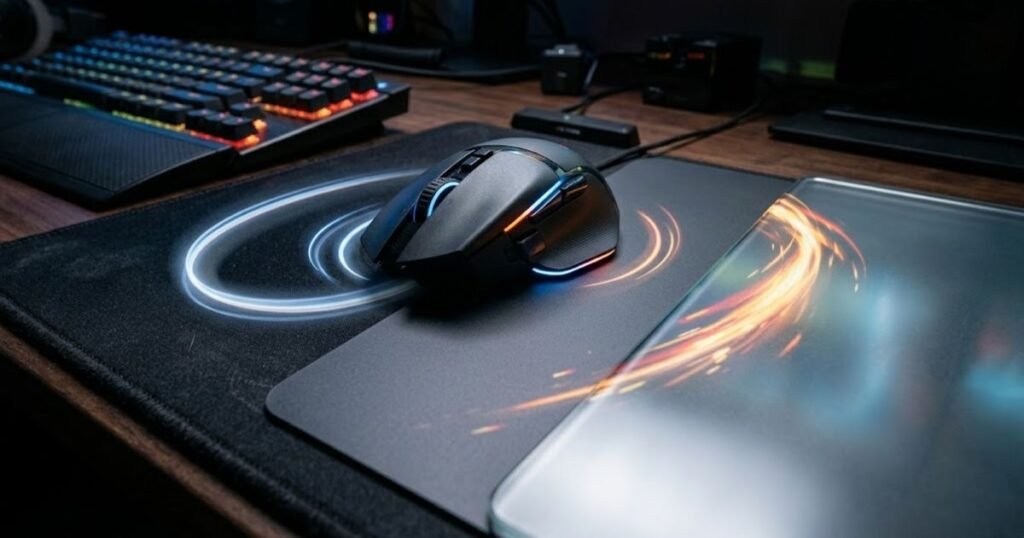
Surface texture, hardness, and friction characteristics all influence how a material performs. Before replacing your mouse feet, it’s worth considering whether your current mouse pad already complements your preferred glide or whether a different material would create a better overall balance.
Cloth Mouse Pads
Virgin PTFE is the best mouse feet material for cloth mouse pads because it delivers smooth glide while maintaining excellent stopping control.
Cloth mouse pads remain the preferred choice for most competitive FPS players because they provide a balanced level of friction. Virgin PTFE complements this surface exceptionally well, producing predictable glide without making the mouse feel overly slippery. This combination helps players transition smoothly between large flicks and precise micro-adjustments.
Glass mouse feet also work on cloth pads, but their significantly lower friction can reduce stopping confidence for some players. While certain users enjoy the effortless movement, others find it more difficult to maintain consistent crosshair placement during tactical gameplay.
Regular PTFE and UHMWPE generally perform well on cloth surfaces, although their overall feel depends on manufacturing quality and the specific texture of the mouse pad.
For the vast majority of FPS players using cloth pads, virgin PTFE remains the most balanced and forgiving option.
Hard Mouse Pads
Hard mouse pads naturally produce less friction, making material choice even more noticeable during gameplay.
Because hard surfaces already allow the mouse to move with minimal resistance, pairing them with extremely low-friction materials can create an exceptionally fast glide. Some players appreciate this effortless movement for tracking-heavy games, while others find that it becomes difficult to stop accurately.
Virgin PTFE still performs very well on hard pads because it preserves a degree of control despite the reduced surface resistance. Ceramic mouse feet are another common choice, as their durability makes them well suited to harder surfaces where wear may occur more gradually.
Players who prefer hard mouse pads should focus less on maximizing speed and more on maintaining predictable stopping behavior throughout long gaming sessions.
Glass Mouse Pads
Glass mouse pads require careful material selection because both the pad and the mouse feet contribute to an extremely low-friction environment.
Unlike cloth or plastic surfaces, glass mouse pads dramatically reduce friction on their own. Pairing them with extremely fast mouse feet may create a glide that feels uncontrollably smooth for many FPS players. As a result, not every aftermarket material is suitable for glass surfaces.
Many manufacturers recommend specific skate designs for glass pads to reduce excessive wear while maintaining consistent movement. Material compatibility becomes more important than simply choosing the fastest option available.
Although mouse feet thickness can also influence how the sensor sits relative to the surface, this effect is different from lift-off distance, which depends on both sensor design and the physical distance between the sensor and the mouse pad.
Choosing a material that matches your glass mouse pad helps maintain consistent glide while avoiding unnecessary wear on either surface.
The table below compares which mouse feet materials work best on different mouse pad surfaces:
| Mouse Pad Surface | Recommended Material | Reason |
|---|---|---|
| Cloth | Virgin PTFE | Excellent balance of speed and control |
| Control Cloth | Virgin PTFE or UHMWPE | Smooth glide without sacrificing precision |
| Hard Pad | Virgin PTFE or Ceramic | Maintains control on naturally fast surfaces |
| Glass Pad | Manufacturer-recommended skates | Optimizes compatibility and reduces wear |
Your mouse pad plays an equally important role in determining how mouse feet feel. Instead of asking which material is universally the fastest, it’s more useful to ask which combination of mouse feet and mouse pad delivers the level of speed and control that best matches your aiming style.
Which Material Is Best for Different FPS Playstyles?
The best mouse feet material depends on how you aim rather than simply how fast you want your mouse to glide. Players who rely on precision flicks often prefer different glide characteristics than those who spend most of their time tracking moving targets. Matching the material to your playstyle usually produces better long-term results than choosing based solely on advertised speed.
Instead of searching for a universally superior material, consider how each option supports your preferred aiming technique and the demands of the games you play most often.
Tactical FPS Players
Virgin PTFE is the best choice for tactical FPS players because it provides predictable stopping power without sacrificing smooth movement.
Games such as Counter-Strike 2 and VALORANT reward accurate crosshair placement, disciplined flicks, and controlled micro-adjustments. Virgin PTFE helps maintain this balance by offering enough glide for quick target acquisition while preserving the resistance needed for precise stopping.
For players who value consistency over raw speed, virgin PTFE remains the safest recommendation.
Fast Tracking FPS Players
Players who spend more time tracking fast-moving targets may prefer lower-friction materials that make continuous movement feel easier.
Titles such as Apex Legends, Call of Duty, and The Finals often involve sustained tracking rather than isolated flick shots. Some players therefore enjoy the effortless glide provided by glass or other low-friction materials, although these options require greater mouse control to maintain precision.
The ideal choice depends on how comfortable you are managing extremely fast glide characteristics during extended tracking.
Balanced Competitive Players
Balanced players benefit most from materials that perform consistently across multiple aiming techniques instead of excelling in only one area.
If your game library includes both tactical shooters and fast-paced arena titles, virgin PTFE remains the most versatile solution. It supports flicking, tracking, and general movement without forcing major adjustments to muscle memory as you switch between different games.
For players seeking one material that performs reliably in almost every FPS scenario, virgin PTFE continues to set the benchmark.
The table below recommends the most suitable mouse feet material for different FPS playstyles:
| Playstyle | Recommended Material | Why It Works |
|---|---|---|
| Tactical FPS | Virgin PTFE | Excellent stopping control and consistency |
| Tracking FPS | Glass or Virgin PTFE | Smooth continuous movement for target tracking |
| Hybrid Players | Virgin PTFE | Balanced performance across different games |
If you’re also comparing complete aftermarket skate options instead of materials alone, our guide to the best gaming mouse skates explains how different skate designs and brands build upon these material characteristics.
Ultimately, your playstyle should guide your decision more than marketing claims. The best mouse feet material is the one that complements how you naturally aim, not necessarily the one that produces the fastest possible glide.
Durability, Maintenance, and Long-Term Value
Virgin PTFE offers the best long-term value for most gamers because it combines excellent durability with consistent performance throughout its lifespan. Although every mouse feet material eventually wears down, the rate of wear and its impact on glide quality vary significantly depending on the material, mouse pad, and maintenance routine. Choosing a material that maintains predictable performance over time is often more valuable than selecting one that simply feels fast when brand new.
The example below shows how clean and worn mouse feet differ after long-term use:
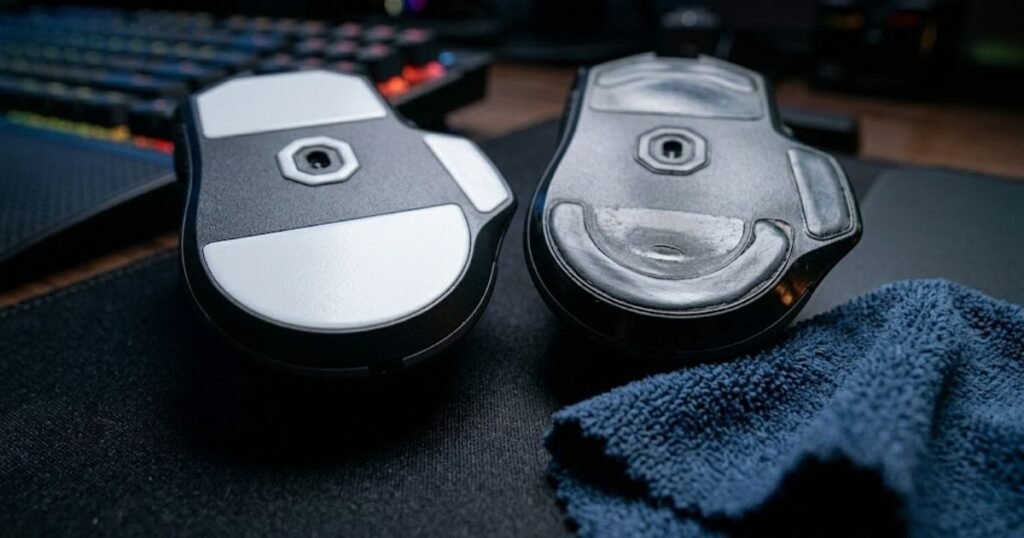
Long-term performance is influenced by several factors, including surface hardness, manufacturing quality, environmental conditions, and daily usage. Understanding these factors helps you determine not only which material lasts longer, but also how to maximize its lifespan.
Which Materials Wear Out the Fastest?
Different mouse feet materials wear at different rates, but durability should always be evaluated alongside performance consistency rather than lifespan alone.
Virgin PTFE gradually becomes smoother as it breaks in, yet it generally maintains predictable glide characteristics throughout most of its usable life. This gradual wear pattern is one of the reasons it remains the preferred material for competitive gaming. Instead of changing dramatically, the glide evolves in a controlled and consistent manner.
Regular PTFE typically wears faster than high-quality virgin PTFE because its composition may include recycled material or manufacturing additives. Depending on the quality of the stock skates, players may notice increased friction or uneven glide after extended use.
Ceramic and glass materials are considerably harder than PTFE-based alternatives, allowing them to resist wear for much longer. However, their durability does not automatically make them a better choice. Extremely hard materials can feel noticeably different from PTFE and may require a longer adjustment period before players become comfortable with their glide characteristics.
Ultimately, the longest-lasting material is not always the best investment if its glide no longer matches your preferred aiming style.
How to Maintain Mouse Feet
Proper maintenance keeps mouse feet gliding consistently and often extends their usable lifespan more effectively than replacing them frequently.
Dust, skin oils, and debris gradually accumulate on both the mouse feet and the mouse pad. This buildup increases friction and creates an inconsistent glide that many players mistakenly attribute to worn-out skates. In many cases, simple cleaning restores much of the original performance.
Regularly wiping the mouse feet with a soft microfiber cloth and keeping the mouse pad clean helps maintain smooth movement. It’s also important to inspect the edges of the skates for excessive wear or damage, as rough edges can introduce scratchiness even when the center of the feet remains in good condition.
Avoid using abrasive cleaning tools or harsh chemicals that may damage the surface of the skates. Gentle maintenance performed consistently is far more effective than aggressive cleaning performed occasionally.
The factors below have the greatest impact on mouse feet lifespan:
- Mouse pad texture: Rougher surfaces generate more friction and increase wear over time.
- Dust and debris: Dirt trapped between the mouse feet and the mouse pad accelerates abrasion.
- Daily usage: Longer gaming sessions naturally produce more wear than occasional use.
- Mouse pressure: Applying excessive downward force increases friction and shortens lifespan.
- Cleaning habits: Regular maintenance helps preserve consistent glide and reduces unnecessary wear.
Although none of these factors can completely prevent wear, good maintenance habits significantly improve long-term consistency regardless of the material you choose.
The table below compares the durability and maintenance requirements of the most common mouse feet materials:
| Material | Expected Durability | Performance Consistency | Maintenance Level |
|---|---|---|---|
| Virgin PTFE | Very Good | Excellent | Low |
| Regular PTFE | Good | Good | Low |
| Glass | Excellent | Very Good | Moderate |
| Ceramic | Excellent | Very Good | Low |
| UHMWPE | Excellent | Very Good | Low |
While harder materials generally last longer, longevity alone should not determine your decision. For most FPS players, maintaining consistent glide and predictable control over months of gameplay provides greater value than simply maximizing durability.
How to Choose the Best Mouse Feet Material
The best way to choose a mouse feet material is to match it with your playstyle, mouse pad, and preferred glide rather than chasing the fastest or most expensive option. Every material involves trade-offs between speed, control, durability, and feel. Instead of searching for a universally perfect material, focus on selecting one that complements your overall gaming setup.
Most players don’t need an exotic material to improve their experience. In fact, many competitive FPS gamers achieve the best results simply by choosing high-quality virgin PTFE that matches their mouse pad and sensitivity.
The following process can help you choose the right mouse feet material:
- Identify your primary games: Tactical shooters usually benefit from balanced control, while tracking-heavy games may favor faster glide.
- Determine your preferred glide: Decide whether you value effortless movement or stronger stopping control.
- Consider your mouse pad: The same material behaves differently on cloth, hard, and glass surfaces.
- Think about long-term maintenance: Choose a material whose durability and maintenance requirements fit your routine.
- Select the material that balances your needs: For most competitive players, virgin PTFE remains the safest overall recommendation.
Following a structured decision-making process helps eliminate unnecessary trial and error. Rather than buying multiple aftermarket skates, you can narrow your options based on how you actually play.
If you’re still deciding which gaming mouse to pair with your preferred skate material, our guide to the best gaming mice for FPS games compares top-performing models across different budgets and playstyles.
Ultimately, the best mouse feet material is the one that feels natural throughout every match. When your mouse feet complement both your aiming style and mouse pad, you’ll spend less time thinking about your equipment and more time focusing on your gameplay.
Common Myths About Mouse Feet Materials
Many misconceptions about mouse feet materials come from marketing claims or isolated user experiences rather than consistent real-world performance. While every material has strengths and weaknesses, no single option is universally superior in every situation. Understanding the facts behind these common myths helps players make better purchasing decisions based on their own setup instead of following trends.
The best mouse feet material is determined by how well it matches your mouse pad, aiming style, and gameplay requirements. Believing common myths often leads players to buy products that don’t actually improve their performance.
The myths below explain some of the most common misconceptions about mouse feet materials:
- Glass mouse feet are always the fastest: Glass generally produces very low friction, but the actual glide depends on the mouse pad, surface condition, and skate design. On some surfaces, the difference is much smaller than many players expect.
- Ceramic mouse feet never wear out: Ceramic is highly durable, but no mouse feet material is completely immune to wear. Surface contamination, edge damage, and long-term use can still affect performance.
- The fastest glide always improves aim: Faster glide reduces physical resistance, but many FPS players actually perform better with moderate friction that provides more predictable stopping control.
- Expensive materials automatically perform better: Price often reflects manufacturing quality, brand reputation, or production complexity rather than guaranteed improvements in aiming performance.
- Stock mouse feet are always poor quality: Many modern gaming mice include high-quality PTFE skates that already perform very well. Aftermarket replacements are most beneficial when the stock feet become worn or when a player wants a different glide characteristic.
Rather than chasing the newest material, focus on finding a glide profile that supports your aiming style and remains consistent throughout long gaming sessions.
Frequently Asked Questions
The questions below address common concerns that players have when choosing mouse feet materials.
What is the best mouse feet material for FPS games?
Virgin PTFE is the best overall material for most FPS players because it provides the best balance of glide, stopping power, and long-term consistency.
Is virgin PTFE better than regular PTFE?
Yes. Virgin PTFE is manufactured from pure PTFE, resulting in smoother glide, more consistent friction, and generally better overall performance than standard PTFE blends.
Are glass mouse feet faster than PTFE?
In most cases, yes. Glass mouse feet usually create lower friction than PTFE, but the faster glide may reduce stopping precision for some players.
Do ceramic mouse feet improve aim?
Not necessarily. Ceramic provides a unique glide feel and excellent durability, but aiming performance still depends primarily on player preference and muscle memory.
Which mouse feet material lasts the longest?
Ceramic, glass, and UHMWPE generally offer the highest durability, while virgin PTFE provides the best balance between lifespan and consistent performance.
Which material works best on cloth mouse pads?
Virgin PTFE is the most widely recommended material for cloth mouse pads because it balances smooth movement with reliable stopping control.
Can mouse feet affect tracking accuracy?
Mouse feet do not change sensor accuracy, but they significantly influence how smooth and consistent mouse movement feels during gameplay.
Should I replace stock mouse feet?
Only if they are worn out or no longer provide the glide characteristics you prefer. Many premium gaming mice already include excellent stock PTFE skates.
Are aftermarket mouse feet worth buying?
Yes, if you’re looking for a different glide profile or replacing worn stock skates. Otherwise, the improvement may be relatively small.
Does mouse feet thickness matter?
Yes. Thickness can influence how the mouse sits on the surface and may slightly affect sensor positioning, although it has a much smaller impact than material selection.
How often should mouse feet be replaced?
Replace them when they become uneven, damaged, or noticeably inconsistent rather than following a fixed schedule.
Which mouse feet material should most gamers choose?
For most gamers, high-quality virgin PTFE remains the safest and most versatile recommendation because it performs consistently across nearly every FPS title and mouse pad.
Final Verdict
Virgin PTFE is the best mouse feet material for most FPS players because it consistently delivers the strongest balance of speed, control, durability, and compatibility across different gaming setups. Although materials like glass, ceramic, and UHMWPE each provide unique advantages, they are typically better suited to niche preferences than general competitive play.
If your goal is to maximize consistency across tactical shooters, tracking-heavy games, and everyday competitive gaming, high-quality virgin PTFE remains the benchmark against which every other mouse feet material is measured. It offers enough glide for fast movements while preserving the stopping control needed for accurate flicks and micro-adjustments.
Alternative materials should not be viewed as upgrades that outperform PTFE in every category. Instead, they represent different trade-offs. Glass emphasizes effortless speed, ceramic prioritizes durability, and UHMWPE offers another low-friction option for players seeking a different feel. The right choice depends on the overall balance you want rather than a single performance metric.
Ultimately, the best mouse feet material is the one that complements your complete setup. Your mouse pad, sensitivity, grip style, and preferred FPS titles all influence how a material performs in real gameplay. Evaluating these factors together will lead to a better decision than simply choosing the material with the lowest friction or the highest price.
Thank you for reading this guide. We hope it helps you choose the mouse feet material that best matches your gaming style and setup.