
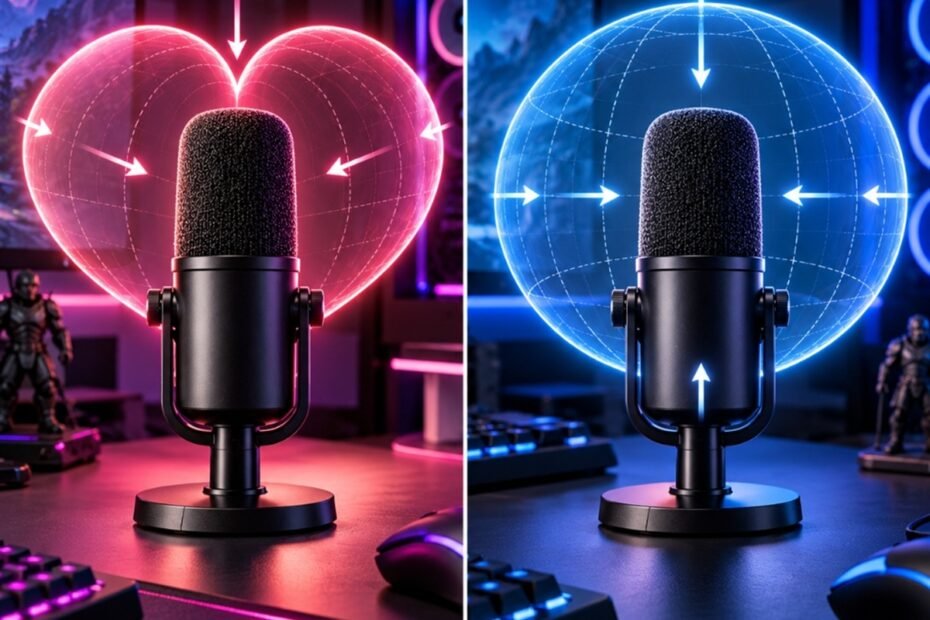
Deciding between a cardioid vs omnidirectional microphone is one of the most consequential acoustic choices for competitive gamers, streamers, and remote broadcasters configuring a dedicated battlestation audio setup. In tactical team shooters like Valorant, Counter-Strike 2, and Apex Legends, high-stakes communication frequently collides with loud mechanical switch chatter, high-RPM PC chassis fans, and reverberant room echoes that clutter voice channels.
Understanding how directional polar patterns differ from 360-degree spherical capture ensures you invest in the correct audio hardware for your specific room acoustic profile. Expanding upon our foundational guide to types of gaming microphones, this technical comparison analyzes polar pattern geometry, ambient noise rejection mechanics, proximity effect behavior, and desk placement ergonomics to help you optimize vocal clarity.
Polar Pattern Mechanics: Directional Heart Cone vs 360-Degree Spherical Pickup
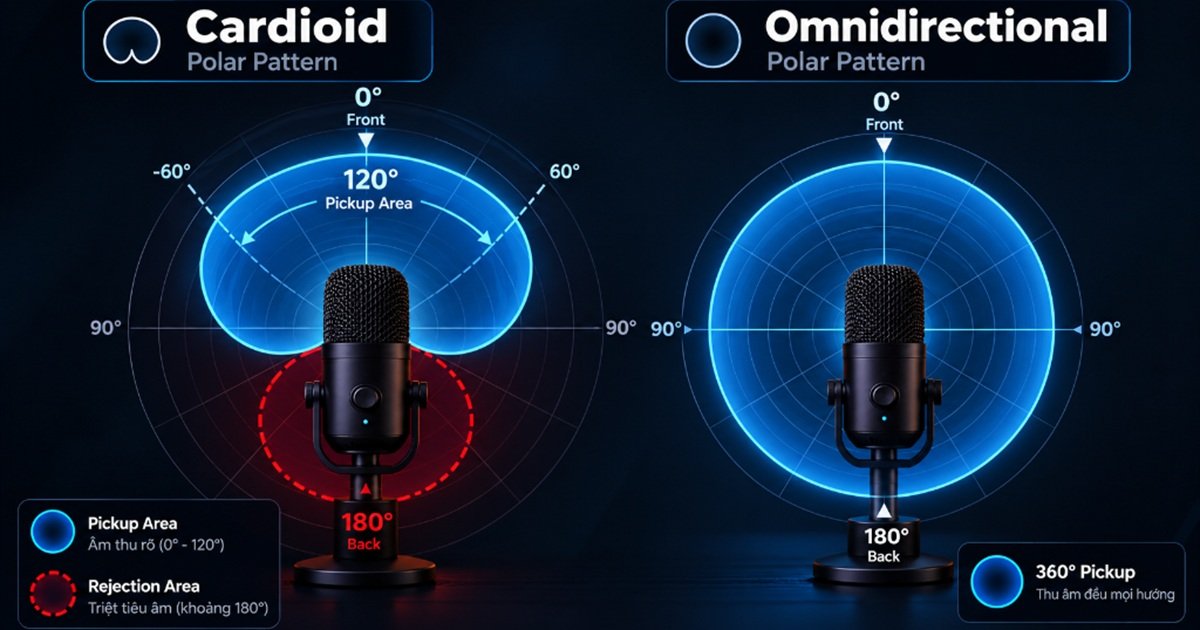
Cardioid microphones capture sound within a directional 120-degree forward cone while canceling audio from the direct rear (180 degrees), whereas omnidirectional microphones capture sound pressure equally across all 360 degrees without directional preference.
Cardioid Architecture: Pressure-Gradient Acoustic Delay and 180-Degree Null
A cardioid microphone operates on an acoustic pressure-gradient principle, meaning its diaphragm reacts to the differential sound pressure between its front and rear faces. Inside the capsule housing, precision-engineered acoustic delay networks and phase-shifting rear ports route external sound waves to the back of the diaphragm.
When sound originates from behind the microphone at 180 degrees, the rear acoustic labyrinth delays the sound wave by the precise duration needed for the external wavefront to reach the front face of the membrane. Because both sound waves impact opposite sides of the flexible diaphragm with identical pressure and opposite polarity, they cancel each other out completely. This physical phase cancellation produces an acoustic null point that attenuates rear sound by 20 to 25 decibels.
Omnidirectional Architecture: Pressure-Operated Capsules and Equal Sensitivity
In contrast to directional designs, an omnidirectional microphone operates on a pure pressure principle. The capsule consists of a completely sealed acoustic chamber where only the front face of the diaphragm is exposed to external atmospheric sound waves, while the interior cavity maintains a fixed reference pressure.
Because acoustic pressure is a scalar quantity possessing magnitude without inherent vector direction, sound waves striking the diaphragm displace the membrane with equal efficiency regardless of whether they arrive from the front, sides, top, or rear. This physical architecture creates a perfectly spherical 360-degree sensitivity envelope that captures every detail of the surrounding acoustic environment.
Ambient Noise Rejection and Room Acoustic Management
Cardioid microphones passively reduce mechanical keyboard clicks and PC exhaust fan noise by positioning desk clutter in the rear null zone, whereas omnidirectional microphones record every background reflection and keyboard click.
Mechanical Keyboard and PC Fan Rejection on Gaming Desks
On a modern gaming desktop, mechanical keyboards with tactile or clicky switches generate sudden transient acoustic spikes between 70 and 80 decibels sound pressure level. When an omnidirectional microphone sits on a desk, its 360-degree sensitivity envelope captures keystroke clatter with identical loudness to your vocal callouts, drowning out strategic voice communication on Discord.
A cardioid microphone neutralizes this issue through strategic spatial alignment. By mounting the microphone on an articulated boom arm and aiming the 180-degree rear null directly downward at your keyboard switches, the mechanical switch noise lands squarely in the cancellation zone. This physical attenuation removes keystroke clatter before the audio signal reaches your software preamplifier, eliminating the need for heavy digital noise gates.
Room Reverberation, Flutter Echo, and Wall Reflections
Most home gaming setups reside in acoustically untreated rooms featuring bare drywall, hardwood or laminate flooring, and large glass windows. Vocal sound waves reflect rapidly off these hard boundaries, generating flutter echo and standing room reverberation that create a hollow, distant voice presentation.
Omnidirectional capsules gather acoustic reflections bouncing from every wall, ceiling, and desk corner, producing a muddy, boomy voice quality unless operated in a professional sound booth. Conversely, a cardioid microphone focuses purely on direct vocal energy arriving on-axis, passively rejecting off-axis room reverberation and preserving punchy, intelligible speech in everyday residential environments.
The Untreated Room Reality: An omnidirectional microphone functions like an acoustic mirror, capturing room reflections as loudly as direct speech. In an untreated bedroom or office, a cardioid capsule acts as a physical acoustic barrier, isolating vocal callouts and rejecting room echo at the hardware level without digital processing latency.
Proximity Effect and Distance Forgiveness
Cardioid microphones exhibit the proximity effect, boosting bass when spoken into closely, whereas omnidirectional microphones maintain flat, natural vocal balance regardless of speaking distance or head movement.
The Proximity Effect: Bass Boost in Cardioid Capsules
The proximity effect is an acoustic phenomenon unique to pressure-gradient directional capsules, wherein low-frequency bass frequencies amplify dramatically as the speaker moves closer to the microphone. When speaking into a cardioid microphone at distances between 5 and 10 centimeters, vocal frequencies between 80 Hz and 200 Hz experience up to 6 to 10 decibels of natural acoustic enhancement.
Gamers and radio broadcasters leverage this bass reinforcement to project rich, authoritative, and intimate vocal presence during tactical voice callouts. However, speaking too close without proper pop filtration can trigger plosive air distortion from harsh P and B consonant blasts.
Consistent Vocal Tone and Distance Forgiveness in Omnidirectional Mics
Because omnidirectional capsules rely on sealed pressure chambers rather than pressure-gradient phase ports, they exhibit zero proximity effect. Whether a speaker speaks 5 centimeters or 30 centimeters away from the capsule, the tonal frequency balance remains completely flat and natural without artificial bass buildup.
Furthermore, omnidirectional microphones offer immense distance forgiveness and head movement tolerance. Gamers who frequently turn their heads toward secondary monitors or lean back in their chairs maintain consistent audio volume and natural speech tone, whereas turning off-axis on a cardioid microphone causes noticeable high-frequency roll-off and volume loss.
Technical Specification Matrix: Cardioid vs Omnidirectional Microphones
Comparing electroacoustic metrics demonstrates that cardioid capsules excel in directional noise rejection and vocal authority, while omnidirectional capsules deliver flat frequency linearity and total spherical coverage.
The following technical comparison outlines the core electroacoustic differences between cardioid and omnidirectional microphone architectures:
| Acoustic Metric | Cardioid Directional Pattern | Omnidirectional Spherical Pattern | Gaming and Voice Setup Impact |
|---|---|---|---|
| Pickup Acceptance Angle | 120 to 130 degrees (Forward cone) | 360 degrees (Complete sphere) | Cardioid focuses on solo gamer; omni captures entire room. |
| Rear Rejection (Null Zone) | 15 to 25 dB attenuation at 180 degrees | 0 dB attenuation (Equal sensitivity) | Cardioid physically silences mechanical keyboard noise. |
| Room Echo and Reverberation | Low (Rejects off-axis room bounce) | High (Captures flutter echo from walls) | Cardioid thrives in bedrooms; omni demands sound treatment. |
| Proximity Bass Boost | Present (Increases bass within 10 cm) | None (Zero proximity bass buildup) | Cardioid offers broadcast warmth; omni provides flat realism. |
| Head Movement Tolerance | Moderate (Volume drops off-axis) | High (Consistent volume at any angle) | Omni forgives restless head motion across multi-monitors. |
| Wind and Plosive Sensitivity | High (Sensitive to breath puffs) | Low (High resistance to air blasts) | Cardioid requires pop filter; omni resists breath pops easily. |
| Operating Principle | Pressure-Gradient (Rear delay ports) | Pressure-Operated (Sealed chamber) | Cardioid uses phase delay; omni uses scalar pressure. |
| Typical Gaming Application | Competitive FPS, Discord, streaming | Multi-person podcasts, tabletop streams | Cardioid is the universal competitive gaming standard. |
| Mounting Recommendation | Articulated boom arm close to mouth | Desktop center or conference boundary | Cardioid requires precise aiming toward mouth. |
| Desk Noise Isolation | High (Rejects desk and floor rumble) | Low (Captures mouse clicks and desk bumps) | Cardioid protects team comms from keystroke chatter. |
This technical breakdown clarifies why peripheral manufacturers overwhelmingly implement cardioid capsules in dedicated gaming hardware. In desktop gaming setups characterized by high ambient noise and reflective room surfaces, physical directional isolation provides an insurmountable competitive advantage.
Gaming and Content Creation Use Cases: Selecting the Right Polar Pattern
Cardioid microphones dominate solo competitive gaming, Discord voice chat, and game streaming, whereas omnidirectional microphones are specialized for multi-person podcasts and conference recordings.
Solo Competitive Gaming, Discord Comms, and Game Streaming
For individual players competing in tactical titles or streaming on Twitch and YouTube, a cardioid microphone is the uncontested industry standard. Gamers sitting in front of a keyboard and monitor require an audio pickup pattern that isolates their direct vocal speech while ignoring mouse sensor sweeps, key actuations, and computer exhaust fans.
Pairing a cardioid polar pattern with dynamic or condenser capsule hardware, as detailed in our comprehensive guide explaining what is a cardioid microphone, ensures your team callouts remain sharp, punchy, and completely free from background distraction during clutch rounds.
Multi-Person Roundtables, Podcast Interviews, and ASMR Creation
Omnidirectional microphones excel in collaborative recording scenarios where multiple speakers sit around a single conference table or desk without individual microphones. Positioning an omnidirectional capsule in the center of the table captures every participant with balanced volume and natural tonal clarity, avoiding phase cancellation artifacts.
Additionally, content creators producing ASMR audio or ambient gaming soundscapes utilize omnidirectional microphones to capture realistic three-dimensional environmental immersion. However, for solo competitive gaming comms, an omnidirectional microphone should never be deployed unless the recording room possesses dedicated acoustic sound absorption panels.
Step-by-Step Selection Framework: Which Microphone Fits Your Battlestation?
Follow this sequential 4-step decision framework to evaluate your room acoustics, speaker configuration, and desk mounting setup before selecting a microphone polar pattern.
Execute these evaluation steps sequentially to determine the optimal polar pattern architecture for your gaming setup:
- Audit Ambient Room Noise and Keyboard Clatter: Determine the acoustic noise floor of your gaming space. If you utilize clicky or tactile mechanical keyboard switches, rapid mouse clicking, or play near computer cooling fans, select a cardioid microphone to leverage its 180-degree rear null cancellation.
- Evaluate Room Acoustic Treatment: Inspect your wall and floor boundaries. If your room features bare drywall, laminate flooring, or tall ceilings without acoustic foam panels, avoid omnidirectional microphones, which will capture muddy room reverberation and flutter echoes.
- Determine Participant Count and Desk Layout: Identify how many individuals will speak into the microphone simultaneously. If you game and broadcast alone, choose a cardioid capsule; if you regularly host in-person multi-guest podcasts around a single desk, an omnidirectional microphone provides balanced coverage.
- Assess Boom Arm Mounting vs Desktop Placement: Verify whether you can install an articulated boom arm to place a cardioid capsule within 10 to 15 centimeters of your mouth. If you must place the microphone flat in the middle of a conference desk to pick up multiple voices, an omnidirectional pattern accommodates wide placement.
Multi-Pattern USB Microphone Trap: Many popular USB microphones feature a hardware toggle switch for Cardioid, Omnidirectional, Bidirectional, and Stereo modes. Unless you are actively recording a multi-person tabletop meeting, always leave the selector locked in Cardioid mode to prevent accidental background noise leakage into your gaming voice comms.
Frequently Asked Questions: Cardioid vs Omnidirectional Microphones
Explore detailed technical answers to the most common questions regarding cardioid and omnidirectional polar pattern differences, background noise handling, and voice chat performance:
What is the main difference between cardioid and omnidirectional microphones?
A cardioid microphone captures sound primarily from the front while rejecting sound from the rear, whereas an omnidirectional microphone captures sound equally from all 360-degree directions around the capsule.
Does an omnidirectional microphone pick up keyboard typing noise?
Yes, an omnidirectional microphone captures mechanical keyboard typing sounds with high sensitivity because it lacks a directional null zone, picking up desktop keystrokes and mouse clicks as loudly as vocal speech.
Why do most gaming microphones use a cardioid pattern?
Gaming microphones rely on cardioid patterns because their 180-degree rear null zone physically cancels keyboard clatter and PC fan hum, delivering clean, isolated vocal callouts to voice communication servers.
Can an omnidirectional microphone be used for gaming voice chat?
Yes, but it requires an exceptionally quiet room with professional acoustic treatment; in standard home environments, an omnidirectional microphone captures excessive background noise, room echoes, and keyboard clatter.
What is an acoustic null zone in a cardioid microphone?
An acoustic null zone is the specific angle behind a cardioid capsule (180 degrees) where internal acoustic phase cancellation neutralizes sound waves, attenuating incoming noise by 20 to 25 decibels.
Do omnidirectional microphones have proximity effect?
No, omnidirectional microphones rely on sealed pressure capsules rather than pressure-gradient delay ports, meaning they exhibit zero proximity effect and maintain a flat bass response at any speaking distance.
Does an omnidirectional microphone require a pop filter?
Omnidirectional microphones are naturally more resistant to plosive breath blasts and wind turbulence than cardioid microphones, but using a foam windscreen is still recommended when speaking at close working distances.
Can you change a microphone from cardioid to omnidirectional?
Multi-pattern USB microphones feature dual or triple internal capsule arrays and a hardware switch that electronically combines signals to toggle between cardioid, omnidirectional, figure-8, and stereo modes.
Which microphone is better for Discord and Valorant comms?
A cardioid microphone is substantially better for Discord and Valorant because it isolates your voice from mechanical keyboard switches, PC exhaust fan noise, and unpadded room reflections without digital latency.
Can a cardioid microphone pick up multiple people?
Yes, provided all speakers position themselves closely together within the forward 120-degree acceptance cone; individuals sitting to the sides or rear of the microphone will sound quiet, distant, and muffled.
Why do interviewers and news reporters use omnidirectional microphones?
Reporters use omnidirectional microphones because their 360-degree pickup accommodates moving subjects without volume dropouts, while their sealed capsules offer exceptional immunity to outdoor wind gusts and handling noise.
Does an omnidirectional microphone sound more natural than a cardioid microphone?
In acoustically treated sound booths, omnidirectional microphones deliver exceptionally flat and uncolored frequency response; however, in untreated gaming rooms, cardioid microphones produce far cleaner and more articulate speech.
Final Verdict: Choosing Between Directional Isolation and 360-Degree Coverage
Choose a cardioid microphone if you are a solo gamer, streamer, or podcaster playing in a standard home room; select an omnidirectional microphone only if you record multi-person roundtables in treated spaces.
Optimizing your competitive voice communication requires choosing an acoustic polar pattern that harmonizes with your physical environment. While omnidirectional capsules provide spherical realism in controlled recording studios, the rear null cancellation, proximity vocal authority, and room noise rejection of cardioid microphones make them the indispensable gold standard for competitive gaming battlestations.
Thank you for reading GearTP. We hope this comprehensive comparison between cardioid and omnidirectional microphones empowers you to select the ideal acoustic pattern for crystal-clear tactical team communication.