
In competitive first-person shooter games like Counter-Strike 2 and Valorant, gunplay precision is fundamentally tied to character movement deceleration. For decades, traditional mechanical keyboards forced players to adapt to rigid physical reset points that introduced mechanical delays whenever they attempted rapid counter-strafing. The emergence of magnetic analog switches has completely disrupted this paradigm, prompting competitive players to ask what is rapid trigger and how this breakthrough hardware feature transforms mechanical responsiveness.
Unlike standard mechanical switches that rely on fixed physical contact leaves, rapid trigger continuously measures analog key travel to deactivate and reactivate inputs dynamically anywhere along the keystroke. In this comprehensive technical guide, we break down the magnetic Hall Effect physics powering rapid trigger, examine the exact input latency advantages during tactical movement stops, and provide optimal sensitivity calibration profiles to elevate your competitive performance on a dedicated gaming keyboard for FPS setup.
What Is Rapid Trigger and How Does It Work in Gaming Keyboards?
Rapid trigger is an analog keyboard switch feature that dynamically resets key inputs the millisecond an upward finger motion begins, eliminating physical reset thresholds to enable continuous, instantaneous actuation in competitive gaming.
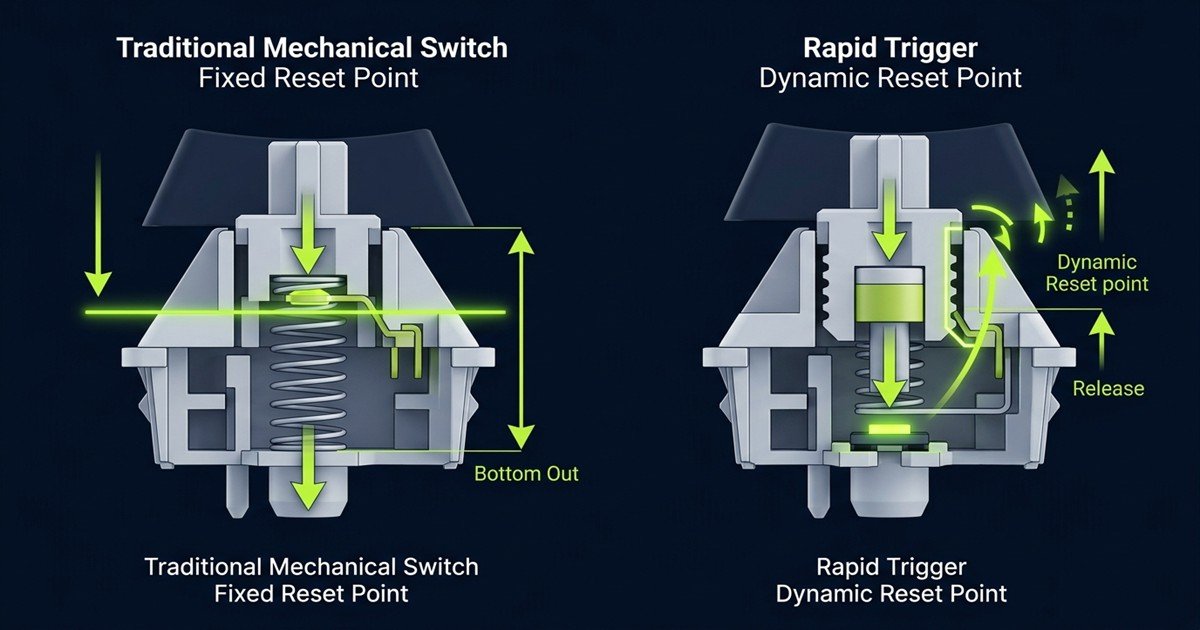
To understand rapid trigger, players must first understand the fundamental limitation of traditional mechanical switches. In standard mechanical keyboards, two metal leaves make physical contact to send an electrical signal. This architecture requires two predetermined physical thresholds: an actuation point where the key registers, and a reset point where the key deactivates.
When an esports athlete presses down on a standard switch, the key travels past the actuation point. To press that same key a second time, the player cannot simply press down again from their current depth. They must lift their finger high enough for the switch stem to physically clear the reset point. This dead space between key release and physical reset creates mechanical input lag that slows down movement in fast-paced titles like Counter-Strike 2 and Valorant.
Dynamic Reset Points: Eliminating Mechanical Dead Travel
Rapid trigger fundamentally redefines switch reset mechanics. Instead of waiting for a switch stem to cross a fixed height on its return path, rapid trigger deactivates the key input the instant the switch begins moving upward by as little as 0.1 millimeters.
Furthermore, if a player decides to repress the key before it returns to the top, rapid trigger reactivates the input immediately upon downward motion. The actuation and deactuation points travel dynamically with the player’s finger throughout the entire 4.0 millimeter stroke. This dynamic behavior eliminates dead travel completely, giving players analog control over keyboard timing similar to how modern optical sensors transformed competitive mice.
Differences between traditional mechanical switches and rapid trigger switches:
| Mechanical Specification | Standard Mechanical Switch | Rapid Trigger Magnetic Switch |
|---|---|---|
| Reset Point Architecture | Fixed physical height (e.g., 1.5mm to 1.8mm) | Dynamic floating point (active anywhere in travel) |
| Minimum Release Sensitivity | 1.0mm to 2.0mm upward travel required | 0.1mm upward travel triggers reset |
| Physical Debounce Delay | 5ms to 20ms algorithm filter required | 0ms (zero contact bounce noise) |
| Actuation Customization | Locked by physical switch stem design | Software-adjustable from 0.1mm to 4.0mm |
| Competitive Movement Advantage | Prone to accidental movement overlap | Instantaneous counter-strafing and stopping |
| Switch Lifespan Rating | 50 to 100 million physical contact cycles | 100+ million cycles (contactless magnetic) |
The comparative data demonstrates why magnetic switches represent a generational paradigm shift in input responsiveness. By decoupling switch activation from physical contact leaves, rapid trigger eliminates the physical latency ceiling that has constrained mechanical keyboards for over four decades.
How Hall Effect Magnetic Sensors Power Rapid Trigger Technology
Hall Effect magnetic sensors power rapid trigger by measuring continuous magnetic flux variations from a permanent neodymium magnet in the switch stem, translating physical analog position into precise digital distance measurements without electrical contact.
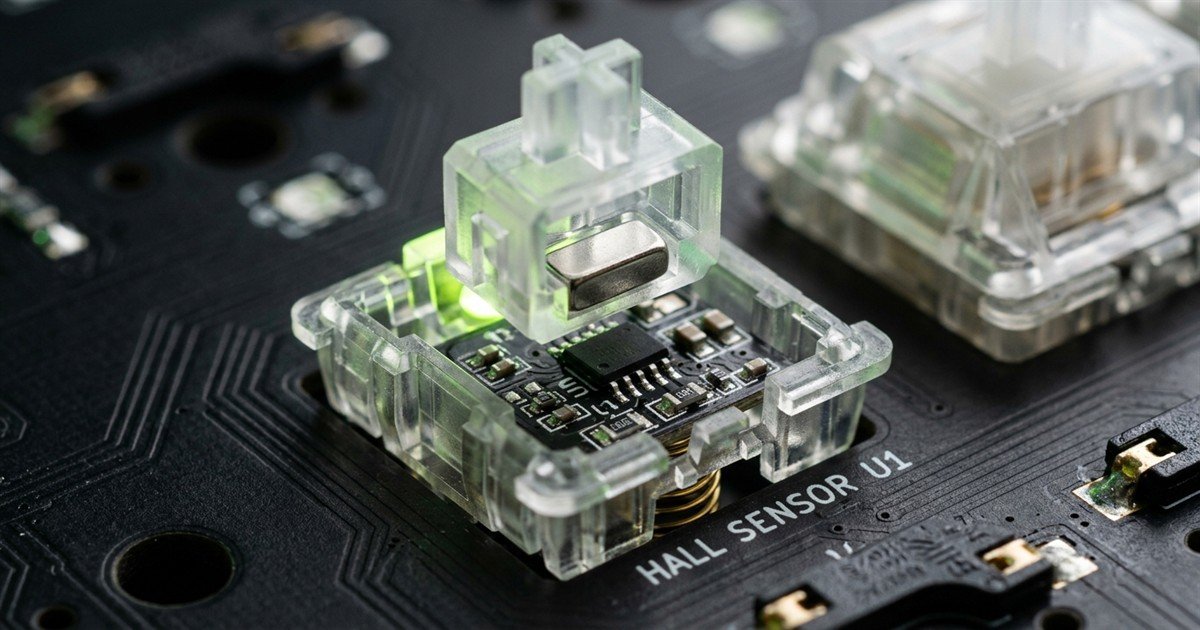
The physical principle behind magnetic gaming keyboards is the Hall Effect, discovered by physicist Edwin Hall in 1879. When an electric current passes through a conductor placed inside a magnetic field, the magnetic field exerts a transverse force on the moving charge carriers. This deflection generates a measurable voltage difference perpendicular to both the current and the magnetic field, known as Hall voltage.
In a modern rapid trigger gaming keyboard, every single key position features a dedicated Hall Effect sensor integrated into the printed circuit board (PCB). Inside the moving stem of each switch sits a small neodymium magnet. As the key is pressed down, the magnet moves closer to the sensor, increasing the magnetic flux density. When the key is released, the magnet moves away, decreasing the magnetic flux density.
Contactless Architecture and Zero Debounce Delay
Because Hall Effect switches rely on magnetic field measurements rather than physical metal-on-metal collision, they completely bypass contact bouncing. In standard mechanical keyboards, two metal leaves strike each other and physically vibrate for several milliseconds before establishing clean contact. Keyboard microcontrollers must implement a software debounce delay between 5 to 20 milliseconds to prevent double-clicking.
Magnetic switches exhibit zero mechanical contact chatter. The analog-to-digital converter (ADC) samples magnetic field strength continuously at multi-thousand Hertz polling rates. This allows firmware algorithms to process raw physical key position instantly without adding protective debounce buffers, creating the cleanest possible input stream for high-performance esports titles supported by a dedicated gaming keyboard for FPS setup.
Why Rapid Trigger Delivers a Massive Competitive Advantage in FPS Games
Rapid trigger delivers a decisive competitive advantage in FPS games by instantly cutting character movement inertia during counter-strafing, allowing players to reach zero velocity and achieve perfect first-shot accuracy up to 50 milliseconds faster.
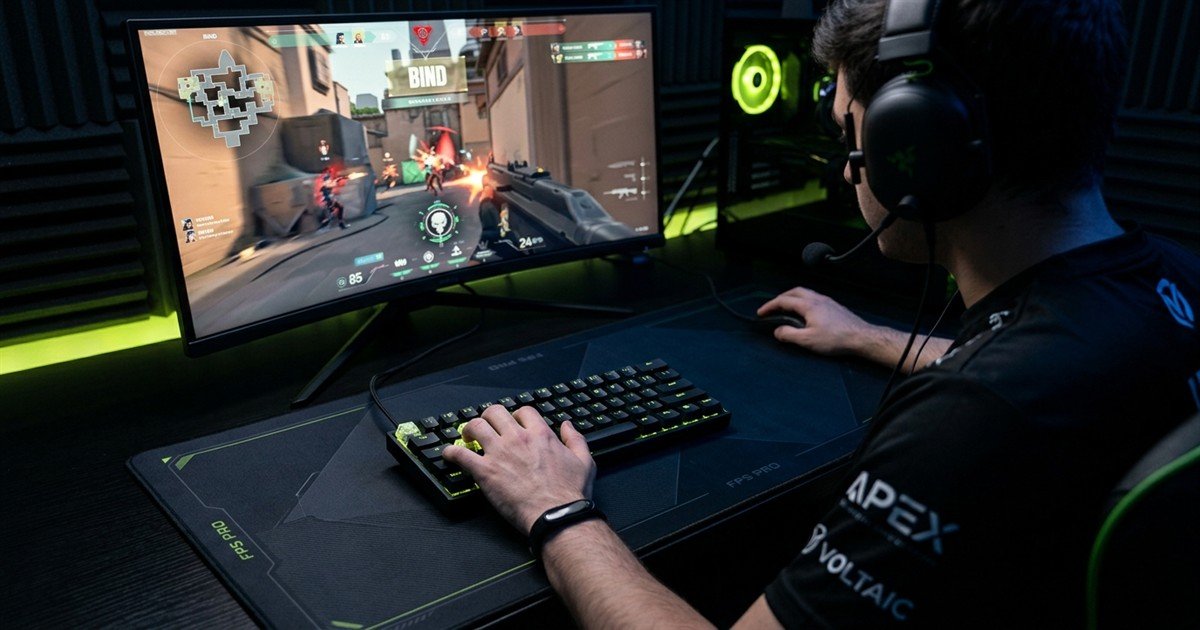
In tactical first-person shooters such as Counter-Strike 2 and Valorant, gunplay mechanics strictly penalize shooting while moving. Firing a rifle like the Vandal or AK-47 while moving results in extreme bullet spread. To fire an accurate first bullet, players must perform a counter-strafe: while moving in one direction, they release their strafe key and tap the opposite direction key to bring character velocity to absolute zero.
On traditional mechanical keyboards, releasing the ‘A’ key requires lifting your finger past the reset threshold. During that mechanical release delay, the game engine continues registering the leftward movement input. If the player presses the ‘D’ key while the ‘A’ key has not yet cleared its physical reset point, both inputs briefly overlap, causing character stutter or delayed stopping.
Milliseconds That Determine Gunfight Outcomes
Sequential advantages delivered by Rapid Trigger during tactical counter-strafing:
- Immediate Input Cutoff: The game engine ceases registering directional velocity the moment your finger releases upward by 0.1mm, cutting movement inertia instantly.
- Zero Overlap Stutter: Opposing movement keys can be actuated immediately without waiting for previous keys to travel back to neutral resting height.
- Accelerated Crosshair Stabilization: Weapon spread resets to pinpoint accuracy between 20ms and 50ms earlier than on standard mechanical switches.
- Rapid Jiggle Peeking: Players can peek around corners, fire a shot, and retreat back into cover with unmatched fluidity and precision.
This microsecond speed advantage explains why competitive esports players in VCT and CS2 Majors have universally transitioned away from standard mechanical keyboards. Rapid trigger turns human reaction time into immediate in-game stopping power.
How to Configure and Tune Rapid Trigger Sensitivity for Competitive Play
Configuring rapid trigger requires balancing initial actuation depth with dynamic release sensitivity to eliminate accidental inputs while maximizing stopping speed, typically starting at 1.0mm actuation and 0.2mm release sensitivity for movement keys.
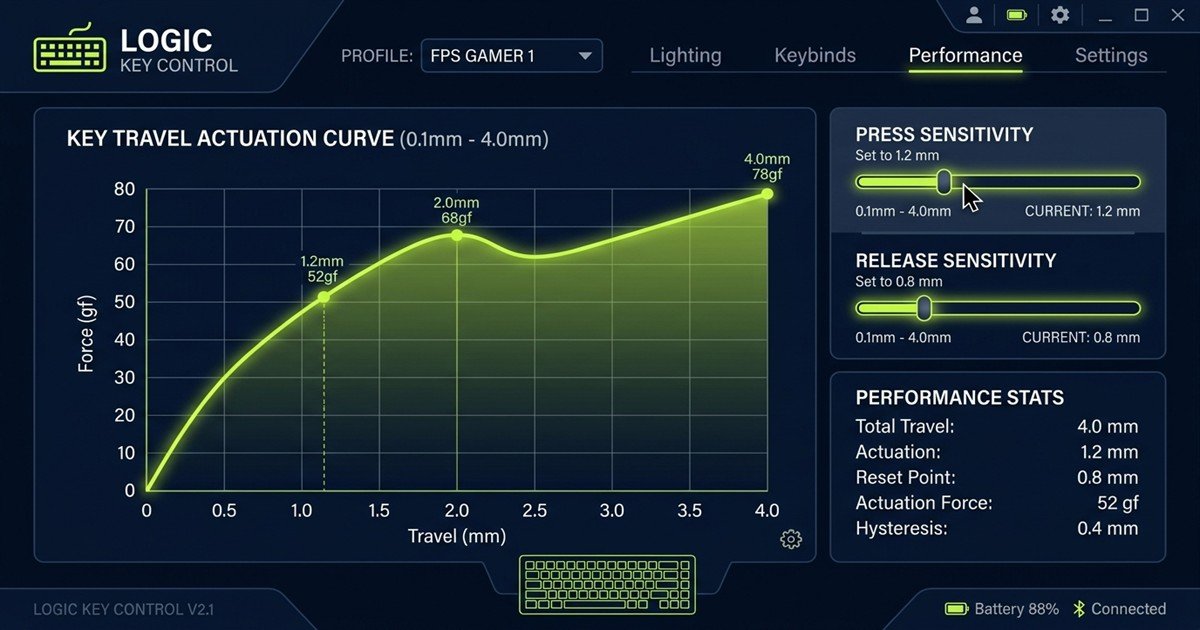
Modern magnetic keyboards feature dedicated configuration software allowing individual per-key adjustments across two primary parameters: initial actuation point and rapid trigger release sensitivity. Setting these parameters excessively low can result in phantom activations caused by normal finger resting weight.
Recommended Settings by Game Genre and Key Role
Competitive configuration profiles for magnetic rapid trigger keyboards:
| Key Function Category | Initial Actuation Point | Rapid Trigger Sensitivity | Target In-Game Application |
|---|---|---|---|
| Movement Keys (W, A, S, D) | 0.8mm to 1.2mm | 0.15mm to 0.3mm | Tactical counter-strafing, peeking, and movement stops |
| Combat Abilities (Q, E, C, X) | 1.2mm to 1.5mm | 0.4mm to 0.5mm | Preventing accidental flashes, smokes, or utility waste |
| Ultimate Ability Key | 2.0mm to 2.5mm | Disabled or 1.0mm | Guaranteed prevention of misclicked round-defining ultimates |
| Spacebar (Jump) | 1.5mm to 2.0mm | 0.2mm to 0.3mm | Bunny hopping, jump-peeking, and obstacle clearance |
| Typing and Text Keys | 1.8mm to 2.2mm | 1.0mm to 1.5mm | Eliminating typos and double presses during chat typing |
Setting your WASD movement cluster between 0.8mm and 1.2mm initial actuation ensures your fingers do not trigger unintended steps when lightly resting on keys. Pairing that with a 0.2mm release sensitivity ensures instant counter-strafing without registering natural hand tremors as key releases, delivering superior stability compared to standard units highlighted in our analysis of gaming keyboard vs office keyboard hardware.
Frequently Asked Questions About Rapid Trigger Keyboards
Essential answers to common questions regarding rapid trigger technology, magnetic switches, and gaming performance:
What is the core definition of rapid trigger in keyboards?
Rapid trigger is an analog switch firmware feature that dynamically deactivates a key the instant it moves upward, regardless of its position in the travel stroke.
Traditional switches require rising past a fixed mechanical reset point. Rapid trigger continuously tracks analog stem movement via magnetic sensors, removing the reset threshold entirely.
How does rapid trigger differ from adjustable actuation?
Adjustable actuation controls how deep you must press a key to register an input, while rapid trigger controls how quickly that key resets when released.
A keyboard can have adjustable actuation without rapid trigger. However, true rapid trigger requires continuous analog distance sensing, meaning keyboards with rapid trigger virtually always support adjustable actuation as well.
Can regular mechanical keyboards get rapid trigger through software?
No, standard mechanical keyboards cannot support rapid trigger because their physical contact leaves only transmit binary on and off electrical signals.
Rapid trigger requires analog position tracking down to fractions of a millimeter. This continuous spatial awareness is only possible with contactless magnetic Hall Effect sensors or specialized optical sensors capable of reading continuous analog voltage levels.
What makes Hall Effect switches different from traditional mechanical switches?
Hall Effect switches use a permanent magnet and a PCB sensor to measure magnetic flux, whereas traditional switches rely on two flexible metal leaves physically touching.
Because magnetic switches have no physical electrical contacts, they suffer no physical contact degradation, require zero debounce delay filtering, and deliver exceptionally smooth linear keypresses.
Does rapid trigger improve counter-strafing in Counter-Strike 2 and Valorant?
Yes, rapid trigger significantly improves counter-strafing by deactivating opposite directional movement keys the microsecond finger pressure releases, stopping character momentum instantly.
By eliminating the 1.0mm to 2.0mm upward dead travel required by traditional switches, players achieve zero velocity up to 50 milliseconds faster, resulting in earlier pinpoint accuracy on first rifle shots.
What is the ideal rapid trigger release sensitivity for competitive gaming?
The ideal release sensitivity for competitive gaming is between 0.15mm and 0.3mm on primary movement keys like W, A, S, and D.
Setting release sensitivity to the absolute minimum of 0.1mm can occasionally cause accidental key releases caused by minor finger tremors. A setting of 0.2mm provides virtually instantaneous response while maintaining dependable tactile consistency.
Can rapid trigger cause accidental keypresses or typing mistakes?
Yes, if initial actuation points and release thresholds are configured too sensitively, gentle finger resting weight can lead to accidental inputs and typing typos.
Esports players solve this by configuring dedicated software profiles: an ultra-sensitive 0.2mm profile strictly for competitive matches, and a moderate 1.8mm fixed actuation profile for general desktop use and typing.
Are rapid trigger keyboards legal in official esports tournaments?
Yes, rapid trigger keyboards are 100 percent legal in official esports tournaments including the Valorant Champions Tour (VCT) and Valve Counter-Strike 2 Major championships.
Tournament rulebooks prohibit automated macros and automated counter-strafe assists (like Snap Tap or SOCD hardware automation), but pure analog rapid trigger is fully compliant because every actuation still requires a 1-to-1 human physical finger movement.
How does rapid trigger eliminate keyboard debounce delay?
Rapid trigger eliminates debounce delay because contactless magnetic switches produce clean continuous voltage signals without the physical contact chatter inherent to metal leaves.
Traditional mechanical switches require microcontrollers to pause 5ms to 20ms to verify contact closure. Hall Effect sensors read pure magnetic flux, allowing firmware to process key positions immediately with zero protective latency padding.
Why are rapid trigger keyboards preferred for rhythm games like osu?
Rhythm game players prefer rapid trigger keyboards because dynamic reset points allow ultra-rapid single-key tapping without bottoming out or fully releasing keys.
In games requiring high beats-per-minute finger stamina like osu!, rapid trigger enables players to vibrate their fingers over minimal travel distances, dramatically increasing tapping speed while reducing tendon fatigue.
Do magnetic Hall Effect switches wear out faster than mechanical switches?
No, magnetic Hall Effect switches wear out significantly slower because they contain no physical metal contact leaves that suffer oxidation, bending, or mechanical friction fatigue.
The only moving parts in a magnetic switch are the stem, spring, and housing. Most Hall Effect switches are rated for 100 million or more keystrokes, outlasting standard mechanical switches by substantial margins.
Is a rapid trigger keyboard worth upgrading for casual gamers?
A rapid trigger keyboard is primarily worth the investment for players dedicated to competitive tactical shooters and rhythm games where movement precision directly dictates competitive rank.
For casual gaming, MOBA titles, and daily productivity, standard mechanical keyboards provide excellent tactile feedback at lower prices. However, players seeking to maximize mechanical responsiveness in fast-paced shooters will experience an immediate tangible benefit from rapid trigger hardware.