
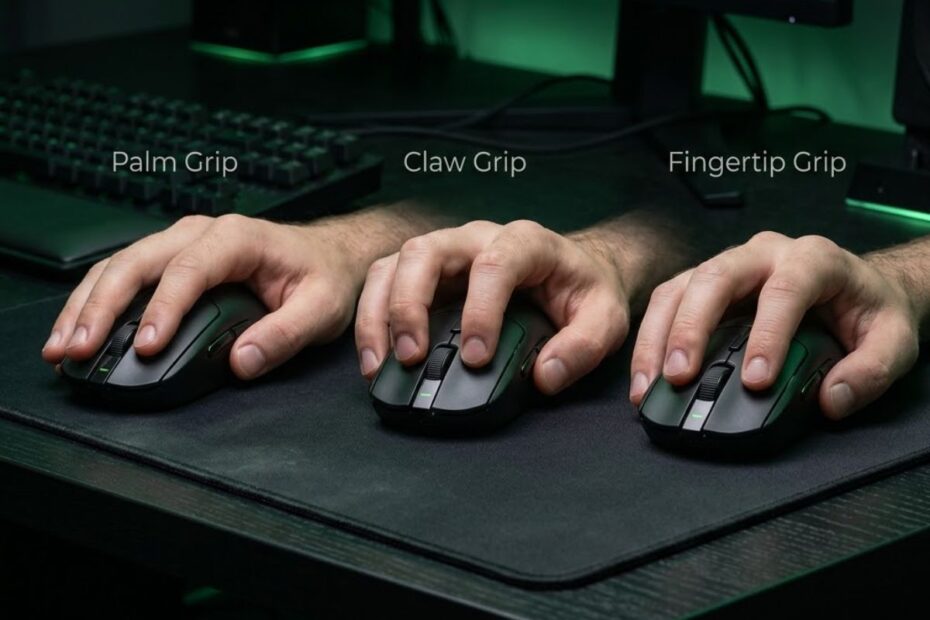
Choosing the right mouse grip style can have a bigger impact on FPS performance than many players realize. While gaming mice often get most of the attention, the way you hold the mouse directly affects aiming speed, precision, comfort, and long-term consistency.
The best mouse grip styles for FPS games are Palm Grip, Claw Grip, and Fingertip Grip. Each style offers unique advantages depending on hand size, aiming habits, and the type of FPS games you play. Understanding these differences can help you identify which grip naturally supports your strengths instead of fighting against them.
If you are also evaluating which mouse shape works best with different grip styles, our gaming mouse for fps games guide explains how grip style and mouse design work together to improve performance.
What Are the Most Popular Mouse Grip Styles for FPS Games?
The most popular mouse grip styles for FPS games are Palm Grip, Claw Grip, and Fingertip Grip. These three grip styles dominate both casual and competitive FPS gaming because they provide different balances of control, speed, comfort, and precision.
Although every player holds a mouse slightly differently, most grip variations are built around one of these three foundations. Understanding the strengths of each style helps players make better decisions when choosing both a grip and a gaming mouse.
Palm Grip at a Glance
Palm Grip is a mouse grip style where most of the hand remains in contact with the mouse surface. This grip helps create a stable and comfortable feeling during long gaming sessions.
Players who use Palm Grip typically rely more on arm movement and larger motions when aiming. This often creates smooth tracking and predictable control, especially in tactical FPS titles where consistency matters more than rapid movement.
Palm Grip is often favored by players who prioritize comfort and stability over maximum agility. If you want a detailed breakdown of how this grip works, see our guide on what is palm grip.
Overall, Palm Grip remains one of the most comfortable grip styles available for FPS players.
Claw Grip at a Glance
Claw Grip is a mouse grip style that combines palm support with elevated fingers, creating a claw-like hand position. This grip helps balance stability and fast reactions.
Because the fingers remain more active, Claw Grip allows quicker clicks and faster directional adjustments than Palm Grip. Many competitive FPS players prefer this balance because it supports both flick shots and tracking.
The versatility of Claw Grip is one reason it appears frequently among professional FPS players. You can learn more in our complete guide on what is claw grip.
For players seeking a mix of control and speed, Claw Grip is often considered the most balanced option.
Fingertip Grip at a Glance
Fingertip Grip is a mouse grip style where only the fingertips contact the mouse while the palm remains mostly elevated. This grip helps maximize movement freedom and responsiveness.
Because the mouse is controlled almost entirely through the fingers, players can make extremely fast micro-adjustments and quick directional changes. However, this increased mobility often comes with reduced stability compared to Palm Grip or Claw Grip.
Fingertip Grip is popular among players who value agility and lightweight mouse control. For a deeper explanation, read our article on what is fingertip grip.
While it has a steeper learning curve, Fingertip Grip can offer exceptional freedom for experienced players.
The table below compares the three most common FPS mouse grip styles:
| Grip Style | Hand Contact | Stability | Speed | Learning Curve |
|---|---|---|---|---|
| Palm Grip | High | High | Moderate | Easy |
| Claw Grip | Medium | High | High | Moderate |
| Fingertip Grip | Low | Moderate | Very High | Advanced |
The three grip styles all have strengths and weaknesses. Instead of searching for a universally superior option, FPS players should focus on finding the grip that best matches their natural movement patterns.
Which Mouse Grip Style Is Best for FPS Games?
The best mouse grip style for FPS games depends on the player’s aiming style, comfort preferences, and game requirements. There is no single grip that outperforms every other option in all situations.
Many players assume professional usage automatically determines the best grip. In reality, successful FPS players use different grip styles because individual biomechanics play a major role in aiming performance.
Best Grip for Tactical FPS Players
For tactical FPS games such as Valorant and CS2, Claw Grip is often considered the most balanced option. It helps players maintain precise control while still allowing rapid adjustments during gunfights.
Tactical shooters reward accuracy, crosshair placement, and consistency more than pure movement speed. Claw Grip provides enough stability for precise shots while maintaining flexibility for quick target corrections.
Many competitive tactical FPS players choose Claw Grip because it supports both controlled aiming and reactive play.
Best Grip for Aggressive Aimers
Players who rely heavily on fast flicks and rapid movement often prefer Fingertip Grip. This grip helps maximize responsiveness and allows quick directional changes with minimal effort.
The reduced hand contact creates a feeling of freedom that some players find beneficial during high-speed engagements. However, maintaining consistency with Fingertip Grip usually requires more practice and stronger finger control.
For players who prioritize speed above all else, Fingertip Grip can be an attractive option.
Why Comfort Matters More Than Popularity
Comfort is often a better predictor of long-term aiming performance than popularity. A grip style that feels natural is easier to repeat consistently under pressure.
Many players perform worse after forcing themselves into a grip style simply because professional players use it. What works for one player may not suit another player’s hand size, mouse shape, or movement habits.
Choosing a grip that feels sustainable during long sessions often leads to better results than chasing trends.
The table below explains which grip styles typically match different FPS playstyles:
| Playstyle | Recommended Grip |
|---|---|
| Tactical and Precision Focused | Claw Grip |
| Comfort and Stability Focused | Palm Grip |
| Speed and Mobility Focused | Fingertip Grip |
Ultimately, the best mouse grip style is the one that allows you to maintain comfort, accuracy, and consistency over thousands of repetitions rather than just a few successful matches.
Palm Grip vs Claw Grip vs Fingertip Grip for FPS Aim
Palm Grip, Claw Grip, and Fingertip Grip create different strengths and weaknesses in FPS aiming. Each grip style changes how players perform flick shots, tracking, and precision adjustments during gameplay.
Rather than focusing on which grip is universally better, FPS players should understand which aiming situations favor each style. The goal is not to copy someone else’s grip but to identify which grip complements your own mechanics.
Which Grip Helps Flick Shots Most?
Claw Grip and Fingertip Grip generally provide faster flicking potential because they allow quicker finger-driven movements. Both grips make it easier to accelerate the mouse rapidly when reacting to sudden targets.
Here is a visual comparison of the three most common FPS mouse grip styles:
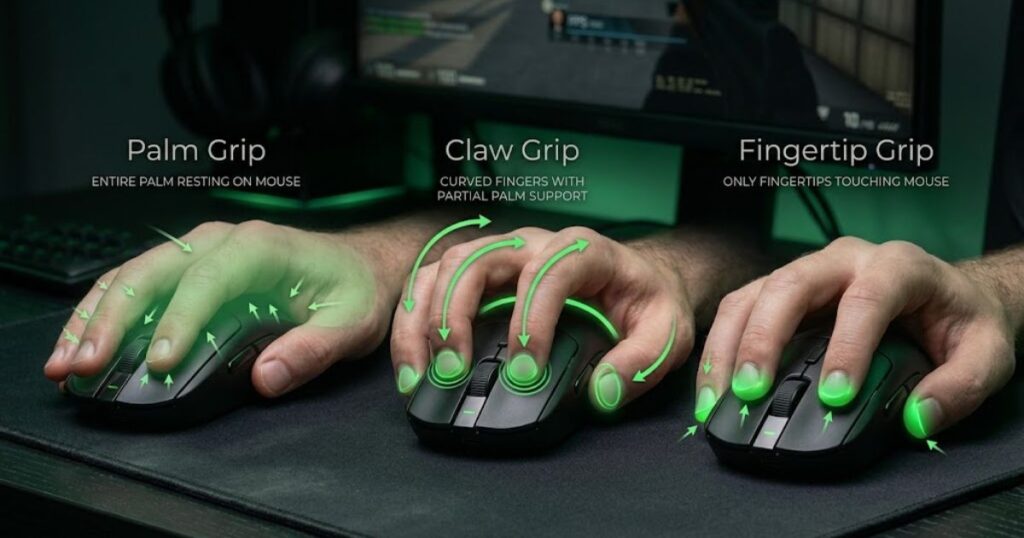
Claw Grip creates a balance between stability and speed, making it easier to perform controlled flicks without losing precision. Fingertip Grip can produce extremely fast flicks, but it often requires more refined control to remain accurate.
Palm Grip can still be effective for flick shots, particularly for low-sensitivity players who rely heavily on arm movement. However, it usually feels less explosive than the other two grip styles.
For players who frequently rely on fast target acquisition, Claw Grip often delivers the most practical balance between speed and consistency.
Which Grip Improves Tracking Consistency?
Palm Grip generally offers the highest tracking consistency because the hand maintains extensive contact with the mouse. This added stability helps create smooth and predictable movement when following moving targets.
Tracking requires maintaining control over longer mouse movements rather than making rapid directional changes. The increased surface contact of Palm Grip can reduce unwanted movement and improve steadiness.
Claw Grip also performs well for tracking while adding more agility than Palm Grip. Fingertip Grip can track effectively in experienced hands, but many players find it less forgiving during extended engagements.
Players who value smooth and controlled target tracking often feel most comfortable using Palm Grip.
Which Grip Offers Better Micro Adjustments?
Fingertip Grip provides the greatest freedom for micro adjustments because the fingers control nearly all mouse movement. This allows very small corrections without requiring significant wrist or arm motion.
Micro adjustments are especially important when correcting crosshair placement before firing a shot. The ability to make tiny movements quickly can improve precision in situations where accuracy matters more than speed.
Claw Grip also performs extremely well because the fingers remain active while maintaining additional support from the palm. Palm Grip can still execute precise corrections, but it usually relies more on wrist and arm movement.
For players who constantly fine-tune their crosshair position, Fingertip Grip often offers the highest level of movement freedom.
The table below compares how each grip style performs across key FPS aiming tasks:
| Aim Category | Palm Grip | Claw Grip | Fingertip Grip |
|---|---|---|---|
| Flick Shots | Good | Excellent | Excellent |
| Tracking | Excellent | Very Good | Good |
| Micro Adjustments | Good | Very Good | Excellent |
| Stability | Excellent | Very Good | Moderate |
| Agility | Moderate | High | Excellent |
No grip dominates every aiming category. Each style creates trade-offs, which is why understanding your preferred aiming habits is more valuable than searching for a universally superior grip.
How Mouse Grip Influences Aim Consistency
Mouse grip influences aim consistency by affecting how players repeat movements under pressure. A grip that feels natural is easier to reproduce across thousands of aiming repetitions.
Consistency is often what separates occasional good aim from reliable performance. While raw speed attracts attention, the ability to repeat the same movement accurately over time is what drives long-term improvement.
The factors below explain how grip affects aim consistency:
- Wrist Control: Different grip styles change how much wrist movement contributes to aiming.
- Finger Precision: Active fingers allow finer adjustments but may require more practice.
- Arm Movement: Some grips encourage larger arm-driven motions that improve stability.
- Comfort: Comfortable grips reduce fatigue during long gaming sessions.
- Repeatability: Consistent hand positioning improves muscle memory development.
These factors work together to determine whether a player’s aim remains stable throughout a match or gradually becomes less reliable as fatigue builds.
Grip and Muscle Memory
Mouse grip affects muscle memory because it determines how aiming movements are generated and repeated. Consistent hand positioning helps the brain associate specific movements with specific results.
Frequently changing grip styles can disrupt this learning process. Every grip uses slightly different combinations of finger, wrist, and arm movement, forcing players to adapt repeatedly.
Building strong muscle memory usually requires sticking with one grip long enough for movements to become automatic.
A stable grip often supports faster improvement than constantly experimenting with new techniques.
Grip and Long-Term Comfort
Long-term comfort plays a major role in maintaining consistent aim performance. Even a technically effective grip can become problematic if it causes discomfort during extended sessions.
Physical fatigue reduces precision, slows reaction speed, and makes fine adjustments more difficult. Players who experience discomfort often compensate by changing their posture or grip mid-game, creating inconsistency.
Finding a grip that remains comfortable over several hours is often more beneficial than choosing the fastest or most aggressive option.
Comfort supports consistency because it allows players to focus on gameplay rather than physical strain.
Grip and Accuracy Under Pressure
Grip stability becomes increasingly important during stressful situations. When players face high-pressure moments, reliable movement patterns help maintain accuracy.
Unstable grips can feel fine during aim training but become harder to control when adrenaline and tension increase. Small inconsistencies often become more noticeable during competitive matches.
Many experienced FPS players prefer grip styles that remain predictable even when reacting quickly or making split-second decisions.
Under pressure, consistency usually provides more value than maximum theoretical speed.
If your current grip feels inconsistent, it may be worth evaluating whether your mouse shape supports the way you naturally hold the mouse. Our guide to the best gaming mouse for fps games explores how shape, size, and grip compatibility influence overall performance.
Which Mouse Grip Do Professional FPS Players Prefer?
Most professional FPS players prefer Claw Grip or relaxed Claw Grip because these variations offer a balance between stability, speed, and flexibility. However, professional players use all three major grip styles depending on personal preference and mouse shape.
Professional FPS Players Using Different Mouse Grip Styles:
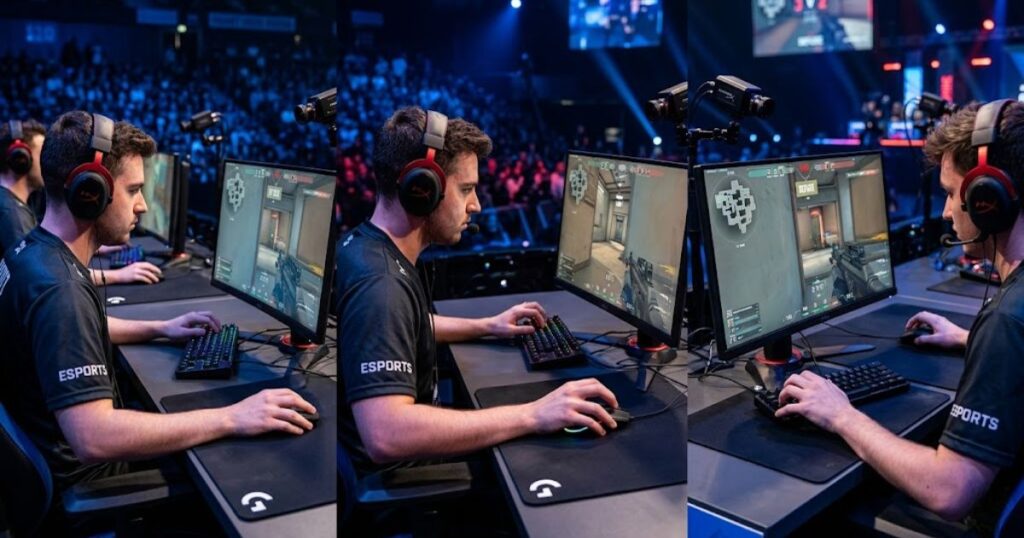
One of the biggest misconceptions among newer players is believing there is a single “pro grip.” In reality, professional players succeed because they develop consistent mechanics around a grip that suits their hands and playstyle rather than forcing themselves into a specific technique.
Why Claw Grip Is Common in Esports
Claw Grip is common in esports because it provides a versatile balance between control and responsiveness. This balance allows players to react quickly while maintaining reliable precision during competitive matches.
Professional FPS players frequently encounter situations that require both rapid target acquisition and accurate shot placement. Claw Grip supports these demands without heavily favoring one area over another.
Its adaptability across different FPS titles is one reason many professional players continue to use Claw Grip throughout their careers.
For competitive environments where versatility matters, Claw Grip often becomes the safest long-term choice.
When Pros Use Palm Grip
Palm Grip remains popular among professional players who prioritize stability and comfort. Many low-sensitivity players find Palm Grip particularly effective because it supports larger arm-driven movements.
Some professionals spend several hours practicing and competing every day. The comfort offered by Palm Grip can reduce fatigue during these extended sessions while maintaining reliable control.
Although Palm Grip is sometimes viewed as slower, many successful players continue to prove that comfort and consistency can outweigh pure agility.
The continued use of Palm Grip at the highest level demonstrates that stability remains valuable in competitive FPS games.
Why Fingertip Grip Is Less Common
Fingertip Grip is less common among professional players because it demands greater precision and control. While it offers exceptional movement freedom, maintaining consistency can be more challenging under competitive pressure.
This does not mean Fingertip Grip is ineffective. Some highly skilled players achieve excellent results with it, especially when using lightweight mice and highly refined mechanics.
The lower adoption rate reflects the increased difficulty of mastering the grip rather than any inherent weakness.
Fingertip Grip can still be highly effective, but it generally requires more practice to reach a similar level of consistency.
The table below summarizes general grip usage trends among competitive FPS players:
| Grip Style | Common Among Pros | Main Advantage |
|---|---|---|
| Claw Grip | Very Common | Balanced control and speed |
| Palm Grip | Common | Stability and comfort |
| Fingertip Grip | Less Common | Maximum movement freedom |
Rather than copying professional players directly, FPS players should focus on understanding why a grip works and whether those advantages align with their own needs.
How Hand Size Affects Mouse Grip Selection
Hand size affects mouse grip selection because it influences comfort, reach, and overall control. A grip that feels natural for one hand size may feel awkward or restrictive for another.
Many grip-related problems are actually sizing problems. Players sometimes blame a grip style when the real issue is that their mouse dimensions do not match their hand size.
Best Grip for Small Hands
Players with smaller hands often find Claw Grip and Fingertip Grip easier to use because these styles require less surface contact and allow greater flexibility.
Smaller hands may struggle to fully support large mice using Palm Grip. As a result, many players naturally transition toward grips that rely more on finger control.
Grip comfort still varies by mouse shape, but smaller hands frequently benefit from the freedom offered by Claw Grip and Fingertip Grip.
For many small-handed players, agility and flexibility become major advantages.
Best Grip for Medium Hands
Medium-sized hands generally have the greatest flexibility when choosing a grip style. Most players in this category can comfortably use Palm Grip, Claw Grip, or Fingertip Grip depending on preference.
Because hand dimensions fall near the middle of most mouse design targets, medium-handed players often have access to the widest variety of comfortable setups.
This flexibility allows them to prioritize aiming style and comfort rather than adapting to physical limitations.
Medium hands often make grip selection a matter of preference rather than necessity.
Best Grip for Large Hands
Players with larger hands frequently prefer Palm Grip or relaxed Claw Grip because these styles provide more support across the hand.
Larger hands can sometimes feel cramped on smaller mice when using Fingertip Grip. Additional contact points often improve comfort and help maintain control during extended sessions.
Many large-handed players naturally gravitate toward grip styles that allow the hand to rest more comfortably on the mouse.
Support and comfort often become increasingly important as hand size increases.
The table below provides general grip recommendations based on hand size:
| Hand Size | Recommended Grip Styles |
|---|---|
| Small | Claw Grip, Fingertip Grip |
| Medium | Palm Grip, Claw Grip, Fingertip Grip |
| Large | Palm Grip, Relaxed Claw Grip |
Once players understand how hand size influences grip comfort, it becomes easier to narrow down which grip styles deserve further testing before making a final decision.
Which Mouse Shapes Work Best With Different Grip Styles?
Different mouse grip styles work best with different mouse shapes because hand positioning changes how players interact with the mouse. A shape that feels comfortable for one grip may feel awkward or restrictive for another.
Many FPS players spend time searching for the perfect grip while overlooking the importance of mouse shape. Even the right grip style can feel inconsistent if the mouse does not properly support the way the hand naturally rests and moves.
Mouse Shapes for Palm Grip Users
Palm Grip users generally benefit from larger mice with fuller rear humps and broader support areas. These shapes allow more of the hand to rest comfortably on the mouse surface.
Different mouse shapes naturally support different grip styles:
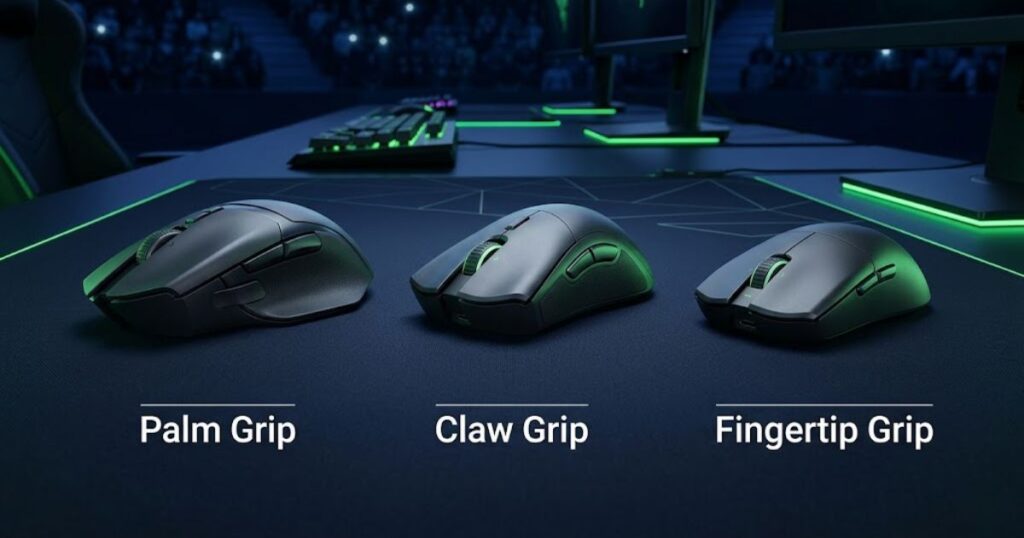
Because Palm Grip relies heavily on hand contact, adequate support becomes an important factor in maintaining comfort and control. Larger ergonomic shapes are often popular among Palm Grip users for this reason.
Players who prefer Palm Grip usually perform best when the mouse feels like a natural extension of the hand rather than something they need to actively hold.
For Palm Grip users, overall support often matters more than extreme weight reduction.
Mouse Shapes for Claw Grip Users
Claw Grip users often prefer mice with a pronounced hump that provides palm support while leaving room for finger movement. This combination helps create a balanced feeling between stability and responsiveness.
The rear section of the mouse plays a particularly important role because it serves as a reference point while the fingers remain active during aiming and clicking.
Many modern FPS gaming mice are designed around Claw Grip compatibility due to the popularity of this grip style among competitive players.
Claw Grip typically benefits from shapes that balance support and maneuverability.
Mouse Shapes for Fingertip Grip Users
Fingertip Grip users often prefer smaller and lower-profile mice that maximize movement freedom. Reduced bulk allows the fingers to control the mouse more efficiently.
Since the palm remains mostly elevated, excessive height or large rear humps can sometimes interfere with the natural positioning of the hand. Compact designs are often easier to manipulate using only the fingertips.
Lightweight mice are frequently paired with Fingertip Grip because they further enhance agility and responsiveness.
For Fingertip Grip users, freedom of movement is usually the primary design priority.
The table below explains which mouse shapes typically match different grip styles:
| Grip Style | Recommended Mouse Shape | Main Priority |
|---|---|---|
| Palm Grip | Large ergonomic shapes | Comfort and support |
| Claw Grip | Medium shapes with rear hump | Balance and control |
| Fingertip Grip | Compact low-profile shapes | Movement freedom |
If you are still comparing mouse designs, our gaming mouse for fps games guide explains how shape, weight, and grip compatibility influence FPS performance.
Players looking for specific recommendations can also explore our list of the best gaming mouse for fps games to see examples of shapes that work well with different grip styles.
At GearTP, we consistently evaluate gaming mice based on how they perform for different grip styles rather than focusing solely on specifications.
Choosing a mouse shape that naturally supports your grip can often improve comfort and consistency more than changing your grip itself.
Common Mouse Grip Mistakes FPS Players Should Avoid
Many FPS players struggle with inconsistent aim because they make grip-related mistakes that limit comfort, control, or long-term development. These mistakes often go unnoticed because players focus on sensitivity settings, hardware upgrades, or aim trainers instead.
A strong grip does not need to look professional or follow popular trends. It simply needs to be comfortable, repeatable, and sustainable over long gaming sessions.
The mistakes below explain common grip-related issues:
- Copying Professional Players: A grip that works for a professional player may not suit your hand size, mouse shape, or aiming style.
- Choosing a Grip Based on Trends: Popularity does not automatically make a grip the best choice for every player.
- Using the Wrong Mouse Size: Poor mouse sizing can make an otherwise effective grip feel uncomfortable and inconsistent.
- Switching Grip Styles Too Often: Constant changes disrupt adaptation and make it difficult to build reliable habits.
- Holding the Mouse Too Tightly: Excessive tension can reduce smoothness and increase fatigue during gameplay.
Most grip problems are not caused by the grip style itself. Instead, they usually result from poor compatibility between the player, the mouse, and the chosen grip.
Why Constantly Changing Grip Styles Slows Improvement
Frequently changing grip styles prevents players from developing stable habits. Every grip requires slightly different movement patterns, making it difficult to build consistency when switching repeatedly.
Short-term experimentation can be useful, but constantly chasing a better grip often creates more problems than it solves. Improvement usually comes from refining a grip rather than abandoning it.
Players who commit to a suitable grip style often progress faster than those who continuously search for alternatives.
Consistency is typically more valuable than endless experimentation.
Why Mouse Size Matters More Than Many Players Realize
Mouse size has a direct impact on how comfortable and effective a grip feels. Even an excellent grip style can become difficult to use if the mouse is too large or too small for the player’s hand.
Many players incorrectly blame their grip when the underlying issue is actually poor mouse fit. This misunderstanding often leads to unnecessary grip changes instead of addressing the real problem.
Finding the right mouse dimensions creates a stronger foundation for long-term comfort and performance.
A well-matched mouse size often makes grip selection much easier.
Why Relaxed Grip Pressure Improves Control
A relaxed grip pressure helps players maintain smoother and more predictable mouse movement. Excessive tension can reduce precision and increase fatigue over time.
Many players instinctively squeeze the mouse harder during stressful situations. Unfortunately, this often introduces unwanted movement and reduces overall control.
Learning to maintain a comfortable grip pressure can improve consistency without changing hardware or settings.
Small improvements in grip tension can have a surprisingly large impact on aiming comfort and reliability.
Avoiding these common mistakes allows players to evaluate grip styles more objectively and focus on building a setup that supports long-term FPS improvement.
How to Find Your Ideal FPS Mouse Grip Style
The ideal FPS mouse grip style is the one that feels natural, remains comfortable during long gaming sessions, and allows consistent aiming performance. The goal is not to find the most popular grip but to find the grip that works best for your hand, mouse, and playstyle.
Many players spend too much time searching for the perfect grip without following a structured process. A simple evaluation framework can make the decision much easier and prevent unnecessary experimentation.
The following process can help identify the best grip style for your needs:
- Measure Your Hand Size: Determine whether your hands are small, medium, or large before evaluating grip options.
- Identify Your Playstyle: Consider whether you prioritize stability, balanced control, or maximum agility.
- Test All Three Grip Styles: Spend several gaming sessions using Palm Grip, Claw Grip, and Fingertip Grip.
- Evaluate Comfort: Pay attention to fatigue, hand strain, and natural positioning during extended play.
- Compare Consistency: Focus on repeatable performance rather than occasional highlight plays.
- Commit to One Grip: Give your chosen grip enough time to develop reliable habits and muscle memory.
Following a structured process removes much of the guesswork from grip selection and allows players to make decisions based on experience rather than assumptions.
When Should You Change Your Current Grip?
You should consider changing your current grip if it consistently causes discomfort, limits control, or feels incompatible with your mouse shape. Small adjustments may solve some issues, but major compatibility problems are often difficult to overcome.
A grip should support performance rather than create obstacles. If a grip feels unnatural after a reasonable adaptation period, exploring alternatives may be worthwhile.
Changing grips should be a deliberate decision rather than a reaction to a few bad matches.
Long-term comfort and consistency remain the most important evaluation criteria.
How Long Should You Test a New Grip?
Most players should test a new grip for at least one to two weeks before making a final judgment. This allows enough time for initial discomfort and unfamiliarity to fade.
Switching too quickly can make every grip feel ineffective because adaptation never has time to occur. Consistent testing provides more reliable feedback than short-term impressions.
A fair testing period increases the likelihood of making an informed decision.
Patience often leads to better grip selection outcomes.
Finding the right grip takes time, but a structured evaluation process can significantly reduce trial and error.
Final Recommendation: Which Mouse Grip Style Should You Choose?
Most FPS players will perform best with Claw Grip because it offers a strong balance between control, speed, flexibility, and compatibility with modern FPS mice. However, Palm Grip and Fingertip Grip can still be excellent choices depending on individual preferences.
Best Overall Choice for Most FPS Players
Claw Grip is generally the safest recommendation because it balances multiple performance factors without strongly sacrificing any single area.
This versatility makes it suitable for a wide variety of FPS games, hand sizes, and aiming styles.
For players unsure where to start, Claw Grip is often the most practical first option.
Best Grip for Stability
Palm Grip is usually the strongest choice for players who value comfort, control, and long-term consistency.
The increased hand contact helps create a stable aiming platform and may reduce fatigue during long sessions.
Players who prioritize predictability often gravitate toward Palm Grip.
Best Grip for Speed
Fingertip Grip is often preferred by players who prioritize movement freedom and rapid adjustments.
Although it can be more difficult to master, it offers exceptional agility for players willing to invest the required practice.
For highly mobile aiming styles, Fingertip Grip remains a compelling option.
Best Grip for Beginners
Most beginners should start with Claw Grip or Palm Grip because both styles are relatively accessible and easier to maintain consistently.
As experience grows, players can decide whether additional speed or flexibility is worth pursuing.
Beginning with a stable foundation often produces better long-term results.
The best grip style is ultimately the one that allows you to aim comfortably, consistently, and confidently every time you play.
Frequently Asked Questions About FPS Mouse Grip Styles
Choosing the right mouse grip often raises additional questions about comfort, performance, and long-term improvement. The answers below address some of the most common concerns FPS players have when comparing Palm Grip, Claw Grip, and Fingertip Grip.
Is Claw Grip the best mouse grip for FPS games?
Claw Grip is often considered the most balanced option because it combines stability, speed, and versatility. However, the best grip still depends on the individual player.
Do professional FPS players use Palm Grip?
Yes. Many professional players use Palm Grip because of its comfort and consistency, particularly in tactical FPS games.
Why is Claw Grip so popular among esports players?
Claw Grip provides a balance between control and responsiveness, making it suitable for a wide range of competitive situations.
Is Fingertip Grip good for Valorant?
Yes. Fingertip Grip can work well in Valorant, especially for players who rely on quick micro-adjustments and fast reactions.
Which grip style is best for beginners?
Palm Grip and Claw Grip are usually easier for beginners because they offer more stability and require less finger control.
Does hand size affect mouse grip choice?
Yes. Hand size can influence comfort, reach, and overall compatibility with different grip styles and mouse shapes.
Can changing grip styles improve aim?
It can, but only if the new grip provides a better fit for your hand size, mouse shape, and aiming habits.
How long does it take to adapt to a new grip?
Most players need one to two weeks of consistent use before accurately evaluating a new grip style.
Does Palm Grip reduce wrist strain?
Palm Grip can reduce strain for some players because it provides more hand support and encourages larger arm-driven movements.
Should I copy the grip used by professional players?
Not necessarily. Professional players succeed because their grip suits their individual needs, not because the grip itself is universally superior.
Can mouse shape affect grip performance?
Yes. Mouse shape can significantly influence comfort, control, and overall compatibility with different grip styles.
What is the biggest mistake players make when choosing a grip?
The most common mistake is selecting a grip based on popularity rather than personal comfort and long-term consistency.
Conclusion
The best mouse grip style for FPS games is not determined by trends, professional players, or internet recommendations. It is determined by how well a grip supports your hand size, mouse shape, aiming habits, and long-term comfort.
Palm Grip offers stability and support, Claw Grip provides balanced performance, and Fingertip Grip maximizes movement freedom. Each style can be highly effective when matched with the right player and setup.
Rather than searching for a universally perfect grip, focus on finding the one that allows you to aim consistently and comfortably over time. The players who improve the most are usually the ones who commit to a suitable grip and refine it through practice.
Thank you for reading