
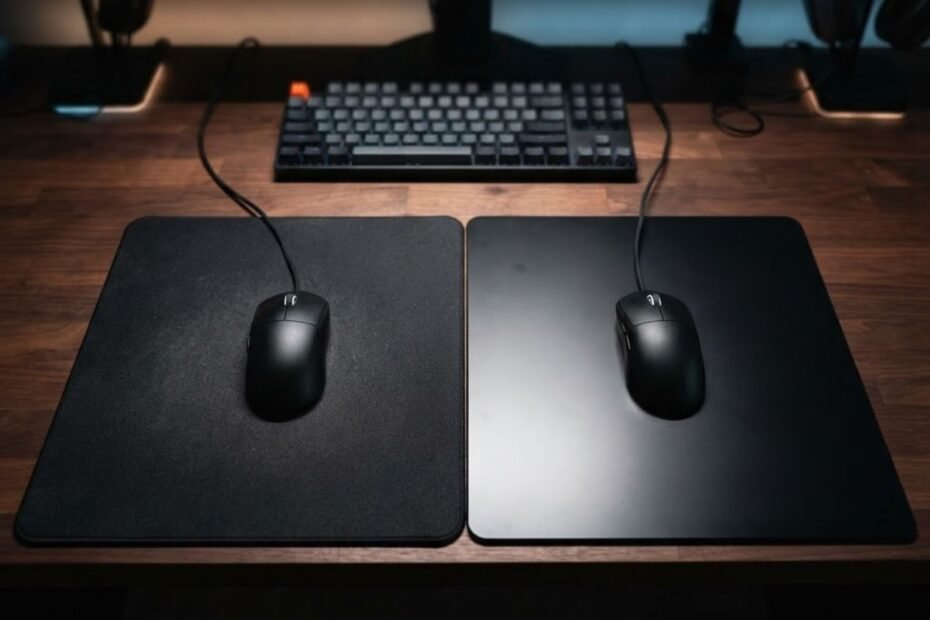
For Apex Legends, neither a cloth nor a hard mouse pad is automatically better. A faster surface can make tracking and large mouse movements feel easier, while a more controlled surface can make stopping and small corrections feel more predictable. For most players, a balanced or fast cloth pad is the safer starting point, while a hard pad makes more sense if you specifically want very low friction and already have good control over fast mouse movement.
The important question is not simply whether cloth or hard is better. It is whether the surface gives you the right balance of glide, control, and consistency for the way you aim in Apex Legends.
Is Cloth or Hard Better for Apex Legends?
Neither surface is universally better for Apex Legends. A faster surface can help players who rely on smooth tracking and large mouse movements, while a more controlled surface can make stopping and precise corrections easier. Your sensitivity, mouse movement style, and ability to control the mouse matter just as much as the surface material.
Why Apex Legends Puts More Emphasis on Smooth Mouse Movement
Apex Legends places a strong emphasis on keeping your crosshair aligned with moving targets while you adjust your aim continuously. That makes smooth mouse movement particularly important, especially during fights where the target is moving unpredictably or changing direction.
EA recommends practicing smooth mouse movement to improve tracking and specifically suggests using the Firing Range to test how well you can keep your crosshair on a moving target. That does not mean Apex players need the fastest possible mouse pad, but it does explain why surface glide can have a noticeable effect on how a setup feels.
A mouse pad with too much resistance can make large movements feel more demanding. On the other hand, a surface that moves too freely can make it harder for some players to stop exactly where they want. The useful target is a surface that lets the mouse move smoothly without making control feel unpredictable.
In other words, Apex rewards smooth movement, but smooth does not mean unrestricted. The best surface still needs to give you enough control to keep your crosshair where you intend it to be.
Why More Speed Does Not Automatically Mean Better Aim
A faster mouse pad reduces resistance between the mouse and the surface, but lower resistance does not automatically improve accuracy. If your mouse moves farther than expected during a tracking adjustment or target switch, the extra speed can create another problem that you have to control.
This is especially important when comparing a hard pad with cloth. A hard surface may feel immediately faster and more effortless, but that first impression is not the same as better long-term aim. Apex requires both movement and correction, so a surface that feels extremely fast during a wide swipe may still feel less comfortable when you need to stop and make a small adjustment.
The same principle works in the opposite direction. A very slow cloth pad can provide plenty of resistance, but too much resistance can make repeated large movements feel unnecessarily difficult. If tracking becomes physically demanding, the extra control is not necessarily helping.
That is why mouse pad speed should be treated as a range rather than a simple ranking from slow to fast. The goal is to find enough glide for your movements while keeping enough resistance to control the crosshair.
What Apex Players Should Prioritize in a Mouse Pad
The best mouse pad for Apex should make your mouse movements predictable rather than simply making them faster. These are the characteristics worth prioritizing:
- Smooth glide: The mouse should move continuously without feeling unnecessarily resistant during tracking.
- Predictable movement: The amount of physical movement should feel consistent enough to build reliable aim habits.
- Stopping control: You should be able to slow or stop the mouse without fighting either excessive friction or excessive glide.
- Consistent surface feel: The pad should maintain a reasonably consistent interaction with the mouse across the area you actually use.
- Usable space: The surface should provide enough room for the movement style created by your sensitivity and aiming technique.
These factors matter more than choosing cloth or hard based on the material alone. A fast cloth pad can behave very differently from a slow control cloth pad, just as different hard surfaces can produce different levels of glide.
For Apex Legends, the practical goal is therefore a surface that supports smooth tracking while still giving you enough control to stop, correct, and change direction reliably.
Apex does not require a hard mouse pad, and cloth is not automatically too slow. A faster surface can benefit tracking, but the best choice is the one that gives you enough glide without sacrificing the control you need to keep your aim consistent.
Cloth vs Hard Mouse Pad for Apex Legends: How Does Each Surface Feel?
Cloth and hard mouse pads create noticeably different mouse movement because they provide different levels of surface resistance and physical feedback. Cloth generally offers a more cushioned, controlled feel, while hard surfaces usually feel smoother and faster under the mouse. For Apex Legends, the difference is most noticeable when you transition between long tracking movements, rapid target changes, and controlled stops.
How Cloth Affects Mouse Movement and Stopping
Cloth mouse pads generally give the mouse more physical resistance than hard surfaces, although the exact feel depends on the cloth weave, surface treatment, and overall construction. That resistance can make the mouse feel easier to settle when you finish a movement.
The physical difference between cloth and hard surfaces becomes easier to understand when both materials are viewed side by side:
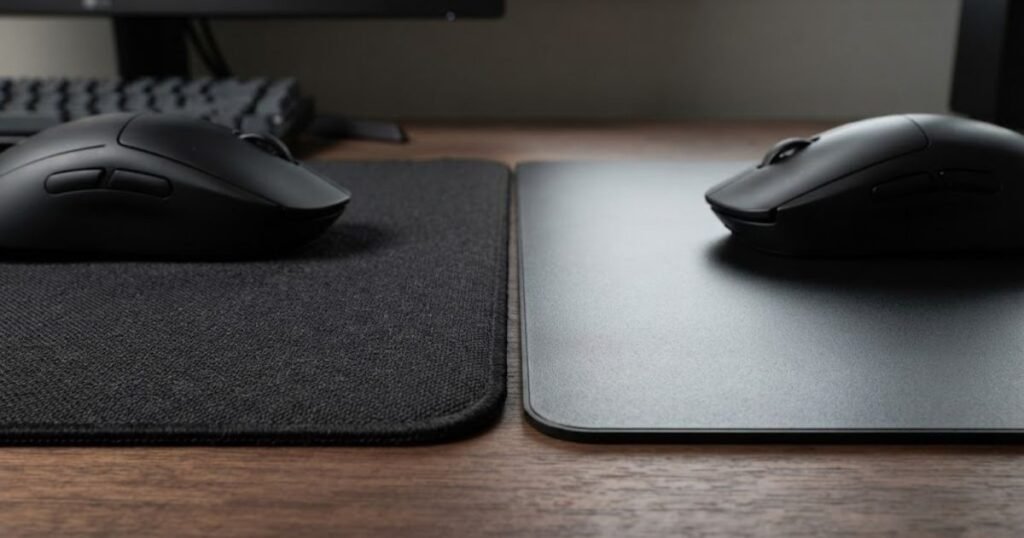
For Apex players, this can be useful when tracking needs to transition into a controlled correction. The mouse does not feel as if it is moving freely across the desk, which can provide a more deliberate feel during aim adjustments.
However, cloth should not automatically be treated as a slow surface. Fast cloth pads can provide considerably more glide than traditional control-oriented cloth pads. The material category tells you that the surface is cloth, but it does not tell you exactly how fast it will feel.
Cloth provides a broad range of movement characteristics, but its main advantage is the ability to combine glide with a more noticeable sense of resistance and stopping feedback.
How Hard Surfaces Affect Glide and Control
Hard mouse pads generally produce less resistance between the mouse feet and the surface, which creates a faster and more direct glide. This can make the mouse feel easier to move during long tracking motions and rapid changes in direction.
The trade-off is that the surface provides less physical resistance to help slow the mouse down. Players who are already comfortable controlling fast movement may enjoy this feel, while others may need more deliberate hand control when stopping or making precise corrections.
The surface itself also matters. A hard mouse pad is not defined by one universal glide level, so two hard surfaces can still feel different. What matters for Apex is how much movement and stopping control the specific surface gives you.
Hard surfaces prioritize a fast, low-resistance glide, but that extra freedom of movement can require more active control from the player.
Why Cloth Does Not Always Mean Slow and Hard Does Not Always Mean Identical Speed
Comparing mouse pads only by material can lead to the wrong conclusion. Cloth and hard describe the broad surface type, not the complete performance profile. Surface texture, weave, coating, and construction can all change how the mouse interacts with the pad.
This means a fast cloth pad may feel closer to the speed a player expects from a hard surface, while a controlled hard surface may not feel as extreme as another hard pad. The meaningful comparison is therefore the actual glide and control characteristics rather than the label printed on the product.
For Apex Legends, this distinction matters because players can prioritize different combinations of speed and control. Someone who wants more freedom during tracking does not necessarily need to move directly from a controlled cloth pad to the fastest hard surface available.
The table below compares the typical movement characteristics of cloth and hard mouse pads:
| Factor | Cloth | Hard |
|---|---|---|
| Glide | Ranges from controlled to fast | Typically fast |
| Surface resistance | Varies by surface design | Usually lower |
| Stopping feedback | Generally more noticeable | Generally lighter |
| Surface feel | Softer and more cushioned | Firmer and more direct |
| Movement character | Broad range of control and speed | More focused on low-resistance movement |
The key difference is not simply that one surface is fast and the other is slow. Cloth offers a wider range of resistance and can provide more stopping feedback, while hard surfaces generally emphasize lower resistance and faster movement. The specific surface profile is more useful for choosing an Apex mouse pad than the material category alone.
Cloth and hard mouse pads can both work well for Apex Legends, but they create different movement characteristics. Understanding the actual glide and stopping feel is more useful than assuming every cloth pad is slow or every hard pad has the same speed.
Is a Hard Mouse Pad Better for Apex Tracking?
A hard mouse pad can be a strong choice for Apex Legends players who want very low resistance during tracking, but it is not automatically better than cloth. Its main advantage is the freedom to move the mouse quickly across the surface, while its main drawback is that the player has less physical resistance to help slow the mouse down.
When Low Friction Helps Apex Tracking
Low friction can make sustained tracking feel easier because the mouse requires less effort to keep moving across the pad. This can be useful when an Apex fight requires continuous crosshair movement rather than a single precise flick.
A very low-friction surface can make large tracking movements feel effortless, but that same glide can change how easily the mouse stops:
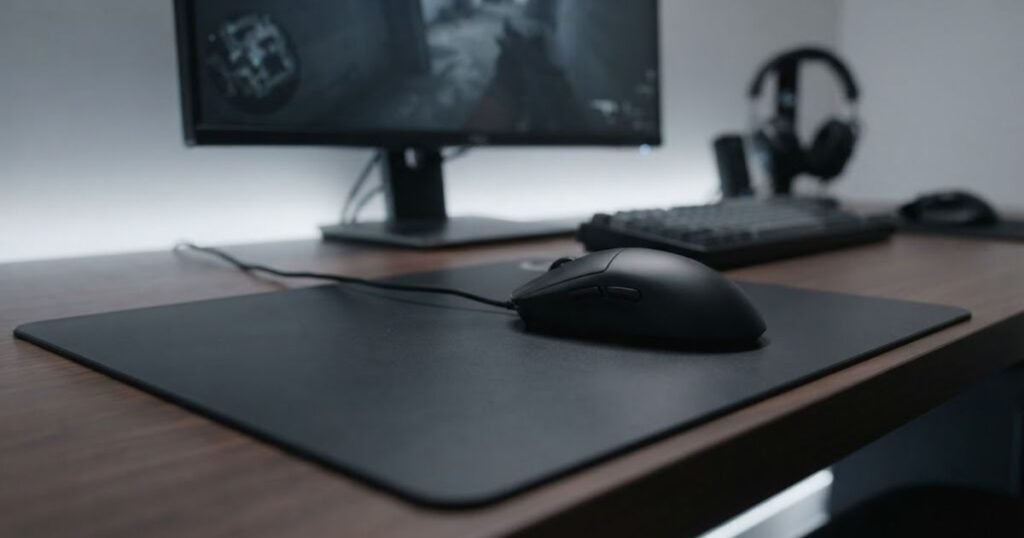
A hard surface can also feel responsive during larger mouse movements. When the target changes direction, the mouse can move quickly without the surface adding much resistance to the movement. Players who naturally use a light grip and make fluid adjustments may find this especially comfortable.
Another advantage is that low resistance can reduce the physical effort required during repeated movements. This does not make the player more accurate by itself, but it can make a fast aiming style feel less restricted.
For an Apex player who already has reliable control, that combination of fast movement and low resistance can be useful during tracking-heavy fights.
Low friction is therefore most valuable when the player can take advantage of the additional freedom without losing control of the crosshair.
When a Hard Mouse Pad Can Make Stopping More Difficult
The same low resistance that helps the mouse move quickly can make stopping feel less forgiving. When there is little friction between the mouse feet and the surface, the player has to control the end of each movement more actively.
This can become noticeable when a fast tracking movement needs to transition into a precise correction. If the mouse continues farther than intended, the player may need an additional correction to bring the crosshair back onto the target.
A very fast surface can create several control problems for some Apex players:
- Overshooting: The mouse can travel farther than intended when the player makes a fast movement.
- Stopping control: The player may need more deliberate hand control to stop precisely.
- Micro-corrections: Small adjustments can feel less forgiving when the surface provides very little resistance.
- Overcorrection: An initial movement that goes too far can lead to unnecessary counter-movements.
These problems do not mean that hard mouse pads are unsuitable for Apex. They simply show why maximum glide is not the same thing as maximum control.
A player who already struggles with overshooting may gain more from a surface with additional resistance than from removing even more friction.
Which Apex Players Are Most Likely to Prefer Hard Surfaces?
Hard surfaces tend to make the most sense for Apex players who already know that they prefer fast, low-resistance movement and can control the mouse when stopping. They are less suitable as a blind upgrade for someone who is hoping that a faster pad will automatically fix inconsistent aim.
The table below shows which Apex player profiles are more likely to benefit from a hard surface:
| Apex Player Profile | Hard Surface Fit | Main Reason |
|---|---|---|
| Tracking-focused player | High | Low resistance can support continuous mouse movement |
| Player who prefers very low friction | High | Matches a naturally fast movement preference |
| Player who frequently overshoots | Low | Additional glide may make stopping harder |
| Player who wants strong stopping feedback | Low | A fast hard surface provides less resistance during movement |
| Player already comfortable with fast surfaces | High | Requires less adaptation to low-resistance movement |
| Player new to very fast surfaces | Moderate | May need time to develop better stopping control |
The strongest case for a hard mouse pad is a player who already understands their preference for fast movement and does not have major problems controlling the end of that movement. If overshooting and stopping are already weaknesses, adding more glide may move the setup in the wrong direction.
For that reason, hard should be viewed as a specific surface preference rather than the default Apex Legends choice. Its value comes from giving the right player more freedom of movement, not from making the mouse faster for everyone.
Is a Cloth Mouse Pad Good for Apex Legends?
Yes, a cloth mouse pad can be an excellent choice for Apex Legends, especially when you want a balance between smooth tracking and reliable control. Fast and balanced cloth surfaces can support the large mouse movements common in Apex without making the mouse feel as difficult to stop as an extremely fast surface.
Why Fast Cloth Can Work Well for Apex Tracking
Fast cloth gives Apex players more freedom during continuous mouse movement while retaining the familiar feel of a soft surface. This makes it a useful middle option for players who want easier tracking but do not want to move all the way to a very low-resistance hard surface.
Cloth is not a single speed category, and different weaves can produce very different levels of resistance:
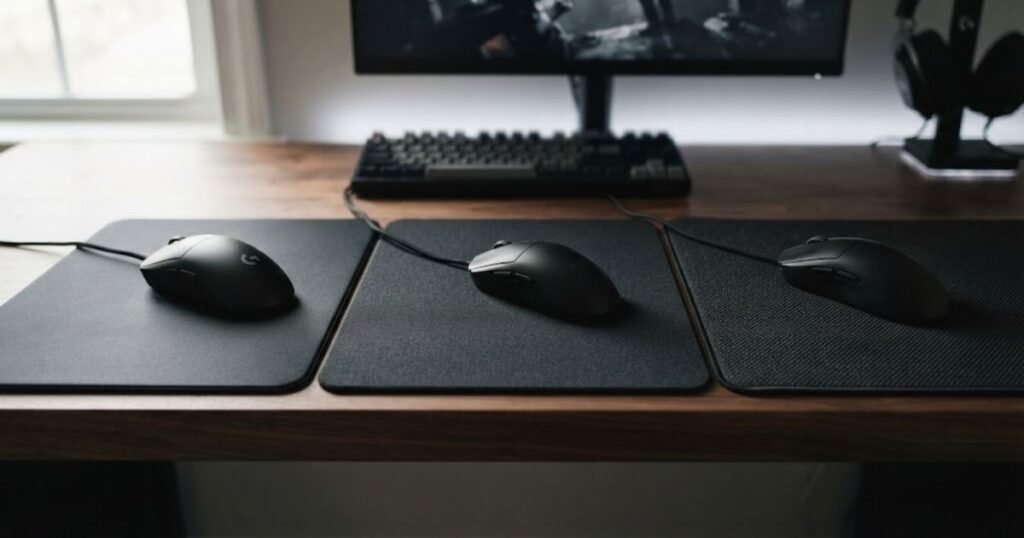
The main benefit is flexibility. A fast cloth pad can let you move across the surface quickly enough for sustained tracking while still providing some resistance when you change direction or finish a movement.
This can be particularly useful when your aim involves frequent transitions between following a target and making a controlled correction. Instead of treating tracking and stopping as completely separate requirements, fast cloth can provide a compromise between the two.
That compromise is why fast cloth can work well for Apex players who want more glide without completely giving up the familiar control of cloth.
Why Balanced Cloth Works for Mixed Apex Aim
Balanced cloth is a strong middle ground for players who do not want their mouse pad to heavily favor either speed or control. It provides enough movement freedom for tracking while retaining enough resistance for corrections, target changes, and controlled stops.
This makes balanced cloth particularly practical for players whose Apex aim includes more than one movement pattern. You may need to track a strafing opponent one moment and make a short adjustment the next. A surface that sits between extreme speed and extreme control can handle both without pushing your setup too far in either direction.
Balanced cloth is also a sensible starting point when you are unsure how much surface speed you actually need. Instead of immediately choosing an extreme surface, you can establish a predictable baseline and determine whether you need more or less glide from there.
For mixed Apex aim, balanced cloth is often the most forgiving starting point because it does not force the player to adapt to an extreme movement characteristic.
When a Slow Control Cloth Can Feel Too Restrictive
A slower control-oriented cloth pad can become a limitation when its resistance makes repeated mouse movements feel harder than necessary. This does not make control cloth bad for Apex, but the additional resistance may work against players who need frequent large movements.
A slower cloth surface can become restrictive when these problems appear:
- Large movements: Sweeping the mouse across the pad can require more physical effort.
- Tracking: Continuous target following can feel more resistant when the mouse needs to keep moving.
- Target transitions: Moving quickly between targets may require more effort than on a faster surface.
- Physical fatigue: Repeated large movements can feel less comfortable when the surface consistently resists the mouse.
The important distinction is that more resistance is useful only when it contributes to better control. If the surface makes every large movement feel unnecessarily difficult, moving to a faster cloth option can provide more freedom without requiring the much faster feel of a hard pad.
That makes slow cloth more suitable for players who deliberately prioritize resistance and control rather than players who feel restricted by their current surface.
The table below compares common cloth surface profiles for Apex players:
| Cloth Profile | Apex Fit | Main Benefit | Main Trade-Off |
|---|---|---|---|
| Slow control | Moderate | More resistance for controlled movement | Can make large movements feel demanding |
| Balanced | High | Combines glide and control | Less specialized toward either extreme |
| Fast | High | Easier movement during tracking | Provides less resistance for stopping |
Cloth is therefore not a single performance category. Slow, balanced, and fast cloth surfaces can produce very different experiences in Apex. For players who want a practical balance, balanced or fast cloth is generally a more useful starting point than assuming all cloth pads are too slow for tracking.
The best cloth surface depends on how much resistance you actually need to control your aim. If slow cloth feels restrictive, moving toward balanced or fast cloth can address the problem without requiring the full change in movement feel associated with a hard pad.
How Should Apex Sensitivity and Aim Style Affect Your Mouse Pad Choice?
Your Apex Legends sensitivity and aiming style should influence how much surface speed or control you want from a mouse pad. Lower sensitivity usually creates larger physical mouse movements, while higher sensitivity relies more on smaller wrist or finger movements. That means the same mouse pad can feel very different depending on how you move the mouse.
Your sensitivity and aiming style determine how much mouse movement you actually need, making surface speed more noticeable in practice:
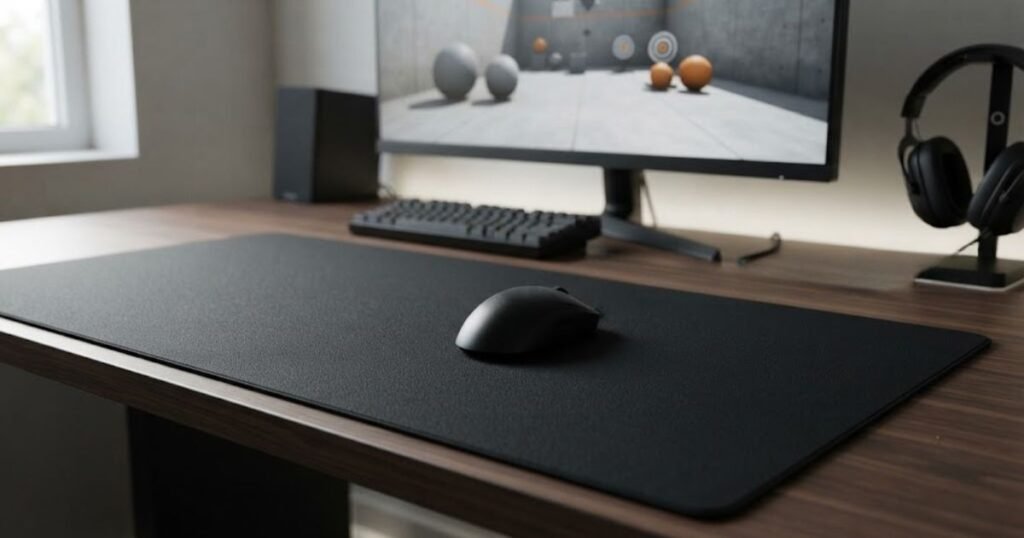
EA notes that lower sensitivity can provide more control but requires larger arm movements, while higher sensitivity allows faster aim changes with smaller movements. EA also points out that the right sensitivity depends on factors such as aiming style, desk space, and the balance between speed and accuracy.
Low Sensitivity Players and Large Mouse Movements
Low sensitivity players generally move the mouse farther across the pad to make the same in-game adjustment. Because of that, the physical characteristics of the surface become more noticeable during normal gameplay.
A surface with excessive resistance can make repeated large movements feel more demanding. This does not mean every low sensitivity player needs the fastest possible pad, but it does make surface speed more relevant when your aim regularly uses a large portion of the pad.
Fast cloth can be a useful starting point because it reduces some of that resistance while retaining a more familiar level of surface feedback. A hard pad can also suit low sensitivity players who already prefer very low friction and have enough space to make wide movements comfortably.
Desk space matters here as well. A large movement style needs enough usable pad area to avoid repeatedly reaching the edge of the surface. If space is limited, changing the pad alone may not solve the underlying problem created by a very low sensitivity.
For low sensitivity Apex players, the key consideration is therefore whether the surface lets you make large movements comfortably without becoming difficult to control.
Higher Sensitivity Players and Small Corrections
Higher sensitivity changes the equation because smaller physical mouse movements create larger changes on screen. This can reduce how much of the pad you use during normal aiming, but it also makes fine hand control more important.
A very fast surface can feel responsive with high sensitivity, but small movements may become less forgiving if you already have difficulty making precise corrections. A more controlled surface can provide additional resistance that helps you regulate those smaller inputs.
This does not mean high sensitivity automatically calls for a slow cloth pad. A player with strong fine-motor control may prefer a fast surface and have no difficulty using it. The important factor is whether the amount of physical movement you make matches the level of control provided by the surface.
When small wrist or finger movements already produce significant changes in aim, adding excessive surface speed may provide little practical benefit. In that situation, predictable control can be more useful than simply reducing resistance.
For higher sensitivity players, the surface should therefore complement the precision of their hand movements rather than forcing them toward either extreme.
Tracking-Focused Players vs Flick-Focused Players
Your dominant aiming style can also change which surface profile makes sense. Tracking-focused players spend more time maintaining crosshair movement with a target, while flick-focused players place greater emphasis on rapid transitions between separated targets.
EA recommends practicing both continuous tracking and flicking in the Firing Range, which highlights why these movement patterns should not be treated as exactly the same skill.
The table below connects common Apex aiming styles with a suitable starting surface:
| Apex Aim Profile | Starting Surface | Why It Can Fit |
|---|---|---|
| Low sensitivity with large movements | Fast cloth or hard | Provides more freedom during wide mouse movements |
| Tracking-focused | Fast cloth, hybrid, or hard | Supports continuous mouse movement |
| Mixed tracking and flicking | Balanced cloth | Provides a middle ground between movement and control |
| Flick-focused | Balanced or controlled cloth | Provides more resistance for deliberate stopping and correction |
| Frequent overshooting | Balanced or controlled cloth | Additional resistance can make movement easier to regulate |
There is no sensitivity value or aim style that automatically determines the correct mouse pad. Low sensitivity makes surface space and movement resistance more important, while higher sensitivity makes fine control more noticeable. Tracking-focused players may appreciate additional glide, while players who rely heavily on controlled flicks may prefer more resistance.
The most useful approach is to match the surface to the movement you already make rather than changing your sensitivity simply to justify a particular mouse pad. Your mouse pad should support your established aiming technique, not force you into a different one.
How Do Mouse Weight and Skates Change the Cloth vs Hard Experience?
Mouse weight and mouse skates can significantly change how a cloth or hard mouse pad feels in Apex Legends. A lighter mouse with fast skates can make a fast surface feel even more responsive, while a heavier mouse or more controlled skates can add resistance to the same setup. For that reason, the mouse pad should be evaluated as part of the entire mouse and surface combination rather than as an isolated component.
How a Lightweight Mouse Changes a Fast Surface
A lightweight mouse places less downward force on the mouse pad, which can make the movement feel more effortless. When paired with a fast surface, that combination can produce a very free-moving setup that responds easily to small changes in hand pressure.
This can be useful for players who already prefer a light and fluid mouse movement. However, reducing both mouse weight and surface resistance at the same time can also make the setup feel less forgiving if your hand control is not consistent.
The result is not simply faster aim. A lighter mouse can change how quickly the mouse responds to your hand, which means the surface characteristics become more noticeable. A setup that feels controlled with a heavier mouse may feel substantially faster after switching to a lighter one without changing the mouse pad.
That is why a lightweight mouse should not be evaluated separately from the speed of the surface underneath it.
How a Heavier Mouse Changes Surface Control
A heavier mouse generally requires more force to accelerate and change direction. On a fast surface, that additional mass can make movement feel more deliberate compared with the same pad paired with a lightweight mouse.
Some players may prefer this because the mouse feels more planted during movement. Others may find the extra weight less comfortable when making frequent movements across the pad.
The important point is that mouse weight changes the physical interaction between your hand, mouse, skates, and surface. A player who dislikes the feel of a particular pad may not necessarily need a different surface. The mouse itself could be contributing to the experience.
This is especially relevant when comparing two setups with similar surface characteristics. Changing the mouse can alter the amount of effort required to start, maintain, and stop movement even when the pad remains exactly the same.
Mouse weight therefore changes the balance of a setup rather than determining whether cloth or hard is inherently better.
Why Mouse Skates Matter on Fast Surfaces
Mouse skates form the direct contact point between the mouse and the pad, so their condition and material can affect how the surface feels. This becomes particularly noticeable on fast surfaces because there is less overall resistance to mask differences in the mouse feet.
The mouse and surface should be evaluated together because these factors affect the final glide:
- Mouse weight: Changes how much physical force is needed to start and stop movement.
- Skate material: Influences how the mouse feet interact with the surface.
- Skate condition: Worn or damaged feet can change the consistency of movement.
- Surface speed: Establishes the general level of resistance beneath the mouse.
- Surface consistency: Helps keep the interaction between the mouse and pad predictable across the area you use.
Skates are particularly important when moving from cloth to a hard surface because the change in surface can make differences in glide more noticeable. A mouse that feels moderately fast on one setup may feel considerably more responsive after the surface and feet are changed together.
This also means that replacing a mouse pad should not automatically be accompanied by a change in mouse skates. Changing several parts of the setup at once makes it harder to determine which change actually improved or hurt your aim.
For a more consistent comparison, keep the mouse and skates unchanged when evaluating two different surfaces. This isolates the pad as the main variable and gives you a clearer idea of how it affects your movement.
Mouse weight and skates do not replace the importance of surface choice, but they can amplify or soften the characteristics of that surface. A fast pad paired with a lightweight mouse and fast skates can feel very different from the same pad paired with a heavier mouse and more controlled setup.
The practical takeaway is simple: judge the mouse pad as part of the complete aiming system. If the setup feels too fast or too resistant, changing the surface may help, but the mouse and skates can also be contributing to that sensation.
Which Mouse Pad Surface Should You Choose for Apex Legends?
For most Apex Legends players, a balanced or fast cloth mouse pad is the safest starting point because it provides enough glide for tracking without making control unnecessarily difficult. A hard mouse pad is a better fit when you already know that you prefer very low resistance and can control the faster movement consistently.
The decision should be based on the problem you are trying to solve. If your current surface feels restrictive during movement, moving toward a faster surface makes sense. If your mouse already feels difficult to stop or you frequently overshoot, adding more speed may not solve the problem.
A broader comparison of cloth vs hard gaming mouse pads follows the same principle: surface material is only the starting point, while the actual balance of speed, control, and comfort determines how a pad fits a particular player.
Choose Controlled Cloth If Stopping Is Your Main Problem
A controlled cloth surface makes the most sense when your main limitation is stopping the mouse accurately rather than moving it quickly. The additional resistance can give your hand a more deliberate response when you finish a flick or make a small correction.
This is particularly useful if your current setup feels too slippery or if increasing surface speed consistently creates more overshooting. In that situation, reducing friction is unlikely to address the underlying problem.
Controlled cloth is also a reasonable choice when you value predictable movement over maximum glide. It does not need to be the slowest surface available. The goal is simply to have enough resistance to make your movements easier to regulate.
If your main complaint is that the mouse is difficult to stop, prioritize control before chasing additional speed.
Choose Balanced or Fast Cloth If You Want Speed and Control
Balanced or fast cloth is the most practical middle ground for players who want easier movement without committing to an extremely low-friction setup. It can provide enough freedom for tracking while retaining more surface feedback than a very fast hard pad.
This option also makes sense if you play Apex regularly but do not want your mouse pad to be highly specialized around one particular aiming characteristic. A middle-ground surface can accommodate different types of mouse movement without making the player adapt to an extreme glide profile.
For players who are uncertain about their ideal surface, balanced cloth is usually the easiest starting point. If it later feels too slow, moving toward a faster surface is a more controlled change than immediately jumping to the fastest option available.
If you want a combination of movement freedom and predictable control, balanced or fast cloth is the most straightforward place to start.
Choose Hard If You Already Prefer Very Low Friction
A hard mouse pad makes the most sense when low friction is already something you know you prefer. It should be a deliberate choice based on how you control the mouse, not simply an assumption that faster movement will produce better Apex aim.
Players who naturally use smooth movements, prefer a firm surface, and have no major problem stopping the mouse are more likely to benefit from the characteristics of a hard pad. The faster response can complement an established aiming style instead of forcing the player to change how they control the mouse.
If you frequently overshoot, struggle with small corrections, or dislike the feeling of very fast movement, a hard surface is less likely to solve those problems. In that situation, a balanced or controlled surface may provide a more useful starting point.
Choose hard when low resistance is something you can already control, not simply because Apex is a tracking-heavy game.
Choose Based on Your Current Problem, Not on the Material Alone
The simplest way to make the decision is to identify what feels wrong with your current setup. Surface selection becomes much easier when you treat the mouse pad as a solution to a specific aiming problem rather than as a piece of gaming gear that should match a particular game.
Use this decision process to choose a starting surface for your Apex setup:
- Identify your problem: Decide whether your current setup feels too resistant, too fast, difficult to stop, or simply inconsistent.
- Check your movement: Consider whether your aim relies on large arm movements, smaller wrist movements, or a combination of both.
- Consider your mouse setup: Account for your mouse weight and skate characteristics before judging the surface by itself.
- Choose the surface profile: Start with controlled cloth, balanced cloth, fast cloth, or hard based on the movement problem you want to solve.
- Test before changing settings: Keep your Apex sensitivity consistent while evaluating the new surface so you can judge the pad itself.
This approach is more reliable than choosing a mouse pad because a professional player uses it or because a particular material is marketed as faster. Your starting point should reflect how your own setup behaves.
GearTP’s broader gaming mouse pad for FPS games guide also emphasizes matching surface choice with sensitivity, movement style, and the type of FPS being played rather than treating one surface as universally best.
The right choice is therefore the surface that addresses your current limitation with the smallest necessary change.
How Should You Test a Mouse Pad in Apex Legends Before Switching?
The most reliable way to test a mouse pad is to keep your mouse, sensitivity, and testing routine consistent while comparing how each surface handles tracking, target switching, and stopping. This makes the surface itself easier to evaluate instead of mixing several setup changes together.
Test Tracking With the Same Aim Routine
Start with a repeatable tracking exercise and focus on how naturally you can keep the crosshair on a moving target. Do not judge the pad only by how fast the mouse feels. Pay attention to whether your movement remains smooth when the target changes direction.
A surface that feels slower may still produce better results if it lets you maintain consistent control. Likewise, a faster surface is not automatically better if you have to make frequent corrections to compensate for excessive movement.
The goal is to determine whether the surface makes your tracking movement easier to repeat, not whether it produces the fastest possible glide.
Test Target Switching and Flicks
After tracking, test how easily you can move between separate targets. This reveals whether the surface allows you to transition quickly while still giving you enough control to settle the crosshair on the new target.
Use the same movement pattern on both surfaces and pay attention to where the mouse stops. If one surface repeatedly causes you to travel past the target, that is useful information even if the initial glide feels smoother.
The better surface is the one that lets you complete the movement with fewer unnecessary corrections.
Test Stopping and Micro-Corrections
Stopping is especially important when comparing surfaces with noticeably different glide characteristics. After a fast movement, make a small correction and observe how predictable the mouse feels as you slow it down.
Do not focus only on whether the surface feels fast or slow. Ask whether you can repeatedly place the crosshair where you intend without consciously fighting the surface.
A surface that requires constant compensation may feel impressive during the first few minutes but become less comfortable once you use it for longer sessions.
Judge Consistency After the Initial Adjustment Period
A new mouse pad can feel unusual simply because your hand is accustomed to the old surface. That first impression is useful, but it should not be the only basis for the decision.
Repeat the same tests across multiple sessions and look for patterns. If tracking, target switching, and stopping continue to feel more predictable after the initial adjustment period, the surface is more likely to be a genuine improvement rather than a novelty effect.
Follow these steps to compare two mouse pads under consistent Apex conditions:
- Keep your mouse: Use the same mouse for both surfaces so the change in feel comes primarily from the pad.
- Keep your sensitivity: Do not change your Apex sensitivity while comparing the surfaces.
- Test tracking: Repeat the same tracking exercise and evaluate how consistently you can follow moving targets.
- Test stopping: Compare how accurately you can stop after fast movements and target transitions.
- Repeat the sessions: Judge the surfaces across multiple sessions instead of making the decision from the first few minutes.
A proper comparison should leave you with a clear answer about what the surface changes in your actual aiming behavior. If the new pad only feels faster but does not make your movements easier to control or repeat, the change may not be an improvement.
Cloth vs Hard Mouse Pad for Apex Legends: Final Verdict
For most Apex Legends players, a balanced or fast cloth mouse pad is the safest overall choice because it provides a useful combination of movement freedom and control. A hard mouse pad is worth choosing when you specifically prefer very low friction and can consistently control faster mouse movement.
There is no universal winner between cloth and hard surfaces. The better option depends on how your current setup feels, how much surface speed you can control, and whether your main priority is easier movement or more deliberate control.
The table below summarizes the most suitable starting point for common Apex Legends aiming priorities:
| Apex Aim Priority | Best Starting Point | Why |
|---|---|---|
| Maximum stopping control | Controlled cloth | Provides more resistance for deliberate mouse control |
| Balanced aim | Balanced cloth | Offers a practical middle ground between glide and control |
| Faster tracking movement | Fast cloth | Provides more freedom during continuous movement |
| Very low resistance | Hard | Provides a fast and low-resistance movement experience |
| Large mouse movements | Fast cloth or hard | Reduces resistance during wider movements |
| Frequent overshooting | Balanced or controlled cloth | More resistance can make movement easier to regulate |
The table shows why there is no single material that wins every Apex setup. The right starting point depends on the specific behavior you want from your mouse, with balanced or fast cloth covering the broadest range of players.
For a player who values control and wants a forgiving setup, controlled or balanced cloth is the safer direction. For someone who wants more freedom during movement, fast cloth can provide additional glide without making the setup as extreme as a very fast hard surface. Hard makes the most sense when low resistance is already a preference rather than something you are hoping will fix your aim.
The most important factor is consistency. If a surface lets you repeat your tracking, target transitions, and corrections without constantly compensating for the pad, it is doing its job.
FAQ About Cloth vs Hard Mouse Pads for Apex Legends
These questions cover the key differences, setup factors, and practical decisions that matter when choosing between cloth and hard mouse pads for Apex Legends. Each answer focuses on one specific question so you can quickly determine which surface characteristics fit your setup.
What Is a Cloth Mouse Pad for Apex Legends?
A cloth mouse pad is a gaming surface made with a textile-based top layer that provides varying levels of resistance between the mouse and the pad. Its feel can range from controlled to fast depending on the surface construction.
What Is a Hard Mouse Pad for Apex Legends?
A hard mouse pad is a rigid gaming surface designed to provide a firm contact surface for the mouse feet and typically lower resistance than many cloth surfaces. Different hard surfaces can still have noticeably different glide characteristics.
What Does Mouse Pad Friction Mean?
Mouse pad friction is the resistance created as the mouse feet move across the surface. Higher friction generally makes movement feel more controlled, while lower friction allows the mouse to move more freely.
What Is Stopping Control on a Mouse Pad?
Stopping control is how easily you can slow and stop the mouse at the intended point after making a movement. It is especially relevant when a fast movement needs to transition into a precise correction.
Does Apex Sensitivity Change Which Mouse Pad You Should Use?
Yes, sensitivity can change how a surface feels because lower sensitivity generally requires larger physical movements, while higher sensitivity makes smaller mouse movements produce larger changes on screen.
Does Mouse Weight Affect Cloth vs Hard Mouse Pad Performance?
Yes, mouse weight affects how much physical force is needed to start, maintain, and stop movement, which can change how fast or controlled the same mouse pad feels.
Do Mouse Skates Make a Hard Mouse Pad Feel Faster?
They can, because mouse skates directly interact with the surface and their material and condition can change the amount of resistance produced during movement.
Should You Change Apex Sensitivity When Switching Mouse Pads?
You should generally keep your sensitivity unchanged when first comparing mouse pads because changing both variables at once makes it harder to determine how much of the difference comes from the surface.
Is a Hard Mouse Pad Better for Apex Legends Tracking?
A hard mouse pad can be better for tracking if you prefer very low resistance and can control the faster movement, but it is not inherently better than a suitable cloth surface.
Is Fast Cloth a Better Starting Point Than Hard for Apex Legends?
Fast cloth is often the safer starting point when you want more glide for Apex tracking but still want more surface feedback than an extremely fast hard setup provides.
How Do You Know If a Mouse Pad Is Too Fast for Apex?
A mouse pad may be too fast if you repeatedly overshoot targets, struggle to stop accurately, or need frequent corrective movements after otherwise controlled mouse motions.
What Is the Best Mouse Pad Surface for Apex Legends?
For most players, balanced or fast cloth is the safest starting point, while hard is better suited to players who specifically prefer very low friction and can maintain consistent stopping control.
Final Thoughts
The best mouse pad for Apex Legends is not determined by whether the surface is made from cloth or hard material. What matters is how the surface interacts with your mouse, your movement style, and the amount of control you can maintain during real gameplay.
For most players, balanced or fast cloth is the most sensible place to start. It provides enough freedom for Apex’s movement demands without making control unnecessarily difficult. Hard surfaces remain a strong option for players who already know they prefer very low friction and can handle the faster response.
Instead of choosing the fastest surface by default, choose the surface that makes your mouse movements easier to repeat. Consistent control is ultimately more valuable than speed alone.
Thanks for reading GearTP. I hope this guide helps you choose the right mouse pad for your Apex Legends setup.