
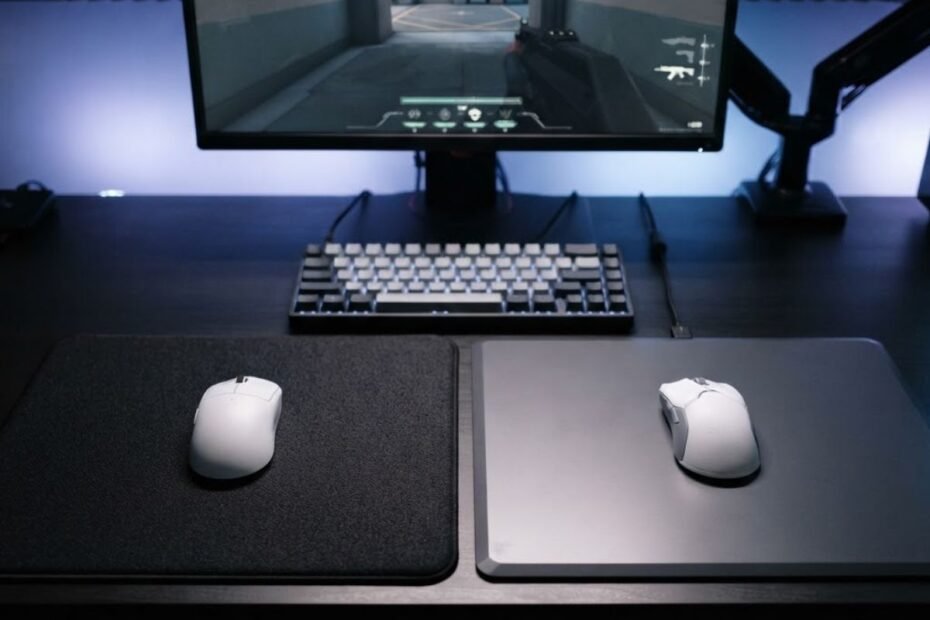
If you are deciding between a cloth and hard mouse pad for Valorant, a cloth surface is generally the safer starting point for controlled aim, while a hard pad makes more sense if you specifically prefer faster, lower-friction movement. Neither surface automatically makes you aim better. The better choice depends on how the surface feels when you move, adjust, and stop your mouse.
Valorant places a strong emphasis on precise gunplay, crosshair placement, and controlled aiming, so the difference between a more controlled cloth surface and a faster hard surface can become noticeable during everyday play. GearTP’s broader FPS mouse pad research also shows that cloth surfaces generally provide more control and comfort, while hard surfaces tend to offer faster glide and lower resistance.
Is Cloth or Hard Better for Valorant?
A cloth mouse pad is usually the better starting point for Valorant players who want controlled movement and predictable stopping, while a hard mouse pad is better suited to players who already prefer fast, low-friction glide.
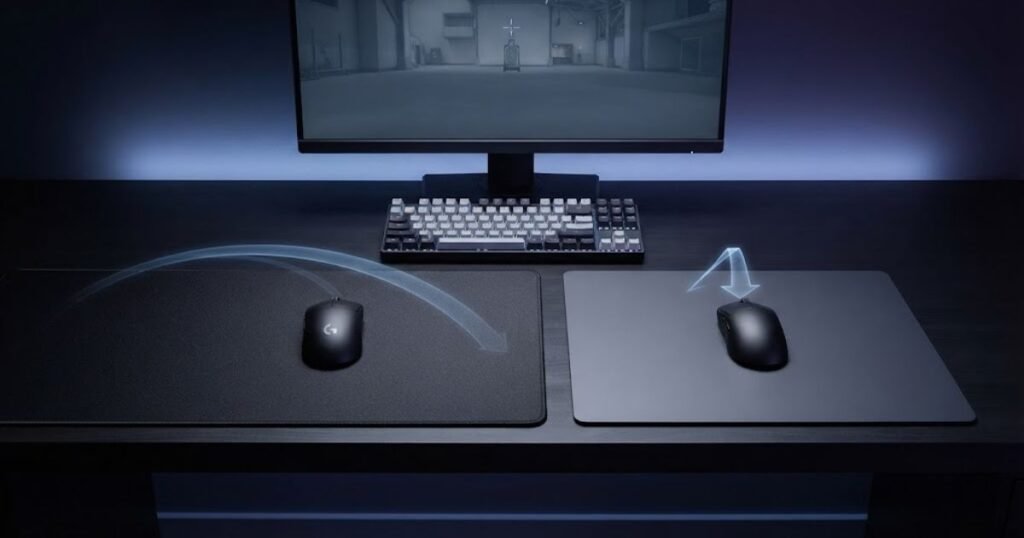
The important distinction is not that one material is universally better. Cloth and hard surfaces create different movement characteristics, and those characteristics can change how the mouse feels during precise aiming. A cloth pad generally gives the mouse more resistance and a more controlled feel, while a hard pad usually allows the mouse to move more freely with less friction.
The physical difference between the two surfaces is easier to understand when they are viewed side by side:
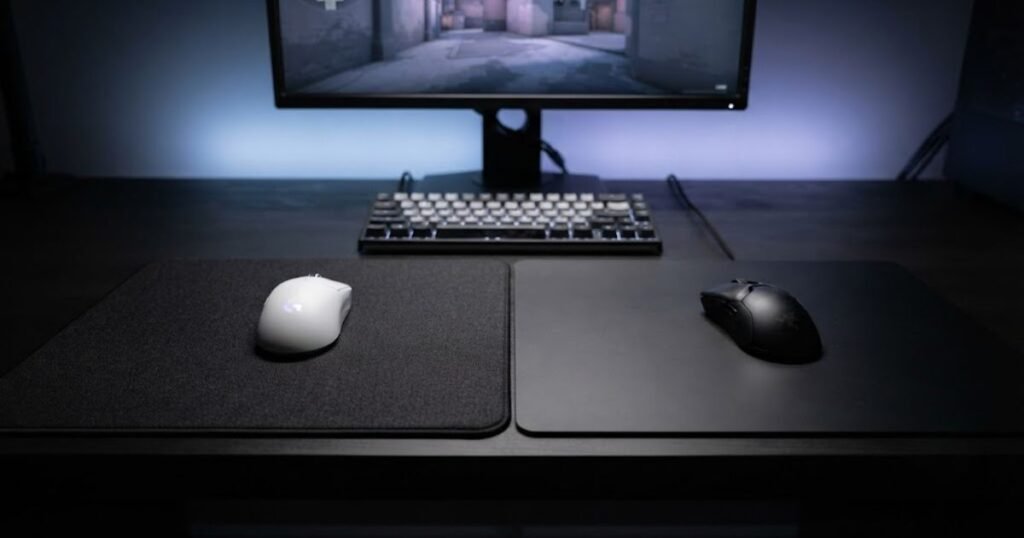
For Valorant, that difference matters because small changes in mouse movement can affect how comfortable a player feels when positioning the crosshair and controlling the end of a movement. GearTP’s comparison of FPS mouse pad materials similarly places cloth toward the control and comfort side, while hard surfaces are associated with higher glide speed and lower control.
The table below gives the simplest starting point for comparing the two surfaces:
| Factor | Cloth Mouse Pad | Hard Mouse Pad |
|---|---|---|
| Glide | More controlled | Faster |
| Resistance | Higher | Lower |
| Stopping feel | More controlled | More demanding |
| Surface feel | Softer | Firmer |
| Noise | Generally lower | Generally higher |
| Maintenance | More involved | Easier to wipe clean |
Overall, cloth is the safer default when your priority is controlled movement and a more forgiving surface feel. A hard mouse pad becomes more attractive when you already know that you prefer low resistance and faster glide.
That does not mean every cloth pad will feel slow or every hard pad will feel uncontrollably fast. Surface texture, construction, coating, and the condition of the pad can change the actual feel within each material category. The material is therefore a useful first filter, not the entire decision.
For a broader comparison of how these two materials differ across gaming use cases, cloth and hard gaming mouse pads can be evaluated through their control, glide, comfort, and durability characteristics before narrowing the choice specifically to Valorant.
For most Valorant players, cloth is the safer starting point because it emphasizes controlled movement rather than maximum glide speed. Hard is still a valid choice when its faster movement matches the way you naturally aim.
Why Does Mouse Pad Surface Matter for Valorant Aim?
Mouse pad surface matters in Valorant because the way the mouse moves across the surface can change how predictable aiming feels, especially when a gunfight depends on precise crosshair placement and controlled movement.
A precision-focused FPS setup makes the relationship between mouse movement and crosshair control easier to visualize:
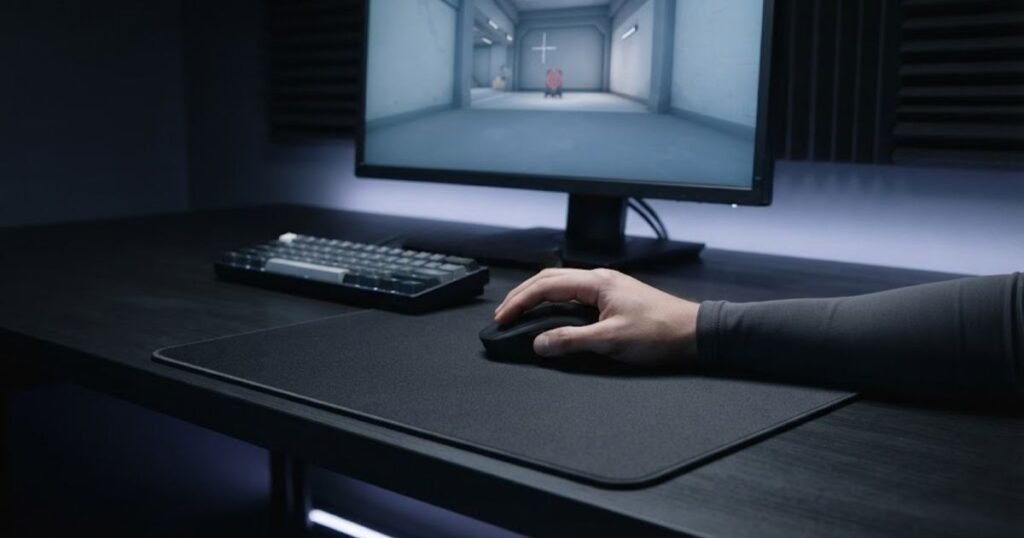
Not every difference between a cloth and hard mouse pad matters equally in Valorant. The important question is whether the surface makes your mouse movement easier to control or forces you to make more corrections than necessary. That distinction becomes more relevant in a game where a small aiming error can decide a gunfight.
Valorant Rewards Precise and Accurate Play
Valorant’s gameplay puts a strong emphasis on precision, accuracy, and crosshair placement, which makes consistent mouse control more important than simply having the fastest possible glide.
Riot Games describes Valorant as a 5v5 tactical shooter built around sharp gunplay and tactical abilities. Riot also states that the game is designed to recognize and reward precise, accurate, and skillful play, with aim and crosshair placement playing an important role in winning gunfights.
VALORANT’s emphasis on precise and accurate play helps explain why mouse control is a more useful way to evaluate a surface than simply asking which material is faster. A mouse pad does not improve a player’s crosshair placement by itself, but its movement characteristics can influence how natural that control feels.
This is particularly relevant when a player needs to place the crosshair on a specific angle, make a small adjustment, or stop the mouse at the intended position. The surface becomes part of the physical setup used to execute those movements, rather than a direct source of better aim.
Valorant’s precision-focused gunplay makes predictable mouse control more important than chasing maximum glide speed.
Surface Feel Changes Mouse Control
A mouse pad surface changes the physical feel of mouse movement, so the same mouse and sensitivity can feel different when used on surfaces with different resistance and glide characteristics.
Think of the surface as part of the movement system between your hand and the crosshair. When the mouse encounters more resistance, movement can feel more deliberate. When resistance is lower, the mouse can move more freely. Neither behavior is automatically better because the useful amount of resistance depends on how the player controls the mouse.
This is why material alone should not be treated as an aim category. Two players using the same mouse and the same Valorant sensitivity can prefer different surfaces because they may have different movement habits, stopping preferences, and levels of comfort with fast glide.
The practical question is therefore not whether cloth or hard is objectively more accurate. It is whether the surface gives you a predictable response when you move the mouse and whether that response helps you place the crosshair where you intend.
That distinction also explains why changing mouse pads can initially make your aim feel unfamiliar even when your sensitivity settings have not changed. The numerical sensitivity remains the same, but the physical resistance under the mouse has changed.
Surface choice matters because it changes the physical feedback of mouse movement, while the player’s actual aim ability still determines the result.
How Does Cloth vs Hard Affect Valorant Aim Control?
Cloth and hard mouse pads can produce different aiming feels in Valorant because their surface resistance changes how easily the mouse starts moving, continues gliding, and comes to a stop. Cloth generally feels more controlled, while hard surfaces generally feel faster and require the player to manage that lower resistance.
The difference becomes most noticeable during movements where the player needs both speed and control. A surface that moves too freely can make a fast adjustment easy but the final stop harder to manage. A surface with more resistance can make movement feel more deliberate, which some players find easier to control.
The movement path of the mouse can look similar on screen while feeling noticeably different under the hand:
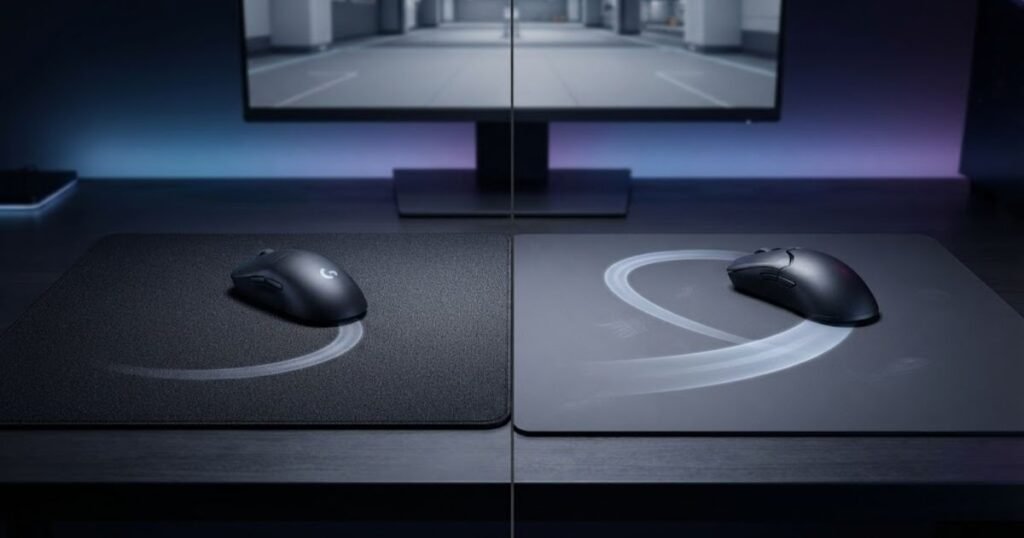
For Valorant, the useful comparison is therefore not simply “slow versus fast.” It is how each surface behaves throughout the movement and whether that behavior matches the way you control your mouse.
The following comparison focuses specifically on the parts of an aiming movement that can feel different between the two surfaces:
| Aim Task | Cloth Mouse Pad | Hard Mouse Pad |
|---|---|---|
| Starting movement | More resistance and a more deliberate feel | Lower resistance and an easier initial glide |
| Flick movement | More controlled movement feel | Faster movement feel |
| Stopping | Generally easier to slow and control | Requires more deliberate braking |
| Micro-corrections | More resistance can make small movements feel controlled | Low resistance can make small movements feel more immediate |
| Large mouse movements | Can require more physical effort | Can feel easier to move quickly across the surface |
The table describes general surface behavior rather than a guaranteed performance advantage. Actual feel can vary between individual mouse pads, mouse feet, surface condition, and the player’s own control style.
Which Surface Is Better for Valorant Micro-Adjustments?
Cloth is often easier to control for players who prefer more resistance during small mouse movements, while hard surfaces can suit players who prefer immediate movement with less resistance.
Micro-adjustments are small changes made after the crosshair is already close to the intended target. At this point, the goal is not to move the mouse as quickly as possible. The goal is to make the amount of movement you intend without adding unnecessary correction.
A cloth surface can make these movements feel more deliberate because the mouse encounters more resistance. This can be useful for players who naturally prefer a controlled hand movement and do not want the mouse to glide farther than expected.
A hard surface can provide a more immediate response because the mouse encounters less resistance. That can feel excellent for a player who is already comfortable controlling low-friction movement, but it can also make unwanted movement more noticeable if the player’s hand control does not match the surface.
The better surface for micro-adjustments is therefore the one that lets you make small corrections without repeatedly fighting the surface or compensating for it.
Cloth tends to favor a more controlled micro-adjustment feel, while hard can favor players who are comfortable with faster, more immediate movement.
Which Surface Is Better for Valorant Flick Shots?
Hard mouse pads can make rapid flick movement feel easier because of their lower resistance, while cloth can make the same movement feel more controlled when the player needs a deliberate stop.
A flick is not only about getting the crosshair to the target quickly. The movement also has to finish in the intended position. This makes the relationship between the initial movement and the final stop important.
With a lower-friction hard surface, the mouse can travel quickly with less resistance. Players who naturally control that movement can benefit from the freer glide, particularly when making larger or faster mouse movements.
Cloth provides more resistance during the same type of movement. That does not necessarily make a flick slower in practice because the player’s hand speed and control still determine how quickly the mouse moves. Instead, the surface can make the movement feel more deliberate and easier to manage for players who prefer additional resistance.
If a player consistently reaches the target but has difficulty stopping exactly where intended, simply choosing the faster surface may not solve the problem. The relevant question is whether the surface makes the complete flick easier to execute consistently.
Hard can favor fast, low-resistance flick movement, while cloth can favor players who value a more controlled feel through the end of the flick.
Ultimately, neither surface guarantees better Valorant aim. The meaningful difference is how much resistance you want during the movement and how reliably you can control the mouse from the first motion to the final position.
How Does Sensitivity Change the Cloth vs Hard Choice in Valorant?
Sensitivity can change how a cloth or hard mouse pad feels in Valorant because it affects how much physical mouse movement you use, but there is no universal rule that low sensitivity requires cloth or high sensitivity requires a hard surface.
Valorant sensitivity changes the relationship between your hand movement and the distance your crosshair travels on screen. Because of that, the same mouse pad can feel different depending on how much physical movement you normally make during a match.
Physical mouse travel becomes especially noticeable when comparing different sensitivity setups:
That makes sensitivity a useful factor when choosing between cloth and hard, but it should not be treated as a shortcut for deciding which material is better. Your preferred level of resistance still matters more than simply labeling yourself as a low-sensitivity or high-sensitivity player.
The table below shows how sensitivity can influence the surface decision without turning sensitivity into a fixed material rule:
| Player Setup | Main Consideration | Surface Tendency |
|---|---|---|
| Low sensitivity | More physical mouse movement | Controlled cloth can be attractive |
| Medium sensitivity | Balanced physical movement | Either surface can work |
| High sensitivity | Smaller physical movements | Depends strongly on resistance preference |
| Very low-friction preference | Easy mouse movement | Hard becomes more attractive |
The table should be read as a starting point rather than a prescription. Sensitivity tells you how much physical movement you tend to make, but it does not tell you how much surface resistance you personally need.
What Low-Sensitivity Valorant Players Should Consider
Low-sensitivity players should pay particular attention to physical mouse travel, desk space, and how much resistance they want during repeated large movements.
Low sensitivity generally requires more physical mouse movement to move the crosshair across a similar distance on screen. That means the surface can become more noticeable during repeated wide movements because the mouse spends more time traveling across the pad.
A controlled cloth surface can be appealing when that additional physical movement already feels demanding and the player prefers a deliberate movement feel. However, choosing cloth simply because you play at low sensitivity is not automatically correct. A low-sensitivity player who dislikes resistance may prefer a faster surface instead.
Desk space also matters. A player using low sensitivity needs enough usable surface area to move the mouse without repeatedly reaching the edge of the pad. This is a physical setup consideration rather than a direct advantage of either material.
The better question for a low-sensitivity player is therefore not “Should I use cloth?” but “Do I want additional resistance during the larger movements my sensitivity requires?”
Low sensitivity makes physical movement more important, but it does not automatically make cloth the better choice.
What High-Sensitivity Valorant Players Should Consider
High-sensitivity players should focus less on the amount of mouse travel and more on whether the surface provides the level of resistance they can comfortably control during small physical movements.
With higher sensitivity, relatively small hand movements can produce substantial crosshair movement. Because the mouse does not need to travel as far across the pad, the main surface question becomes how the player wants those small physical movements to feel.
A lower-resistance hard surface can feel responsive to players who prefer their mouse to move freely. A more resistant cloth surface can suit players who want additional physical feedback while making small movements.
Neither preference guarantees better aim. A high-sensitivity player can use cloth successfully, just as a high-sensitivity player can use hard. The deciding factor is whether the surface makes the player’s normal hand movements easier to control rather than whether the sensitivity number fits a particular material.
This is also why switching surfaces without changing sensitivity can still feel significant. The sensitivity setting has not changed, but the physical resistance underneath the mouse has changed, altering the way the same hand movement feels.
High sensitivity does not automatically favor hard surfaces. It simply makes the player’s preferred level of resistance more noticeable during small movements.
Sensitivity is best treated as a modifier in the decision rather than the decision itself. Once you know how much physical movement your setup requires, the more useful question is whether you want the mouse to feel more controlled or more freely moving across that distance.
When Does a Hard Mouse Pad Make Sense for Valorant?
A hard mouse pad makes sense for Valorant when you prefer low-friction movement, a fast glide, and a firm surface, and you can control that movement without making frequent unwanted corrections.
Choosing a hard mouse pad is less about having an “advanced” setup and more about matching the surface to your natural movement preference. Some players simply prefer a mouse that moves freely with very little resistance. For those players, a hard surface can feel more natural than a cloth pad.
The important test is whether the lower resistance actually helps your gameplay. If the mouse feels effortless to move but difficult to control, the extra glide may create more problems than benefits. If you can move quickly while maintaining predictable control, the same characteristic can become an advantage.
Choose Hard If You Prefer Low-Friction Movement
A hard mouse pad is a strong option if you naturally prefer very little resistance between the mouse and the surface.
Low-friction movement can make the mouse feel lighter and more responsive under the hand. Instead of having the surface noticeably resist movement, the mouse can travel across the pad with relatively little effort.
This can appeal to players who dislike a dragging sensation when moving the mouse. It can also make the physical effort of moving the mouse feel lower, particularly when the player regularly makes broad movements across the available surface.
However, low friction is only useful when the player can control it. A surface that feels effortless during movement is not automatically better if it makes the mouse feel difficult to manage once you need to settle into a precise position.
Hard makes the most sense when low resistance is something you already enjoy and can control rather than something you are choosing simply because it sounds faster.
Choose Hard If You Already Control Fast Glide Well
A hard mouse pad is a reasonable choice when you already feel comfortable controlling a fast, low-resistance surface instead of constantly compensating for it.
The key difference is familiarity. Players who have already used low-friction surfaces may know how much pressure and movement they naturally need to control the mouse. For them, moving to another hard surface can be a straightforward preference change rather than a complete adjustment to their aiming technique.
A player who consistently keeps the mouse under control while using a fast surface has less reason to avoid hard pads simply because they offer lower resistance. The material should be judged by the result it produces in the player’s own setup.
On the other hand, choosing hard solely because it is associated with speed can be counterproductive. If you spend more time compensating for unwanted movement than benefiting from easier glide, the lower resistance is working against your control.
Existing comfort with fast glide is a better reason to choose hard than the assumption that a faster surface will automatically produce faster or better aim.
Signs a Hard Mouse Pad Feels Too Fast
A hard mouse pad may be too fast for your setup when its low resistance consistently causes unwanted movement or makes your normal mouse control feel less predictable.
Pay attention to repeated problems rather than judging the surface from a few minutes of unfamiliarity. A new surface can feel different simply because your hand has not adapted to its movement characteristics yet.
These are the clearest signs that the surface may be working against your control:
- Frequent overshooting: Your mouse regularly travels farther than intended during normal aiming movements.
- Unwanted movement: Small hand movements produce more mouse movement than you comfortably expect.
- Excessive compensation: You repeatedly make an additional movement to correct the position created by the first movement.
- Unstable positioning: Your mouse feels difficult to keep where you want it during controlled aiming.
- Inconsistent control: The same type of movement feels noticeably harder to reproduce from one attempt to another.
One isolated mistake does not mean a hard pad is too fast. The useful signal is a repeated pattern that remains after you have had enough time to become familiar with the surface.
If a hard surface repeatedly creates unwanted movement and compensation, its low-friction behavior may not match your natural control style.
A hard mouse pad is therefore not inherently too fast for Valorant. It becomes a poor fit when the freedom of movement creates more control problems than it solves. The right choice depends on whether you can use that low resistance consistently in your own setup.
When Is a Cloth Mouse Pad the Better Choice for Valorant?
A cloth mouse pad is generally the better choice for Valorant players who prefer a more controlled surface feel, want more resistance during mouse movement, or simply find a softer surface more comfortable for extended play.
Cloth is often the easier starting point when a player does not have a strong preference for very low friction. Its surface provides more physical resistance than a typical hard pad, which can make mouse movement feel less free and more deliberate.
That does not mean cloth is automatically more accurate or that every Valorant player should use it. The advantage is mainly about matching the surface to the player’s preferred movement feel and daily setup. A player who naturally dislikes resistance may still prefer a hard pad even if they value control.
Choose Cloth If You Prioritize Control Over Glide Speed
Cloth is a sensible choice when you would rather have a more controlled mouse movement feel than minimize resistance as much as possible.
Some players prefer to feel a noticeable amount of resistance beneath the mouse because it makes the movement feel more deliberate. Instead of prioritizing how freely the mouse can glide, they prioritize how predictable the surface feels under their hand.
This preference can make cloth a practical fit for Valorant because the player is not choosing the surface based on maximum movement speed. They are choosing it because the amount of resistance feels easier to manage during their normal play.
The distinction is important because “control” should not be treated as a guarantee of better aim. A controlled surface can only help if the player actually prefers that physical feedback. Someone who finds cloth unnecessarily resistant may perform better on a faster surface that feels more natural.
Cloth is a strong choice when controlled movement matters more to you than having the lowest possible surface resistance.
Choose Cloth If You Want More Forgiving Mouse Movement
Cloth can feel more forgiving when you prefer additional resistance to help keep mouse movement deliberate and predictable.
The word “forgiving” here does not mean that cloth corrects mistakes or improves mechanical skill. It refers to how the surface responds to your physical movement. More resistance can make the mouse feel less free to move across the surface, which some players find easier to manage.
This can be especially useful for players who do not enjoy the feeling of a mouse moving with very little resistance. Instead of adapting their hand control to a very fast surface, they may find it more natural to work with a surface that provides more physical feedback.
It is also possible for a cloth pad to feel too resistant. If moving the mouse across the surface feels unnecessarily difficult or tiring, the additional control may not be worth the trade-off for that particular player.
Cloth can provide a more forgiving feel for players who naturally prefer physical resistance, but too much resistance can become a disadvantage when it conflicts with their movement preference.
Choose Cloth If You Play Long Valorant Sessions
Cloth can be the better choice for long Valorant sessions when you prefer a softer surface feel and want the mouse pad to feel comfortable throughout extended use.
Comfort is separate from aiming performance. A surface can have movement characteristics that suit your aim while still feeling unpleasant during a long session, so the physical feel of the pad deserves consideration when two options otherwise seem suitable.
Cloth surfaces generally provide a softer contact experience than hard surfaces. That difference can matter to players who spend several hours at their desk and prefer a less rigid surface under the hand and wrist area.
However, comfort is highly personal. Some players prefer the firm, smooth feel of a hard surface and may find cloth less comfortable. There is no objective rule that a cloth pad will feel better for every player during long sessions.
Long-session comfort can make cloth more attractive, but the best choice still depends on the surface feel you personally find comfortable over time.
For Valorant players, cloth is ultimately the better choice when its controlled feel and softer surface match your preferences. It should not be chosen simply because cloth is commonly associated with FPS gaming. The deciding factor is whether the surface feels natural enough that you can use it consistently without wishing it were faster or slower.
How Do Comfort and Maintenance Affect the Cloth vs Hard Decision?
Comfort and maintenance should usually be secondary factors when choosing between a cloth and hard mouse pad for Valorant, but they can become decisive when both surfaces fit your aiming preferences.
Your mouse pad is part of the setup you use for every match, so a surface that feels good during aiming but becomes uncomfortable or inconvenient to maintain can still be a poor long-term choice. The goal is to find a surface that works for your aiming preferences without creating unnecessary practical problems.
These factors should not override a major mismatch in movement feel. Instead, use them to break a close decision after you have established which type of surface you prefer.
The main practical differences can be summarized as follows:
| Factor | Cloth Mouse Pad | Hard Mouse Pad |
|---|---|---|
| Surface feel | Softer | Firmer |
| Cleaning | Usually requires more care | Generally easier to wipe |
| Moisture management | Can be more affected by moisture | Generally easier to wipe dry |
| Noise | Generally quieter | Can produce more surface noise |
| Long-session feel | Softer contact | Firmer contact |
These are general characteristics rather than guarantees for every mouse pad. Construction, coating, thickness, surface texture, and the rest of the setup can change the experience.
Does Humidity Change How a Cloth Mouse Pad Feels?
Humidity can affect how a cloth mouse pad feels because moisture and surface condition can change the friction experienced during mouse movement.
This matters more when a player notices that the same cloth pad does not feel exactly the same under different environmental conditions. A surface that feels consistent in a dry room may feel different when moisture builds up on or around the pad.
That does not mean every cloth mouse pad will respond to humidity in the same way. The construction and surface treatment of the particular pad matter, as does the environment in which it is used.
If your room is frequently humid, consistency becomes a practical consideration rather than a reason to automatically reject cloth. Keeping the surface clean and allowing it to remain dry can help maintain a more predictable feel.
Humidity can influence cloth surface behavior, so players in humid environments should consider surface consistency as part of their overall decision.
Which Surface Is Easier to Maintain?
Hard mouse pads are generally easier to clean because their non-porous surface can usually be wiped directly, while cloth surfaces require more careful cleaning and drying.
This difference becomes relevant when the mouse pad is used frequently. Dust, skin oils, sweat, and other debris can accumulate on any mouse pad, but the cleaning process differs depending on the surface construction.
A hard pad is generally more convenient when you want a surface that can be wiped down quickly. A cloth pad can require more attention because the fabric surface needs to be cleaned without damaging its material or leaving excess moisture behind.
Maintenance should still be viewed as a supporting factor. A slightly more demanding cleaning routine may be worthwhile if the cloth surface gives you the movement feel you prefer.
Hard generally wins on cleaning convenience, while cloth can still be the better overall choice when its surface feel fits your preferences.
Which Valorant Players Should Choose Cloth or Hard?
Players who want a more controlled and resistant surface will generally have a better starting point with cloth, while players who specifically prefer low resistance and fast movement can consider hard.
At this stage, the choice should be based on your own setup rather than a generic recommendation. Sensitivity, aiming habits, comfort, and previous experience all provide useful context, but none of them should be treated as a mandatory formula for selecting a material.
The following profiles are intended as practical starting points, not strict categories:
| Player Profile | Better Starting Point | Why |
|---|---|---|
| New to choosing mouse pad surfaces | Cloth | Provides a more controlled starting point |
| Control-focused player | Cloth | More physical resistance |
| Player who dislikes excessive glide | Cloth | Less freely moving surface feel |
| Low-friction enthusiast | Hard | Faster, lower-resistance movement |
| Player who dislikes surface drag | Hard | Freer movement |
| Player already comfortable with hard surfaces | Hard | Existing familiarity with the surface feel |
| Player unsure about both options | Cloth | Safer general starting point |
These recommendations are intentionally based on preferences rather than skill labels. Being a beginner does not automatically mean you need cloth, and being an experienced player does not automatically mean you need hard.
The best starting surface is the one that matches your preferred physical mouse feel, not the one associated with a particular skill level.
How to Choose Between a Cloth and Hard Mouse Pad for Valorant
The simplest way to choose is to identify what feels wrong with your current surface, then determine whether you need more resistance, less resistance, a different comfort level, or easier maintenance.
Instead of choosing based on a general recommendation, work through your own setup in order. This makes the decision more useful because you are solving a specific problem rather than copying someone else’s preference.
Use these steps to narrow down the right surface:
- Identify the problem: Decide whether your current surface feels too fast, too resistant, uncomfortable, or inconsistent.
- Consider your physical movement: Think about how much mouse movement you normally use during a Valorant match.
- Check your surface preference: Decide whether you naturally prefer noticeable resistance or freer movement.
- Evaluate your existing experience: If you have already used one surface successfully, consider whether there is a specific problem you are trying to solve by switching.
- Consider practical factors: Account for comfort, cleaning, desk space, and the environment where you use the mouse pad.
- Choose the lower-compromise option: Pick the surface that solves your main problem without introducing a new one that is harder to manage.
Following this process prevents one specification from dominating the entire decision. A player may value fast movement but still prefer cloth because the overall experience is more predictable and comfortable, while another player may accept the additional demands of a hard surface because its freer movement better matches their preference.
The right choice comes from identifying your actual problem and choosing the surface that creates the fewest compromises in your Valorant setup.
Cloth vs Hard Mouse Pad for Valorant: Final Verdict
For most Valorant players, cloth is the safer starting point because it provides a more controlled surface feel, while hard is the better fit for players who specifically prefer low friction and faster movement.
There is no universal winner between the two materials. The better choice depends on which surface allows you to use your mouse naturally and consistently. If you prefer a more resistant surface and do not need extremely fast movement, cloth is the more practical starting point. If you already know that you prefer very low resistance and fast glide, hard can be the better fit.
Your sensitivity, aiming habits, comfort preferences, and experience with different surfaces can all influence the decision, but none of them creates a mandatory rule. A low-sensitivity player can use hard, and a high-sensitivity player can use cloth. The important question is whether the surface works with your physical mouse movement.
The final decision can be simplified into these priorities:
| If Your Priority Is… | Better Starting Point |
|---|---|
| Controlled movement | Cloth |
| More resistance | Cloth |
| Softer surface feel | Cloth |
| Low friction | Hard |
| Faster glide | Hard |
| Firmer surface feel | Hard |
| Unsure where to start | Cloth |
If you are starting from scratch and have no strong surface preference, cloth is the lower-risk option to try first. If you have already used a fast, low-friction surface and know that you prefer that feel, there is no reason to avoid hard simply because Valorant is a tactical shooter.
The best mouse pad is ultimately the one that lets you make your normal mouse movements without constantly adapting to the surface. Material matters, but your ability to use that material consistently matters more.
Choose cloth if you want a controlled starting point, and choose hard if you deliberately prefer faster, lower-friction movement. Neither material is inherently better for every Valorant player.
Frequently Asked Questions About Cloth vs Hard Mouse Pads for Valorant
Most Valorant players can choose either surface successfully, but cloth is generally the safer starting point for controlled movement, while hard is better suited to players who prefer low friction and faster glide.
Is cloth or hard better for Valorant?
Cloth is generally the safer starting point for Valorant because it offers a more controlled surface feel. Hard can be better for players who specifically prefer lower resistance and faster movement.
The material should ultimately be chosen according to your preferred mouse movement rather than a universal rule.
Are hard mouse pads good for Valorant?
Yes. Hard mouse pads can work well for Valorant when a player prefers low friction and can control the faster movement.
A hard surface is not inherently unsuitable for tactical FPS games. Its main trade-off is that the lower resistance may require a different level of physical control.
Is a cloth mouse pad better for Valorant micro-adjustments?
Cloth can be a better fit for players who prefer additional resistance during small mouse movements.
Players who prefer a more immediate, low-resistance response may instead find a hard surface more natural.
Is a hard mouse pad too fast for Valorant?
Not necessarily. A hard mouse pad is only too fast for your setup if its low resistance consistently makes your mouse movement difficult to control.
If you can use the faster glide without repeatedly compensating for unwanted movement, the surface can be a perfectly valid choice for Valorant.
Should low-sensitivity Valorant players use cloth?
Low sensitivity does not automatically require a cloth mouse pad.
Low-sensitivity players generally make more physical mouse movements, so they should consider how much resistance they want during those movements. Cloth can be attractive to players who prefer control, while others may prefer a faster surface.
Should high-sensitivity Valorant players use a hard mouse pad?
High sensitivity does not automatically mean you should use a hard mouse pad.
Because high sensitivity requires less physical mouse movement, the player’s preferred level of surface resistance becomes more important than the sensitivity setting itself.
Does mouse pad friction affect Valorant aim?
Friction can affect how mouse movement feels and how easily a player controls the mouse across the surface.
It does not directly improve aiming skill, but a surface that matches your preferred level of resistance can make your physical mouse movements feel more predictable.
Does mouse pad material change Valorant sensitivity?
The mouse pad does not change the numerical sensitivity setting in Valorant, but it can change how that sensitivity feels physically.
Changing from one surface to another changes the resistance and glide under the mouse, so the same sensitivity can feel different even when the in-game setting remains unchanged.
Can switching from cloth to hard change your Valorant aim?
Switching surfaces can temporarily change how your aim feels because your hand has to adapt to a different movement response.
The sensitivity setting does not need to change for this adjustment to happen. The physical interaction between the mouse and surface is different, which can make familiar movements initially feel unfamiliar.
Which mouse pad surface is better for Valorant beginners?
Cloth is generally the safer starting point for beginners who do not yet know which surface characteristics they prefer.
It is not a requirement for new players, though. A beginner who naturally prefers low-friction movement can still choose a hard mouse pad.
Is stopping control more important than glide speed in Valorant?
Stopping control is often more useful than simply maximizing glide speed when choosing a Valorant mouse pad, because fast movement has limited value if you cannot control where the movement ends.
That does not make slower surfaces universally better. The goal is to find a balance that matches your ability to control the mouse.
How do I know if my Valorant mouse pad is too fast?
A surface may be too fast if you repeatedly overshoot, make unnecessary corrections, or struggle to keep your mouse movement predictable during normal play.
Look for a consistent pattern rather than judging the surface after only a short adjustment period. A new surface can feel unfamiliar before your hand adapts to it.
Thanks for reading, and I hope this guide helps you choose the right mouse pad surface for your Valorant setup.Final takeaway: If you want the safer starting point for controlled Valorant play, choose cloth. If you already prefer fast, low-friction movement and can control it consistently, a hard mouse pad can be an equally valid choice.